

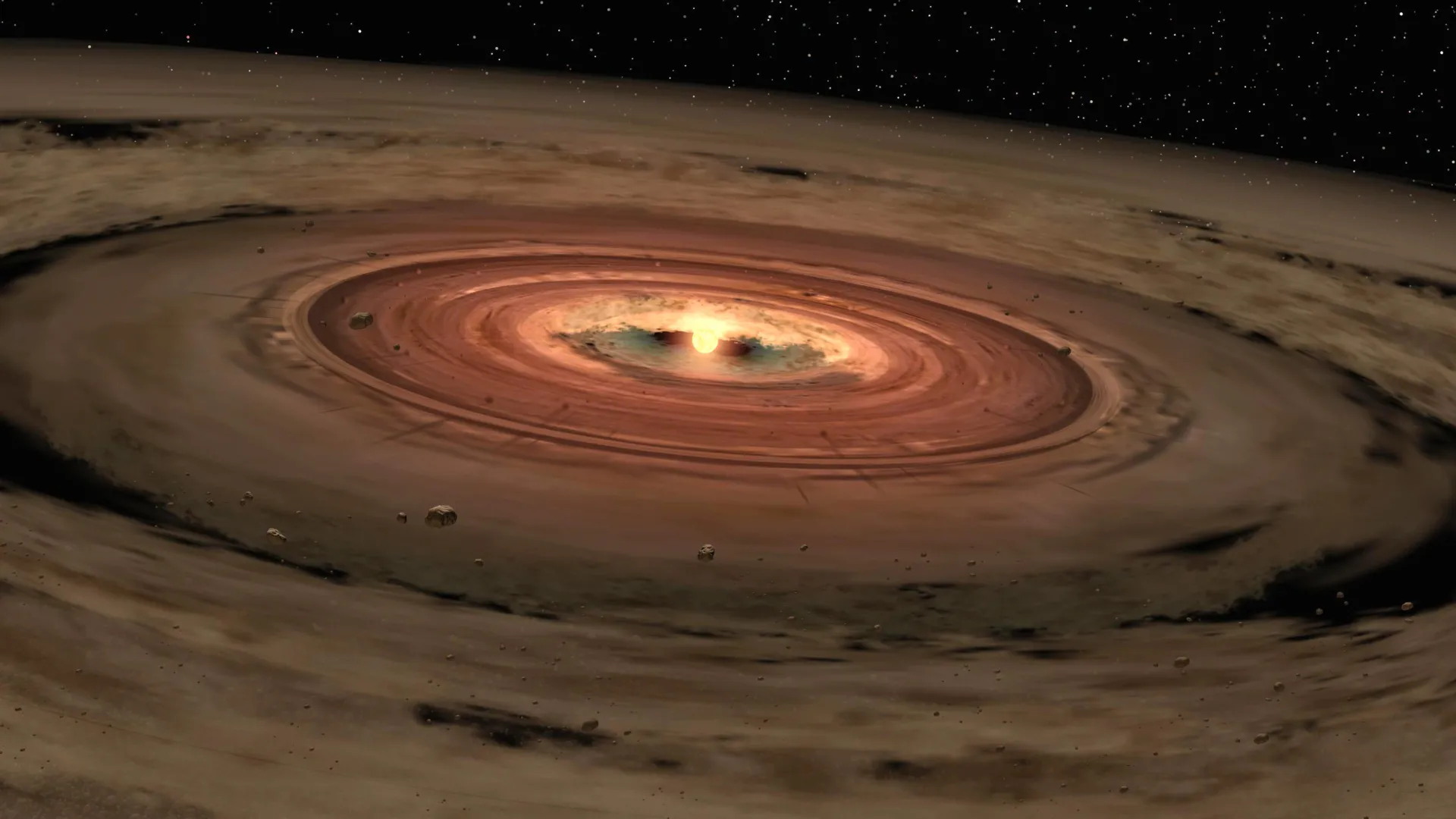
A study led by Yale University provides the first geochemical evidence that the early Solar System engaged in selective material sorting during its initial million years of planet formation. The research, published in Nature Astronomy, demonstrates that solid bodies forming in the outer Solar System were composed predominantly of chondrules—millimeter-sized rocky spheres formed at high temperatures—while containing minimal amounts of cold, fine-grained matrix material rich in water ice and organic compounds.
Previously, scientists had only documented this type of compositional sorting in objects that formed between 2 and 4 million years after the Solar System’s origin. The new findings show that this selective process occurred much earlier than anticipated. According to the research, the earliest planetesimals were constructed from 83 to 92 percent chondrules, with very little of the volatile-rich dust found in objects that formed later.
To reach these conclusions, researchers examined chemical signatures preserved in iron meteorites from the outer Solar System. Since the parent bodies that produced these meteorites contained sufficient radioactive aluminum-26 to completely melt, they destroyed the physical structures that might have revealed original compositions. However, the chemical composition still contained useful information. The team identified two independent chemical tracers associated with matrix material—sulfur concentration and iron oxidation state—which allowed them to reconstruct the original compositions of ancient parent bodies.
The analysis revealed that matrix constituted only 8 to 17 percent of the original material in these early planetesimals, making them significantly more chondrule-dominated than any known chondrites preserved today. The consistency between the two independent chemical tracers strengthened the robustness of the findings. The results also provide a possible explanation for why very old chondrules are surprisingly rare in current meteorite collections, despite evidence suggesting they were abundant during the Solar System’s earliest stages—most were likely incorporated into the first generation of planetesimals that subsequently melted.
Article Attribution | Read More at Article Source
Article summary produced by Claude AI