

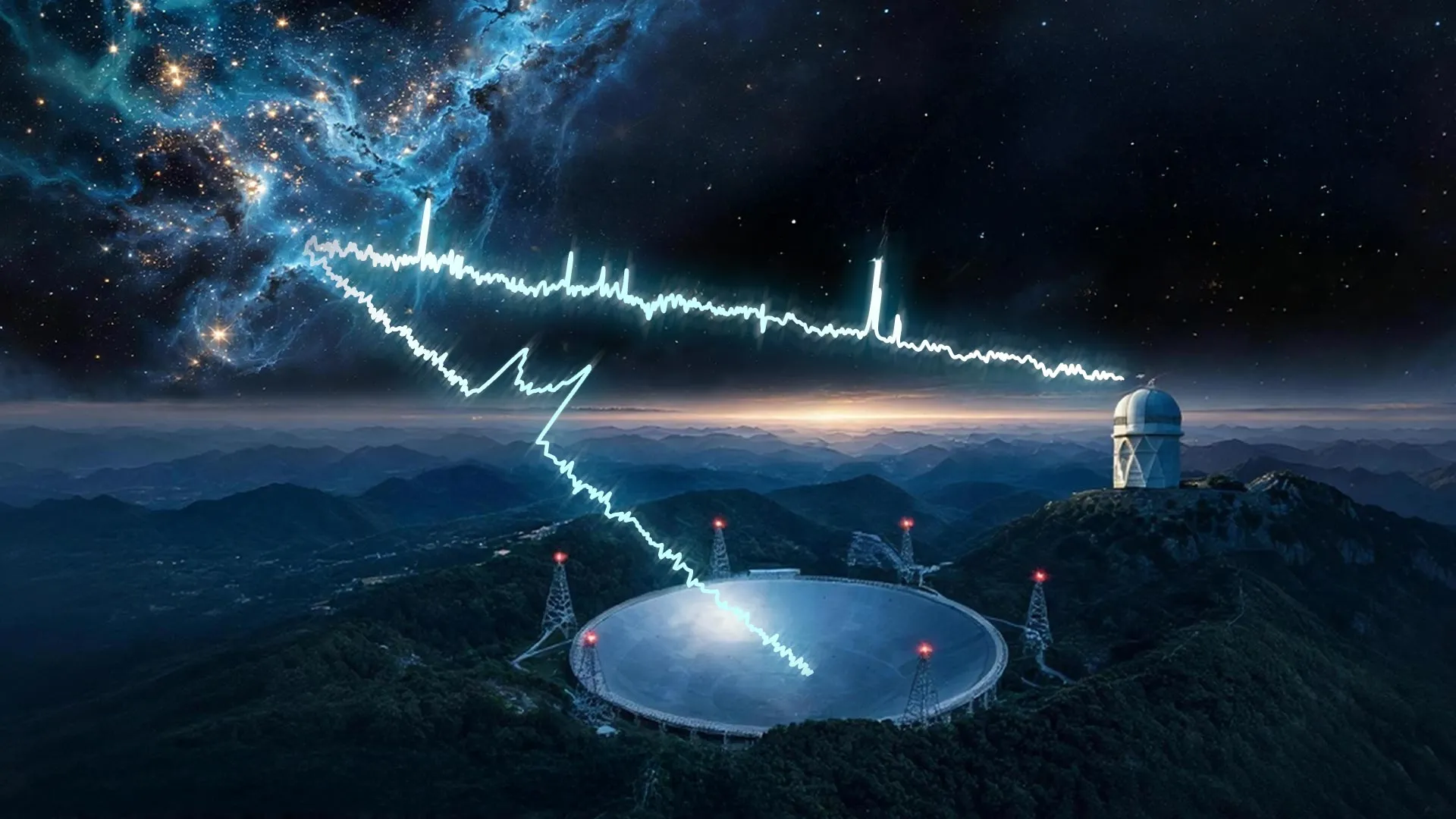
An international research collaboration has identified a significant puzzle in understanding cosmic evolution: the rate of new star formation has declined to less than half its level 4.5 billion years ago, yet the supply of neutral atomic hydrogen has decreased only modestly during the same period.
The research team, led by scientists from the Chinese Academy of Sciences and collaborating with the Dark Energy Spectroscopic Instrument project, conducted the analysis using China’s Five-hundred-meter Aperture Spherical radio Telescope. They measured cosmic neutral atomic hydrogen across billions of years by examining approximately 2.5 million galaxies covering nearly one-third of the sky. The results were published online in Nature Astronomy on Sept. 1.
The measurements revealed that roughly 4.5 billion years ago, the cosmic star formation rate was approximately 2.5 times higher than today, while neutral atomic hydrogen density was only about 1.4 times higher than present levels. This disparity suggests that the simple depletion of cold gas cannot fully explain the dramatic drop in star formation activity.
The researchers propose that the issue may not be the total amount of hydrogen available but rather how efficiently galaxies convert neutral hydrogen into molecular hydrogen, the denser gas where stars actually form. As the flow of gas from the broader cosmic structure weakens and gas densities decrease, galaxies may struggle to process their hydrogen reserves into star-forming material, even as overall hydrogen supplies remain relatively abundant.
The research demonstrates the scientific value of combining sensitive radio observations with extensive optical spectroscopy data, offering new insights into the cosmic gas cycle and the long-term evolution of star formation in galaxies.
Article Attribution | Read More at Article Source
Article summary produced by Claude AI