

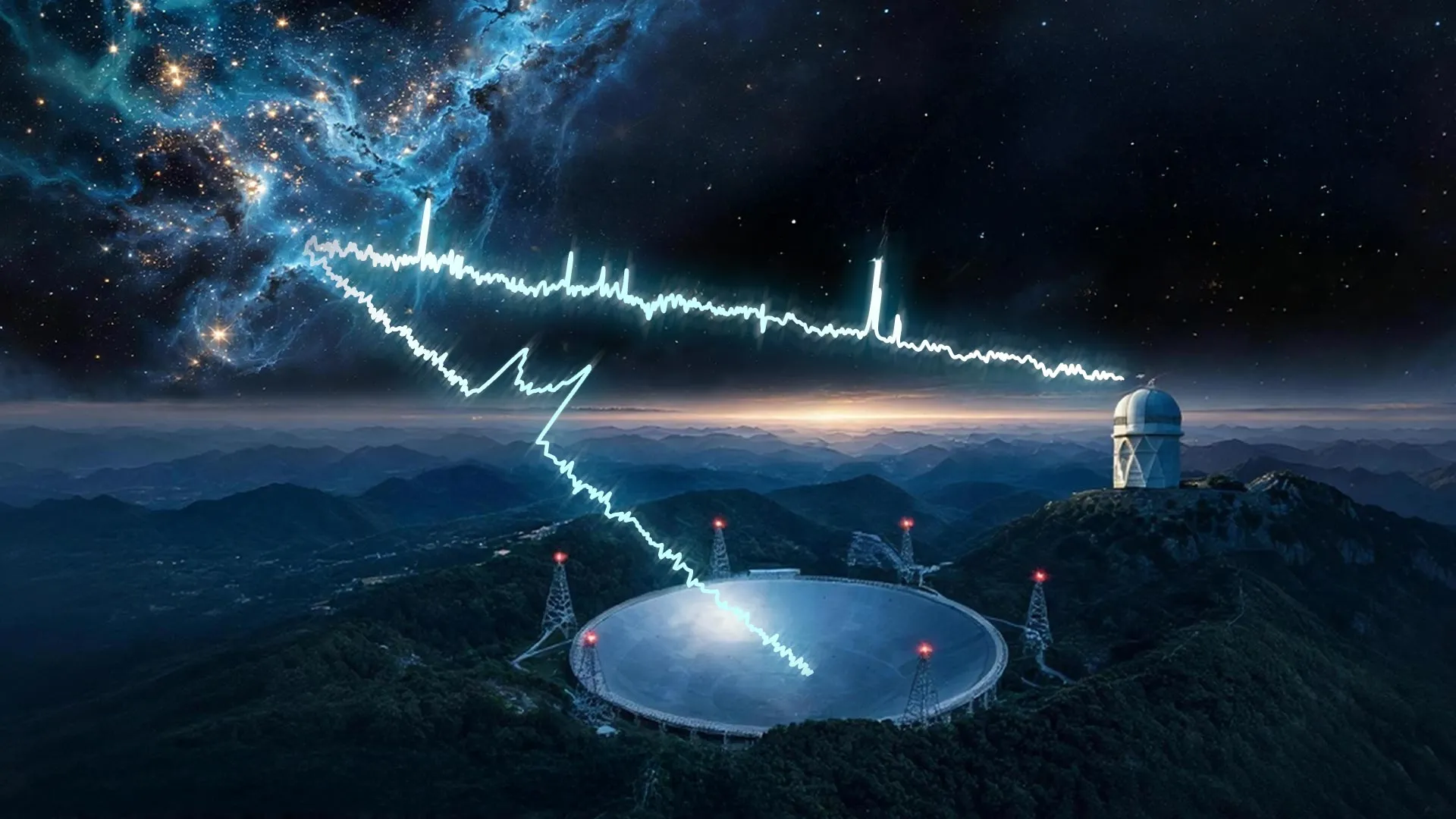
An international research team led by scientists from the Chinese Academy of Sciences has identified a significant mismatch in how the universe evolves. Using China’s Five-Hundred-Meter Aperture Spherical Radio Telescope (FAST) combined with data from the Dark Energy Spectroscopic Instrument (DESI) project, researchers measured cosmic neutral atomic hydrogen across 4.5 billion years of cosmic history. The analysis examined approximately 2.5 million galaxies distributed across nearly one-third of the sky. Findings were published in Nature Astronomy on Sept. 1.
The research addressed a long-standing observational challenge in astronomy. Previous surveys either achieved sufficient sensitivity to detect faint hydrogen signals but covered limited sky areas, or examined large regions without adequate sensitivity. By combining FAST’s exceptional radio detection capabilities with DESI’s extensive optical spectroscopy database, scientists employed an HI spectral stacking method that combined weak individual signals into detectable patterns, enabling measurements with unprecedented statistical precision.
Results revealed a striking disparity in cosmic evolution. Over the past 4.5 billion years, the universal star formation rate declined to approximately 40 percent of its earlier level—a drop of roughly 2.5 times. During the same period, neutral atomic hydrogen density decreased by only about 1.4 times. This indicated that the dramatic collapse in star formation could not be attributed primarily to hydrogen depletion.
The findings reframe fundamental questions about galaxy evolution. Rather than asking whether gas supplies are diminishing, scientists must now determine why stars form less efficiently despite relatively abundant neutral hydrogen reserves. Researchers hypothesize that the key changes involve how gas circulates through galaxies rather than total hydrogen quantities. As cosmic web gas flow weakens and densities decrease, galaxies may struggle to convert neutral atomic hydrogen into the denser molecular hydrogen clouds required for star formation. This mechanism would allow total hydrogen reserves to remain relatively stable while molecular gas supplies—the direct fuel for star creation—gradually decline.
The collaboration, involving institutions across Asia, North America, and Europe, demonstrated the scientific potential of integrating sensitive radio observations with large-scale optical spectroscopy surveys. The combined approach provides new observational frameworks for understanding the cosmic gas cycle, long-term star formation trends, and galaxy formation processes throughout the universe’s evolution.
Article Attribution | Read More at Article Source
Article summary produced by Claude AI