

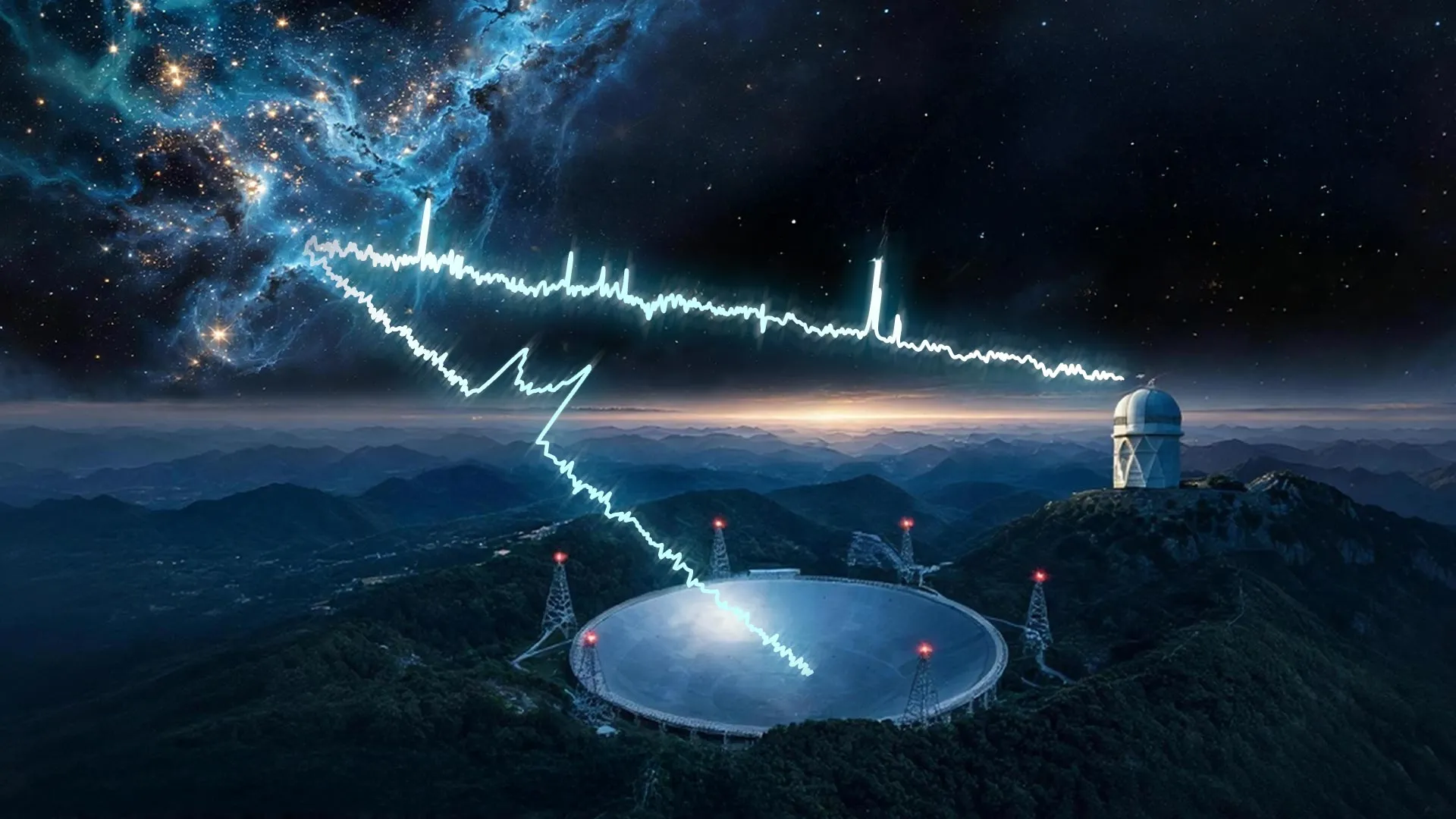
An international research collaboration led by scientists from the Chinese Academy of Sciences has uncovered a significant discrepancy in how the universe’s star formation and hydrogen supplies have evolved. Using data from China’s Five-hundred-meter Aperture Spherical radio Telescope and the Dark Energy Spectroscopic Instrument project, researchers analyzed approximately 2.5 million galaxies across nearly one-third of the sky to track changes in cosmic neutral atomic hydrogen over the past 4.5 billion years.
The findings, published on Sept. 1 in Nature Astronomy, reveal a striking mismatch between two fundamental processes. The rate at which new stars form has declined to less than half its level from 4.5 billion years ago. During the same timeframe, however, the amount of neutral atomic hydrogen—a key cold gas reservoir within galaxies—has decreased only modestly, by roughly one-third. This disparity challenges the conventional explanation that galaxies have simply exhausted their gas supplies as they age.
The research team employed an innovative approach to overcome longstanding observational challenges. By combining radio signals from individual galaxies that were individually too faint to detect, researchers used spectral stacking methods to identify patterns across the large sample. This methodology provided the statistical precision necessary to track hydrogen density changes across cosmic time with unprecedented accuracy.
The implications shift the fundamental question astronomers must address. Rather than asking whether neutral hydrogen is depleting, scientists now must understand why star formation has become increasingly inefficient despite abundant hydrogen reserves remaining in the universe. The research suggests that the critical factor may involve how efficiently galaxies convert neutral hydrogen into molecular hydrogen, the denser gas form where stars actually form, rather than the total amount of hydrogen available.
The findings demonstrate the scientific value of combining sensitive radio observations with large-scale optical spectroscopy surveys, involving contributions from research institutions across Asia, North America, and Europe. This collaborative approach provides new insights into cosmic gas cycles and the long-term decline in galactic star formation across the universe’s evolution.
Article Attribution | Read More at Article Source
Article summary produced by Claude AI