

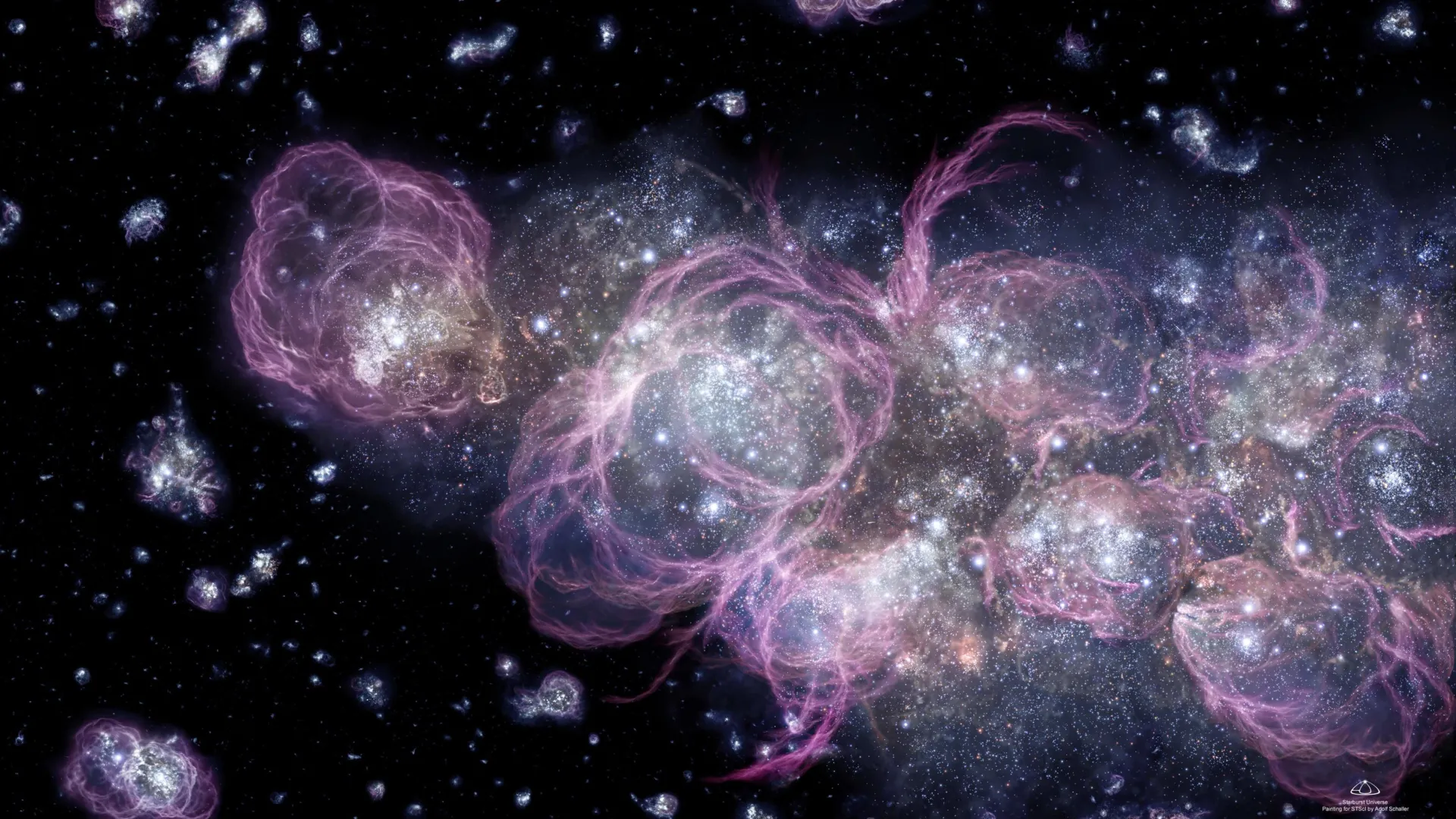
Researchers at the University of Utah are conducting a comprehensive survey of massive stars to better understand the behavior of early galaxies observed by modern telescopes. The project, known as TEMPOS (Treasury of Extremely Metal-Poor O Stars), uses ultraviolet measurements from Hubble’s Cosmic Origins Spectrograph to examine 29 massive stars across six nearby dwarf galaxies. These local systems have chemical compositions similar to conditions that existed in the early universe, making them valuable laboratories for studying how massive stars evolved in metal-poor environments.
Massive stars—those more than 10 times the sun’s mass—exert outsized influence on their host galaxies despite being relatively rare. They emit intense radiation, shed material through stellar winds, and eventually end in supernova explosions that inject energy into surrounding gas. This radiation and material fundamentally shapes how galaxies evolve and whether conditions allow new stars to form. Early galaxies had far fewer heavy elements than modern galaxies like the Milky Way, suggesting that massive stars in those ancient environments may have developed very differently from their contemporary counterparts.
The TEMPOS survey, published on Sept. 21, 2026, in The Astrophysical Journal Supplement Series, reveals a surprising pattern in how stellar winds behave at extremely low metallicity. While wind speeds generally decrease as metallicity drops, the researchers found a dramatic additional decline for stars with metallicity below about 10% of the sun’s value. This unexpected result suggests that the most metal-poor massive stars lose considerably less mass during their lifetimes than existing models would predict, potentially altering their evolutionary paths and the material they eventually return to their galaxies.
The findings carry particular significance given recent discoveries by the James Webb Space Telescope, which has revealed unexpectedly complex structures in early galaxies. Understanding how massive stars evolved in metal-poor conditions could explain features that current models struggle to account for. Among remaining questions is the role of iron, which significantly influences stellar winds and supernova processes but remains difficult to measure in extremely metal-poor environments.
Article Attribution | Read More at Article Source
Article summary produced by Claude AI