

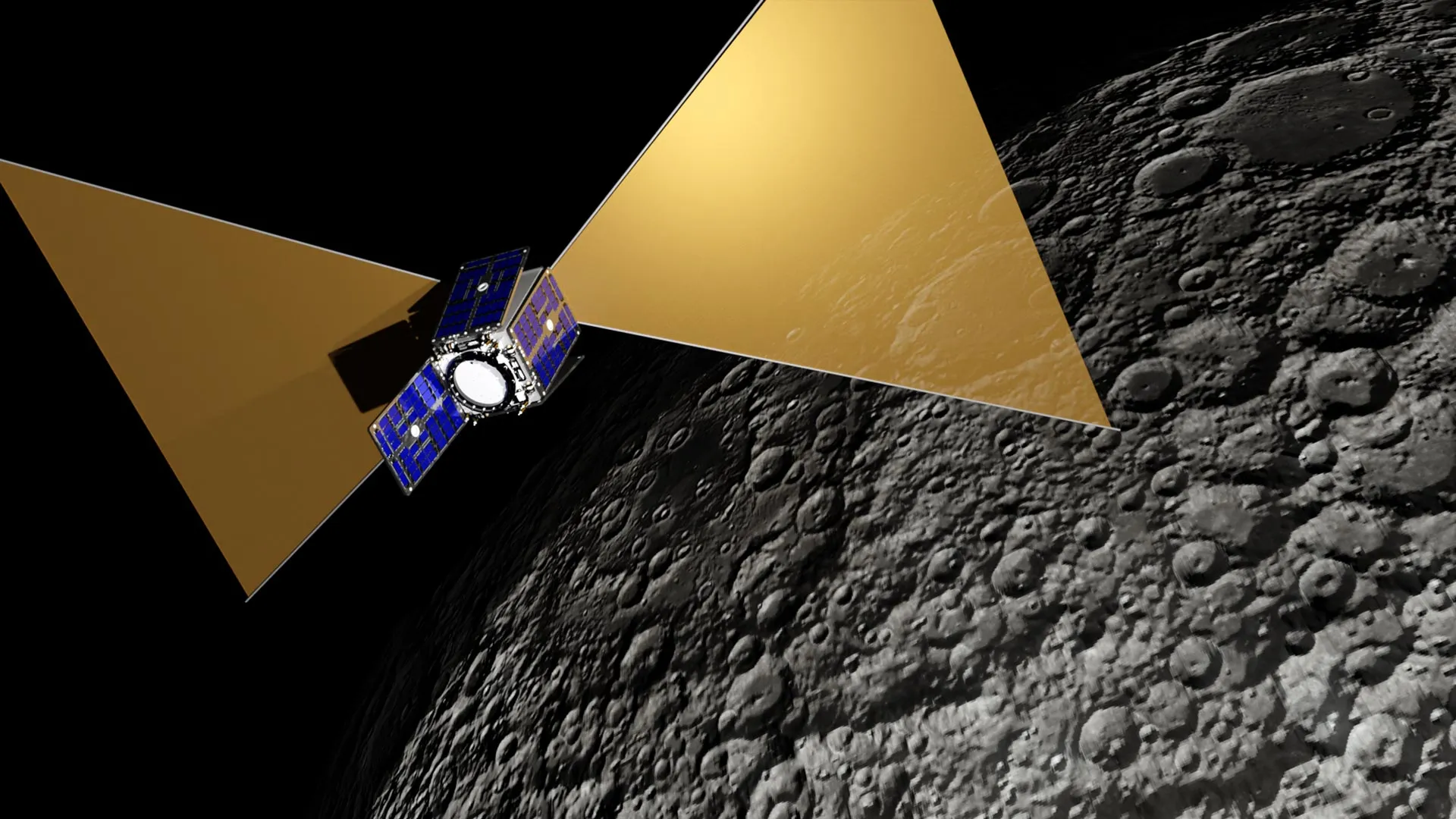
An international research team led by the University of Cambridge is developing a compact spacecraft designed to investigate one of astronomy’s least explored periods: the approximately 150 million years between the Big Bang’s afterglow and the emergence of the first stars. The satellite, called CosmoCube, measures roughly the size of a carry-on suitcase and will be positioned in lunar orbit to conduct observations in an extraordinarily radio-quiet environment.
The primary objective is to detect the 21-centimeter line, a faint signal originating from hydrogen atoms that existed during the universe’s earliest epoch. This signal has never been directly observed from Earth, as the planet’s ionosphere blocks the relevant radio frequencies and human-made interference from FM broadcasts, satellites, and telecommunications overwhelms the extremely weak cosmic signal. By positioning CosmoCube behind the Moon, the lunar body will block terrestrial radio noise for approximately 40 minutes during each two-hour orbit, creating ideal conditions for detection. The mission is anticipated to collect roughly 1,000 hours of observations across its expected two-year duration.
Beyond studying the pre-stellar universe, CosmoCube will also investigate dark matter’s influence on early cosmic structure formation. The spacecraft will observe radio frequencies between 10 and 50 megahertz, a range largely inaccessible to ground-based telescopes. Once in lunar orbit, CosmoCube will deploy a lightweight radio antenna and employ sophisticated calibration techniques to distinguish the ancient hydrogen signal from electronic noise and other interference sources.
The UK Space Agency has provided funding for the project, with researchers targeting launch within the next five years. The spacecraft platform is being developed by Surrey Space Technology Limited, a British company specializing in small satellite manufacturing. Additional partners include Portsmouth University, STFC RAL Space, and research institutions from European countries including Malta. The mission design aims to achieve ambitious scientific objectives while maintaining a compact platform and estimated cost below 50 million Euros. Details of the mission have been published in Nature Astronomy.
Article Attribution | Read More at Article Source
Article summary produced by Claude AI