

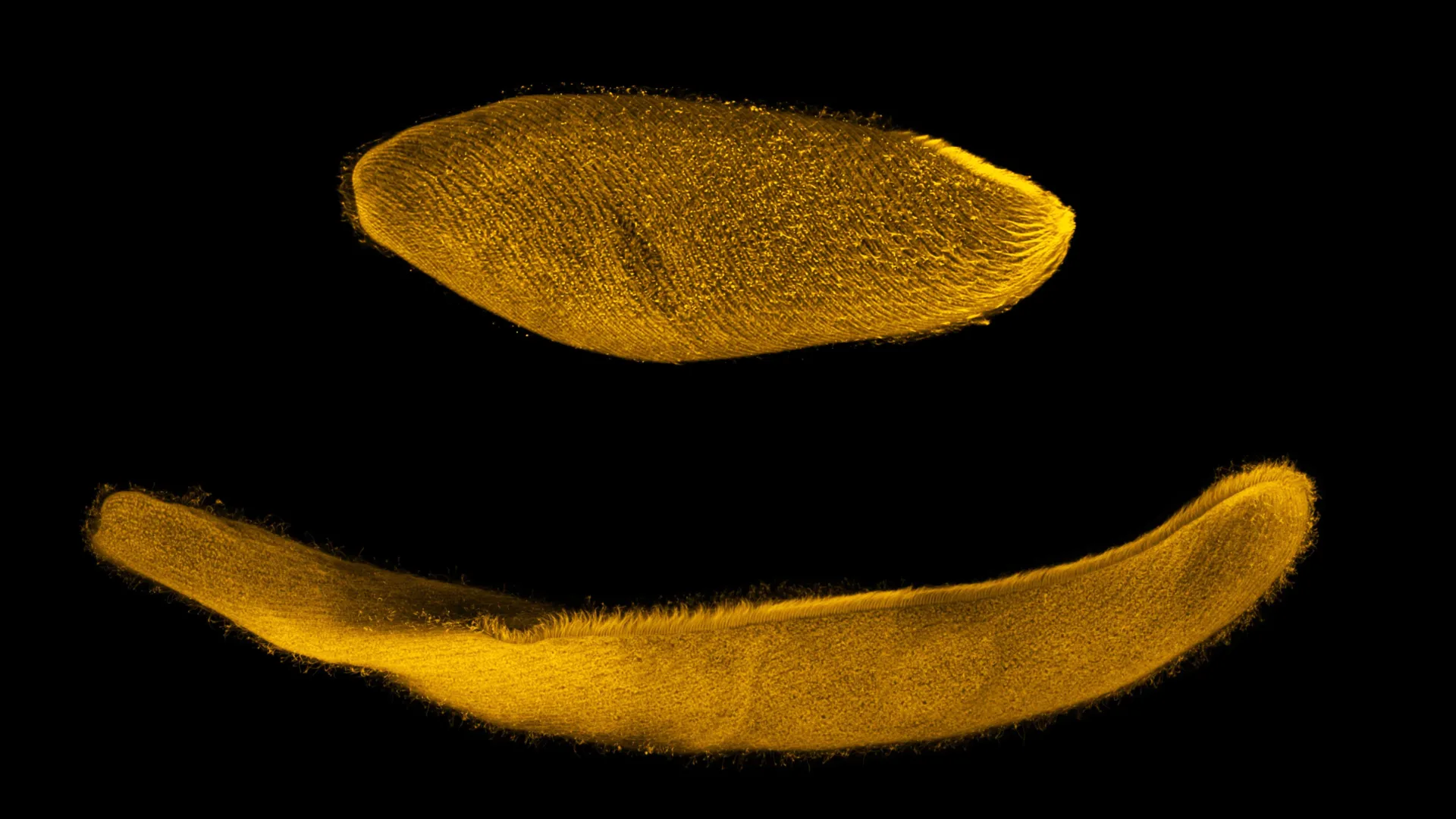
Researchers have uncovered the mechanics behind an extraordinary ability of a microscopic organism to contract its body rapidly. Spirostomum ambiguum, a single-celled ciliate, can compress itself to one quarter its original length in under five milliseconds—approximately 100 times faster per body length than human muscles accomplish the same feat. Scientists believe this speed may serve as a defensive mechanism against predators or enable communication between organisms.
The team used advanced microscopy techniques to study the organism’s structure and identified the contraction system at work. Rather than muscle fibers like those found in animals, Spirostomum relies on a network of fibrous structures called myonemes that are composed of calcium-binding proteins centrin and Sfi1. These myonemes are arranged in a fishnet-like pattern around the organism’s exterior. When calcium ions are present, the Sfi1 protein transitions from a rigid state to a flexible one, causing it to bundle together and pull the fishnet structure inward, shrinking the organism. After contraction, the network returns to its original configuration.
A key distinction exists between how this organism moves and how human muscles function. Human muscles rely on adenosine triphosphate to store and release the energy required for contraction, whereas Spirostomum appears to operate through a calcium-ion-based system fundamentally different from this process. One significant mystery remains unresolved: how the organism repeatedly triggers and resets its contraction system. The researchers noted that calcium-triggered reactions would typically be expected to occur only once, yet Spirostomum can repeat the movement many times.
The research findings, published in the Proceedings of the National Academy of Sciences, may provide valuable insights for developing faster artificial muscles that do not depend on ATP. By further understanding how calcium initiates contraction and how the organism prepares to repeat this process, scientists hope to develop synthetic systems that could replicate the speed and efficiency demonstrated by this single-celled organism.
Article Attribution | Read More at Article Source
Article summary produced by Claude AI