

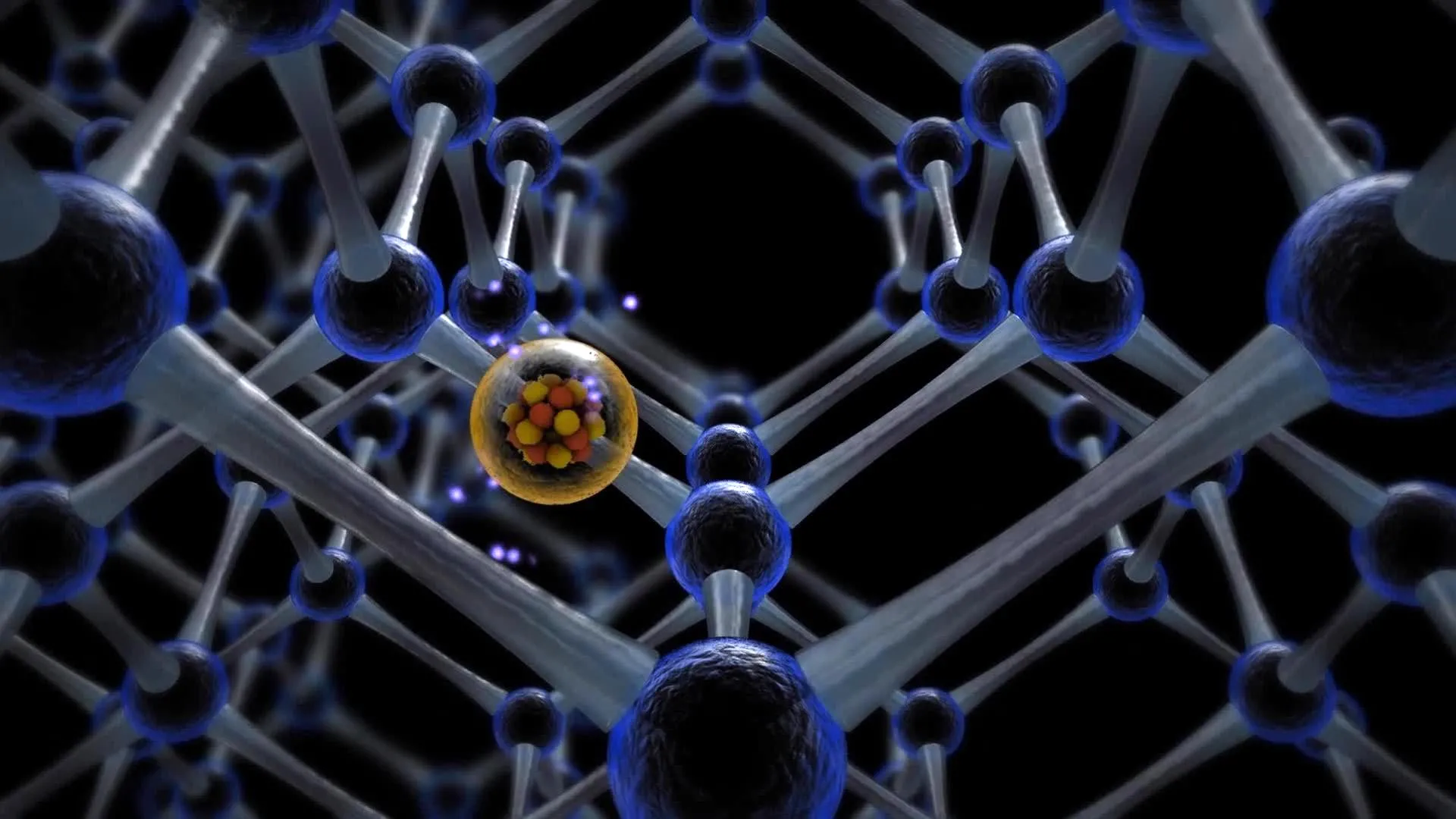
Scientists at Harvard’s John A. Paulson School of Engineering and Applied Sciences have developed a technique that uses mechanical vibrations, or phonons, to safeguard quantum information in computing systems. The work, led by professor Marko Lončar and conducted by recent Ph.D. graduate Eliza Cornell and former postdoctoral scholar Zhujing Xu, was published in Nature Physics. This advancement could facilitate the creation of miniaturized quantum networks integrated directly onto semiconductor chips.
The research builds on an existing approach that uses electron spins associated with impurities in diamond to store quantum information. Phonons act as carriers that transport this information between qubit nodes. The Lončar laboratory has been instrumental in developing phononic cavities—structures that confine mechanical vibrations to enhance their interaction with electron spins. Compared to light, which is traditionally used for moving quantum information across chip-scale networks, phonons have significantly shorter wavelengths at equivalent frequencies. This property allows researchers to design smaller components and integrate them more densely. Additionally, phonons interact effectively with both solid-state spins and electromagnetic fields, making them particularly valuable for hybrid quantum technologies that combine multiple qubit types.
A significant obstacle in phonon-based systems has been maintaining quantum memory integrity. Qubits are highly susceptible to environmental interference, requiring sufficient coherence time to store and process information effectively. Standard microwave pulse techniques used to protect quantum states do not function optimally within phononic cavities, creating tension between achieving strong phonon interactions and preserving long-term quantum memory.
The Harvard team addressed this challenge by implementing “all-mechanical coherence protection” for silicon-vacancy spins in diamond. Rather than employing conventional microwave pulses, they continuously applied a mechanical driving field composed of phonons, transforming the qubit into a “dressed” state that wears a continuous acoustic field. This configuration makes the qubit more resistant to low-frequency environmental noise. Since the protection mechanism relies on continuous mechanical fields compatible with phononic cavities, it can operate within the same structures designed to connect network nodes.
The technique extended the coherence time of silicon-vacancy spins by approximately three times, demonstrating that continuous-wave mechanical noise suppression can enhance quantum coherence in practical devices. The findings suggest that microscopic sound waves may become instrumental in constructing more dependable and space-efficient quantum systems. The Harvard Office of Technology Development is pursuing patent protection and commercialization options for the resulting innovations.
Article Attribution | Read More at Article Source
Article summary produced by Claude AI