

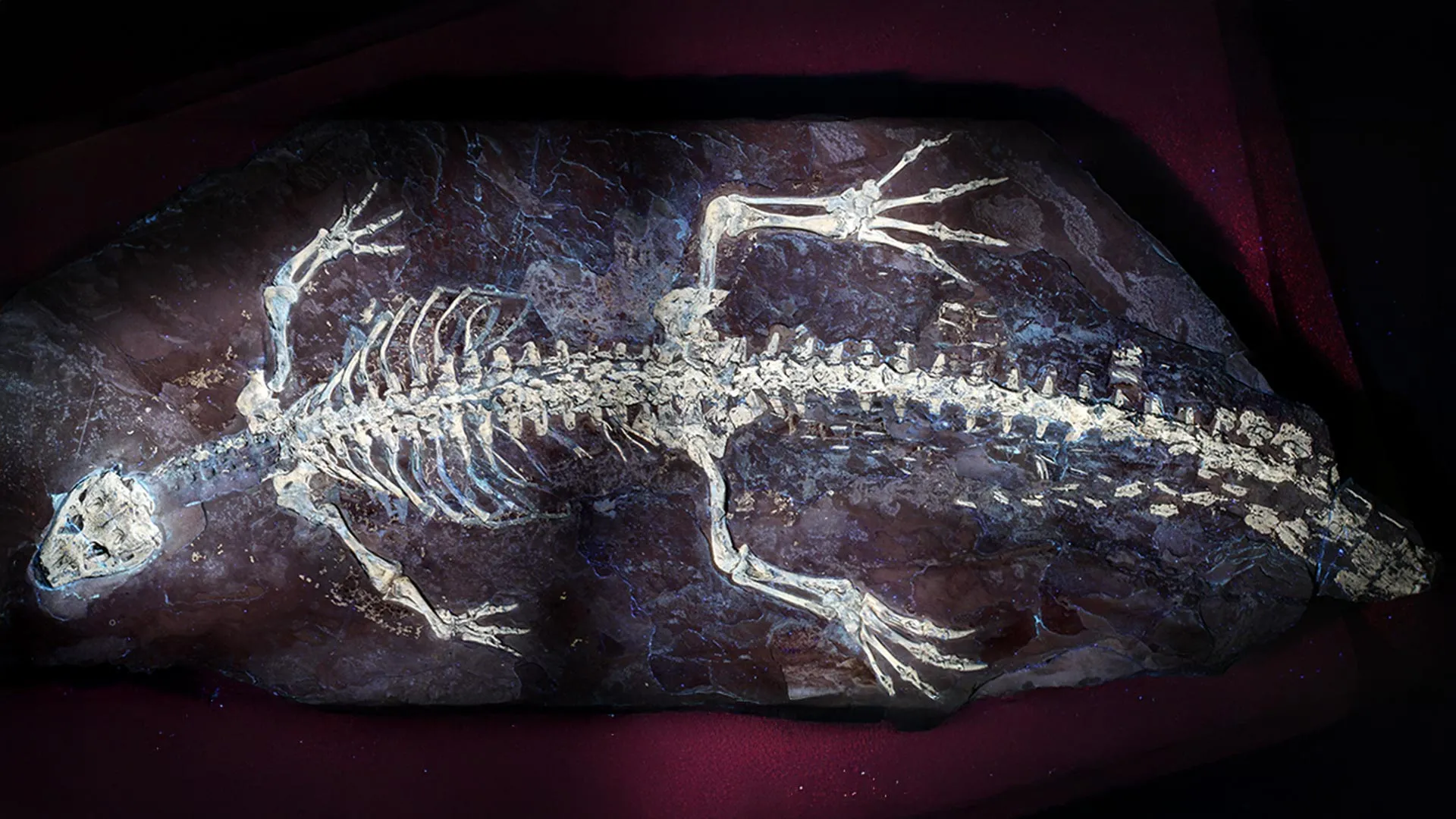
Researchers examining a remarkably preserved fossil of Montsecosuchus depereti, a small crocodylomorph that lived approximately 125 million years ago, have documented previously hidden details about the ancient creature’s anatomy and appearance. The specimen, discovered at the Pedrera de Meià site in Catalonia, Spain, measures about 50 centimeters in length and is housed at the Museum of Natural Sciences of Barcelona. By applying ultraviolet light analysis to the fossil, paleontologists were able to identify soft tissue structures that had remained obscured since the specimen’s discovery more than a century ago.
The ultraviolet examination revealed several significant anatomical features, including the shape and distribution of epidermal scales, which varied considerably across different body regions. The analysis also identified possible sensory organs located within certain scales, particularly around the neck, limbs, and along the sides of the trunk and tail. In modern crocodiles, analogous sensory structures detect tactile information and changes in water pressure while also responding to temperature and chemical signals. The distribution pattern observed in Montsecosuchus suggests that such sensory capabilities may have initially evolved in localized areas before becoming more widespread in subsequent crocodylomorph lineages.
The fossil also provided evidence of an advanced respiratory system, with cartilaginous structures in the chest indicating that the animal possessed efficient thoracic anatomy similar to that found in modern crocodiles. This discovery suggests that sophisticated respiratory adaptations emerged relatively early in crocodylomorph evolutionary history, despite Montsecosuchus being considered a primitive species. Notably, the animal lacked the elevated caudal fin characteristic of contemporary crocodiles.
Perhaps most striking is the discovery of alternating light and dark bands preserved on scales in the tail region. Researchers interpret these markings as possible evidence of the animal’s original coloration pattern, potentially serving as disruptive camouflage to obscure the creature’s outline from predators or prey. If confirmed, Montsecosuchus would represent the oldest known crocodylomorph with preserved coloration evidence. The research was published in the Zoological Journal of the Linnean Society and was led by the Institut Català de Paleontologia Miquel Crusafont, highlighting the scientific value of the Catalan fossil record for understanding vertebrate evolution.
Article Attribution | Read More at Article Source
Article summary produced by Claude AI