

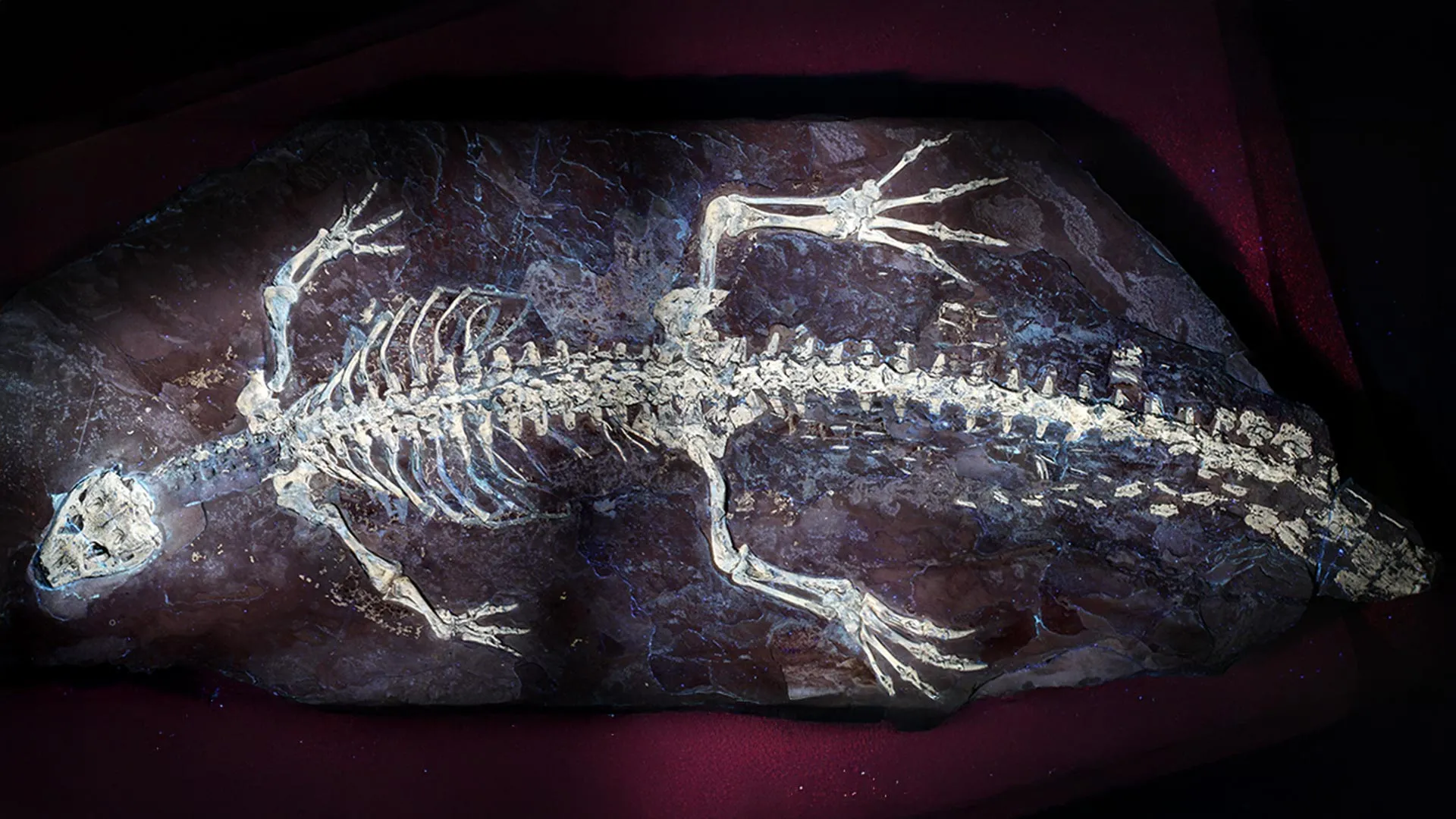
Researchers have uncovered previously hidden details from a remarkably preserved fossil of Montsecosuchus depereti, a small crocodylomorph discovered at the Pedrera de Meià site in northeastern Spain’s Catalonia region. The specimen, measuring approximately 50 centimeters in length and cataloged as MGB-512, has been housed at the Museum of Natural Sciences of Barcelona since its discovery over a century ago. While the fossil received some scientific attention in the 1990s, paleontologists Oscar Castillo and Jesús Serrano made breakthrough discoveries while examining it under ultraviolet light, revealing soft tissue structures that had remained invisible in the surrounding rock.
The ultraviolet imaging technique allowed the research team to document various preserved soft tissues, including detailed information about the animal’s epidermal scales for the first time. The scales demonstrated considerable variation in shape and size across different body regions. The analysis also revealed the absence of a high caudal fin characteristic of modern crocodiles. Additionally, researchers identified what may be sensory organs located within small scales around the animal’s neck, limbs, and along its sides, suggesting that such structures initially evolved in localized areas before becoming more widespread in later crocodylomorph lineages.
Examination of the fossil exposed cartilaginous structures within the chest cavity, indicating that Montsecosuchus possessed an advanced respiratory system sharing similarities with those found in contemporary crocodiles. These findings suggest that sophisticated thoracic anatomy developed relatively early in crocodylomorph evolutionary history, with the animal already well-adapted to semi-aquatic environments despite its primitive classification.
Perhaps most notably, ultraviolet imaging revealed alternating light and dark bands on scales in the tail region. Researchers interpret these patterns as potential evidence of original coloration that may have functioned as disruptive camouflage, serving to obscure the animal’s outline from predators or prey. If confirmed, this specimen would represent the oldest known crocodylomorph with preserved evidence of coloration patterns. The Pedrera de Meià site, designated a Konservat-Lagerstätte for its exceptional preservation qualities, has yielded over 8,000 fossil specimens, making it invaluable for studying Lower Cretaceous vertebrate and plant life.
Article Attribution | Read More at Article Source
Article summary produced by Claude AI