

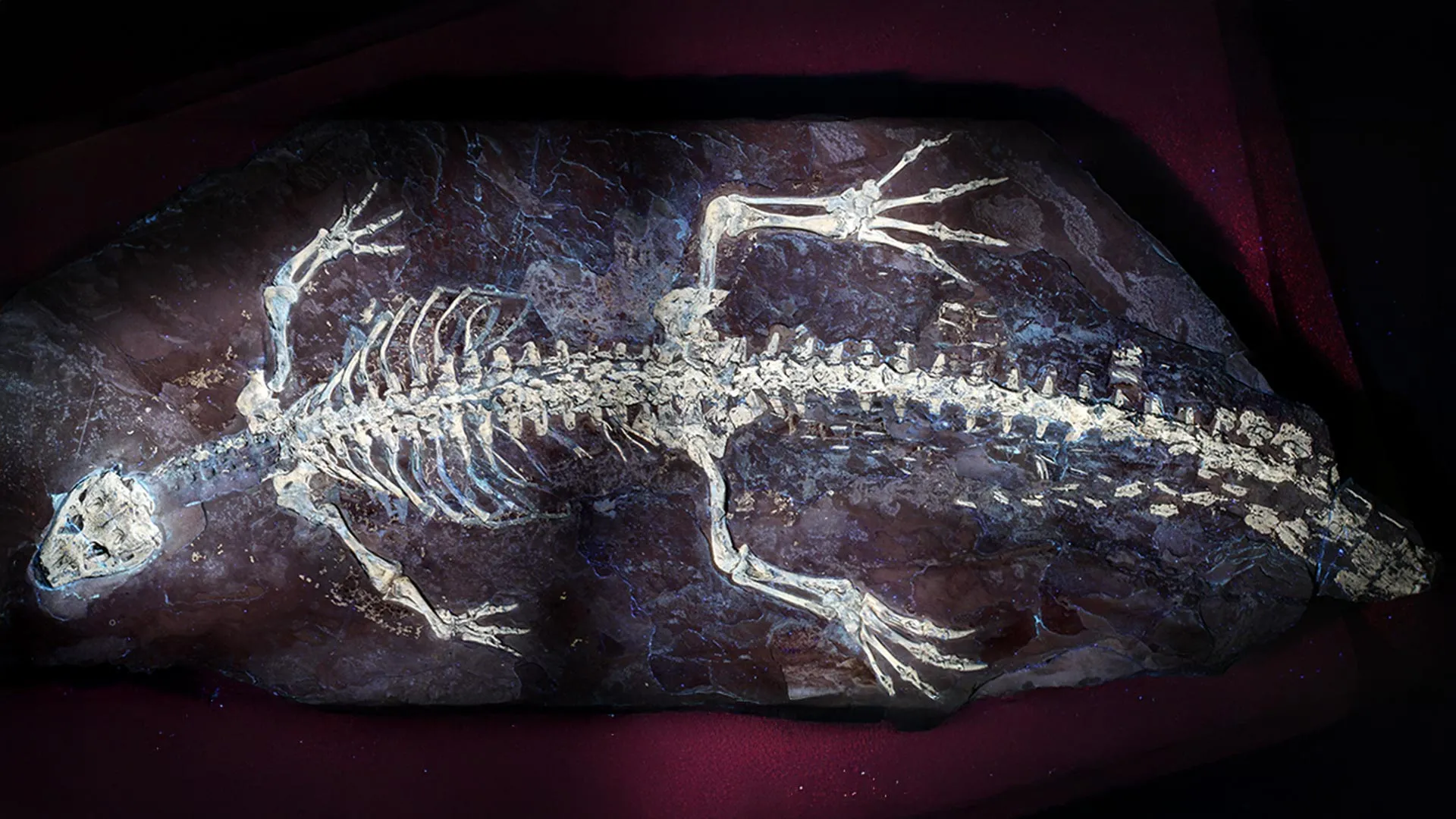
Researchers have completed a detailed analysis of a remarkably well-preserved fossil crocodile from northeastern Spain, uncovering previously hidden information about its physical structure and appearance. The specimen, identified as Montsecosuchus depereti, was discovered at the Pedrera de Meià site in Catalonia over a century ago but has only now yielded its secrets through examination under ultraviolet light. The findings were published in the Zoological Journal of the Linnean Society by scientists led by the Institut Català de Paleontologia Miquel Crusafont.
The fossil, approximately 50 centimeters in length and dating to 125 million years ago, reveals the first comprehensive view of soft tissue preservation in this Lower Cretaceous crocodylomorph. Using ultraviolet light examination, paleontologists documented various preserved tissues, including epidermal scales that varied in shape and size across different body regions. The analysis also identified possible sensory organs within certain scales, particularly around the neck, limbs, and along the body’s sides. These structures, which in modern crocodiles detect touch, pressure changes, temperature, and chemical signals, appear to have been concentrated in localized areas during this early evolutionary period.
The study reveals evidence of sophisticated respiratory anatomy, including cartilaginous structures in the chest that suggest Montsecosuchus already possessed an efficient breathing system comparable to modern crocodilians. This discovery indicates that advanced physiological adaptations for semi-aquatic life evolved earlier than previously understood in crocodylomorph history. Additionally, researchers note that the animal lacked the pronounced tail fin characteristic of contemporary crocodiles.
Perhaps most notably, the fossil displays alternating light and dark bands on the tail scales visible under ultraviolet examination. Scientists interpret this pattern as possible evidence of preserved coloration that may have functioned as disruptive camouflage, helping the animal blend into its environment. If confirmed, Montsecosuchus would represent the oldest known crocodylomorph with preserved evidence of color patterning. The Pedrera de Meià site, designated as a UNESCO Global Geopark, is recognized for its exceptional fossil preservation conditions and has yielded over 8,000 specimens from the Lower Cretaceous period.
Article Attribution | Read More at Article Source
Article summary produced by Claude AI