

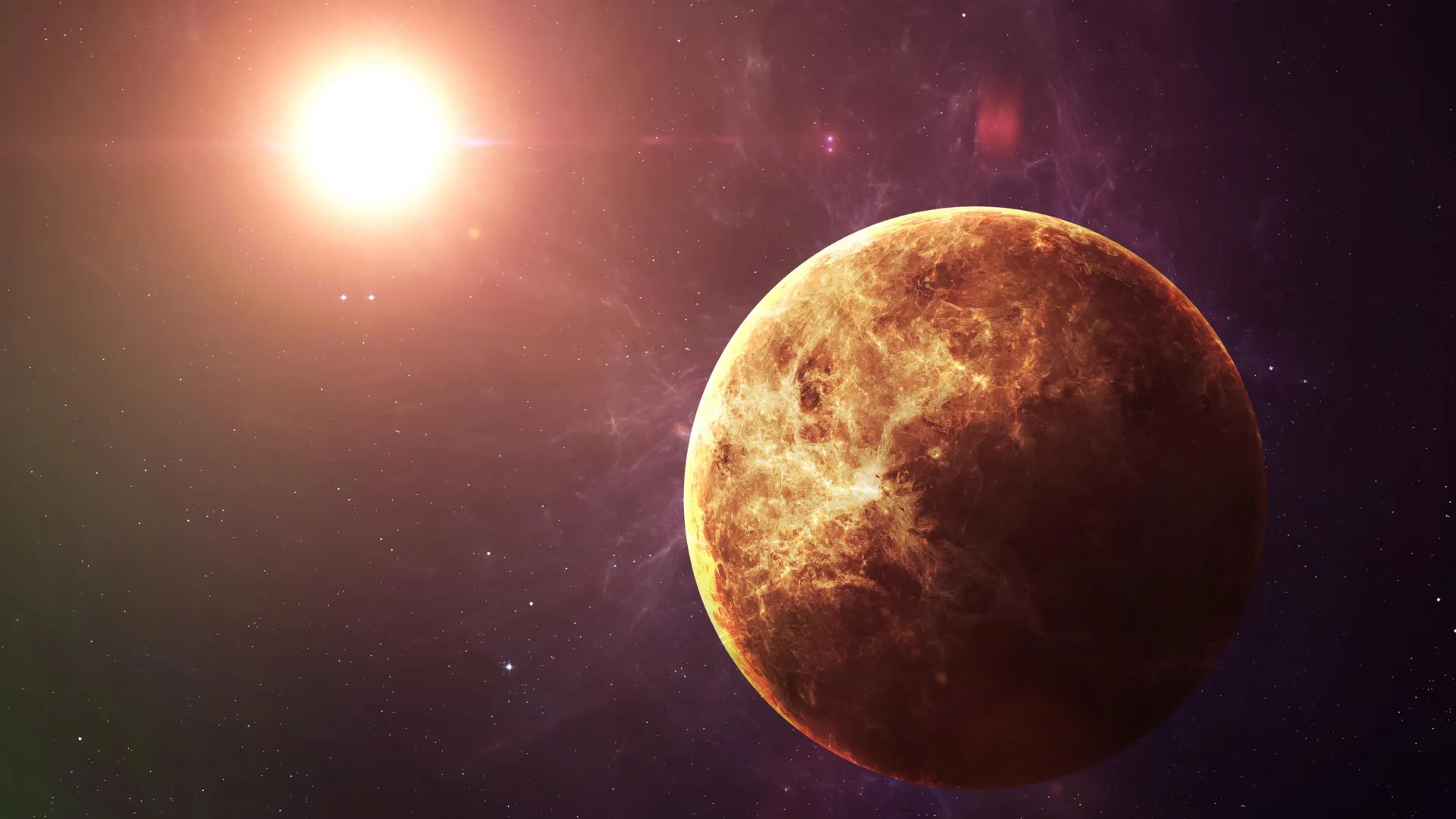
Scientists at UC Riverside have proposed a novel explanation for why Venus lacks a moon despite physical similarities to Earth. Rather than invoking a catastrophic collision or absence of moon-forming events, astrophysicist Stephen Kane’s research suggests Venus’ own gravitational properties and slow rotation rate could have caused any satellite to gradually spiral inward and crash into the planet.
The study relies on comparative analysis of how celestial bodies behave in different rotational conditions. Earth’s moon migrates away from our planet at approximately four centimeters per year, driven by Earth’s relatively rapid 24-hour rotation cycle. Venus operates under fundamentally different conditions, requiring 243 Earth days to complete a single rotation. According to Kane’s calculations, this sluggish spin rate would prevent a moon from moving outward as Earth’s moon does, instead allowing planetary gravity to draw it progressively closer until collision occurs.
Computer simulations testing various hypothetical moon masses, ranging from half to ten times that of Earth’s lunar satellite, consistently produced the same result across different scenarios. The models were first validated using Earth-Moon data before being applied to Venus conditions. Even larger theoretical moons experienced accelerated inward spirals, suggesting robust physical principles rather than edge cases.
Direct evidence of an ancient Venusian moon remains elusive. The planet’s surface underwent extensive geological renewal approximately one billion years ago, erasing much older history. However, scientists note that seismic measurements might eventually reveal deep internal structures associated with past impacts, similar to anomalies detected within Earth following its own collision history.
The implications extend beyond Venus. If moon collisions significantly alter planetary rotation and climate, such events could have fundamentally shaped Venus’ capacity for habitability. The findings also bear relevance for exoplanet research, where scientists assess potentially Earth-like worlds orbiting distant stars. Kane’s work indicates that planets with slow rotation rates may struggle to retain moons over geological timescales, potentially limiting or preventing the planetary evolution that occurs on moon-bearing worlds like Earth—though the research suggests moons may not be strictly required for life to exist.
Article Attribution | Read More at Article Source
Article summary produced by Claude AI