

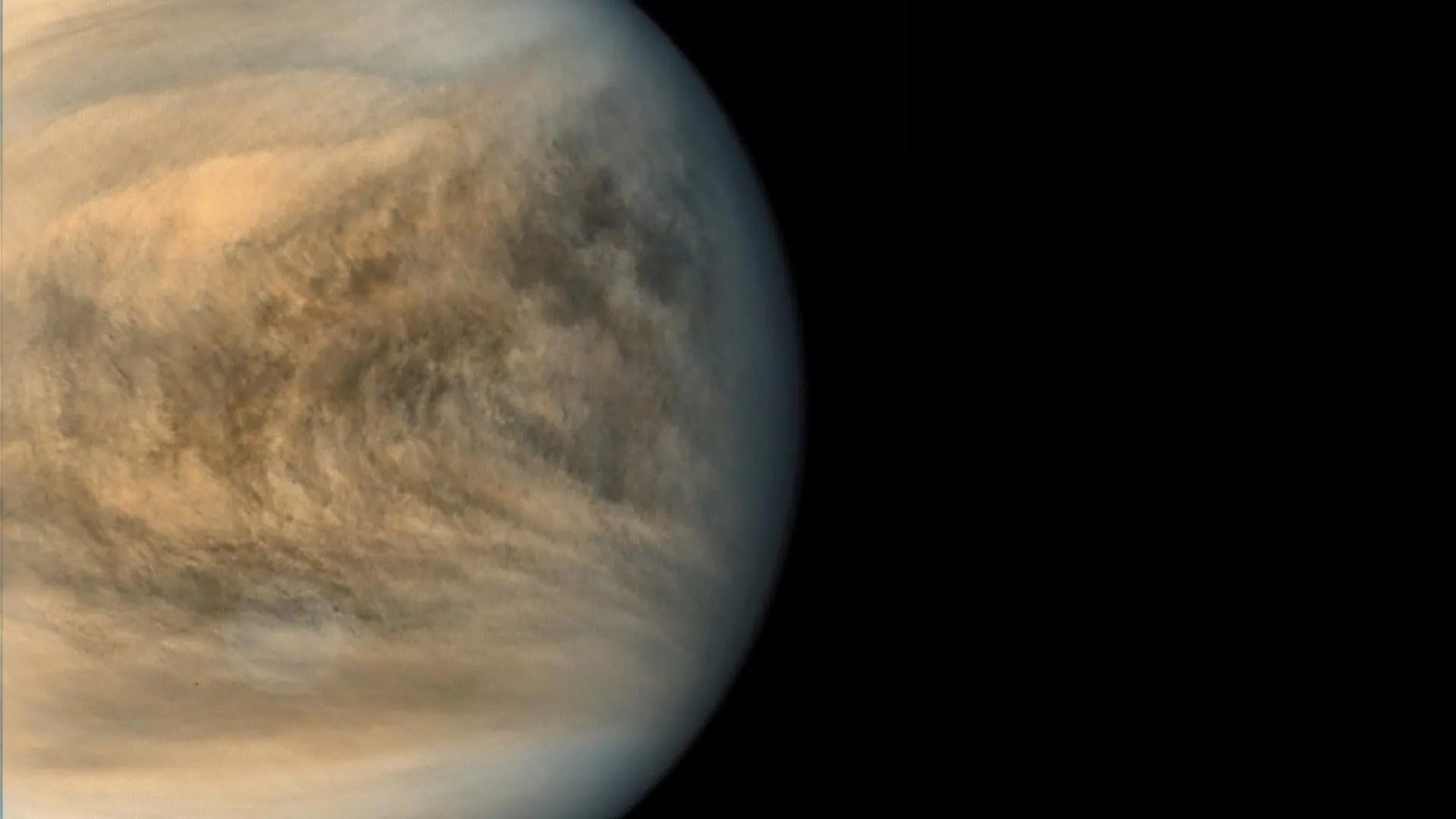
Venus appears pale yellow in visible light, but observations across ultraviolet wavelengths reveal dark and bright patterns sweeping across the planet’s upper atmosphere for approximately a century. The substance responsible for these features, referred to as the “unknown absorber,” has remained unidentified despite decades of study. An international research team has now established new quantitative constraints on the material’s characteristics using spacecraft observations and radiative-transfer modeling.
The researchers approached the problem by determining what properties Venus’s cloud droplet liquid would need to match observed ultraviolet and blue light absorption patterns. Lead author Dr. Jan Spacek and colleagues used a novel methodology, conceptualizing the problem as if cloud material could be collected into a laboratory cuvette for spectroscopic analysis. This distinction proves significant because clouds can appear visually different from their constituent materials—similar to how cigarette smoke appears white despite containing dark tar particles. The study, published in Astrobiology, calculated that the unknown absorber would require an absorption coefficient of approximately 1,278 cm-1 at 375 nanometers across measured wavelengths.
The absorption strength required suggests either highly efficient light-absorbing molecules or very high concentrations within droplets, or both conditions simultaneously. Possible candidates include carbon-based conjugated organic molecules, with reference compounds like porphyrinoid pigments requiring concentrations around 10 grams per liter. The researchers emphasize they are not proposing biological pigments such as chlorophyll or heme, only using them as reference points for light-absorption efficiency. The shape of Venus’s absorption spectrum provides additional constraints, with absorption declining sharply between 365 and 455 nanometers rather than broadly across the visible spectrum.
The findings simultaneously narrow possibilities while intensifying the mystery. Proposed inorganic candidates face substantial challenges meeting the demanding absorption requirements at realistic atmospheric concentrations. The research establishes specific quantitative parameters that any proposed absorber—organic or inorganic—must satisfy, including absorption efficiency, required concentration, atmospheric distribution, and compatibility with observed cloud particle sizes.
Upcoming missions present opportunities to test these constraints directly. The Morning Star Missions to Venus initiative is developing in-situ measurement techniques for cloud chemistry studies, including planned instruments like the Autofluorescence Nephelometer designed to detect fluorescence associated with organic molecules in cloud particles.
Article Attribution | Read More at Article Source
Article summary produced by Claude AI