

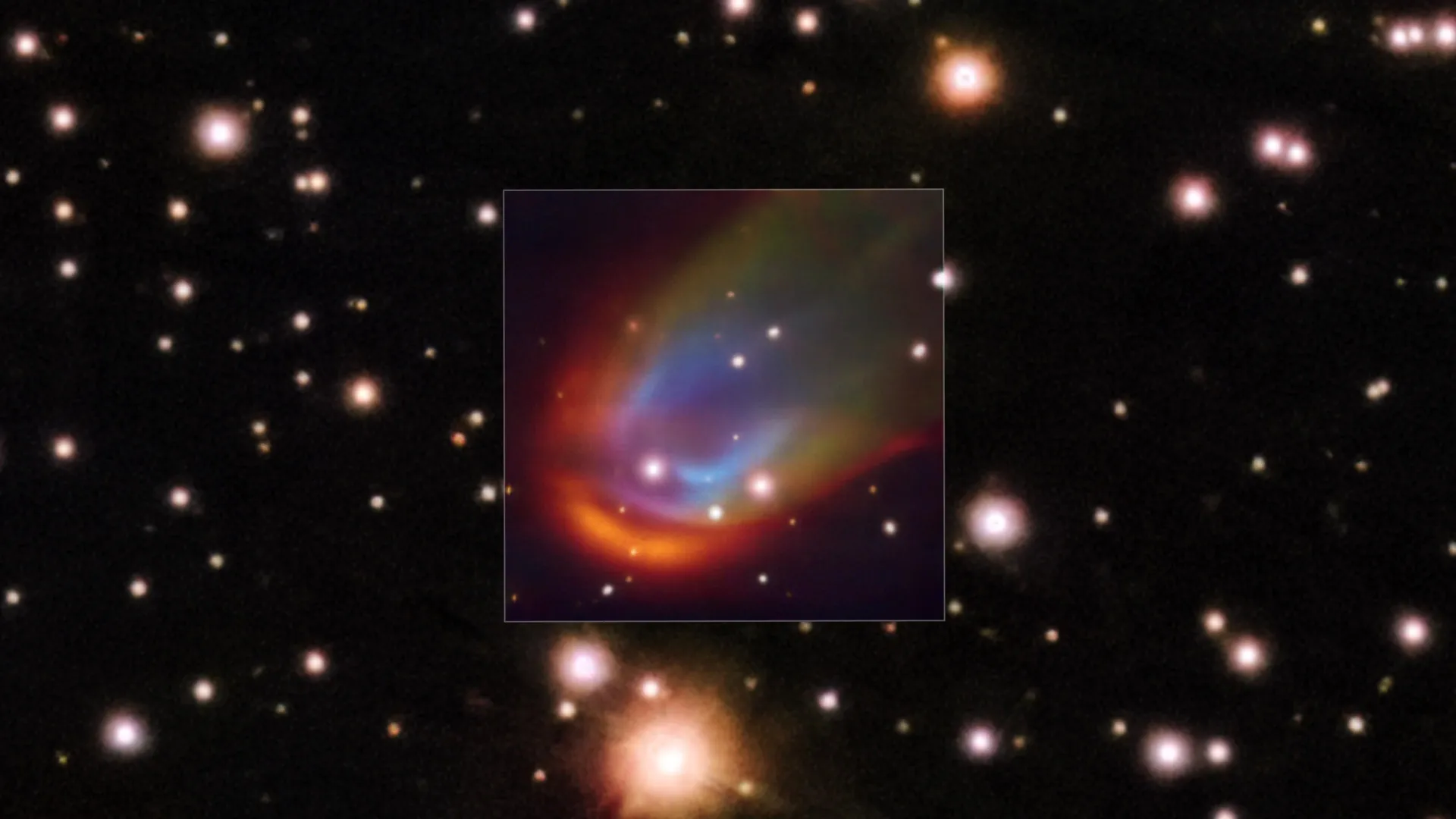
Researchers using the European Southern Observatory’s Very Large Telescope have detected an unusual bow shock around the white dwarf RXJ0528+2838, located approximately 730 light-years from Earth. The discovery presents a puzzle for astronomers because the stellar remnant’s observed outflow contradicts established models of how dead stars exchange material and energy with their environment. The bow shock—a curved wave of material similar to the wave that forms in front of a moving ship—was initially noticed in images from the Isaac Newton Telescope in Spain, prompting the research team to conduct more detailed observations.
The binary system consists of the white dwarf orbited by a Sun-like companion star. In such systems, material typically transfers from the companion onto the dead star, often forming an accretion disk that feeds the white dwarf and generates powerful outflows. However, RXJ0528+2838 shows no evidence of such a disk. Observations using the MUSE instrument on the Very Large Telescope confirmed that the shock wave structure genuinely originates from the binary system rather than from an unrelated cosmic phenomenon.
The bow shock’s characteristics suggest that RXJ0528+2838 has maintained this powerful outflow for at least 1000 years. The white dwarf possesses a strong magnetic field, which the observations revealed guides material from the companion star directly toward the white dwarf rather than allowing it to form a disk. Scientists suspect this magnetic field may connect to an unidentified energy source, described as a “mystery engine.” However, current understanding indicates that the white dwarf’s present-day magnetic field could only sustain the observed bow shock for a few hundred years, leaving a significant gap in the explanation.
Researchers intend to examine additional binary systems to understand how these powerful outflows can develop without accretion disks. The upcoming Extremely Large Telescope is expected to enhance the capacity for studying both known and fainter systems in greater detail, potentially advancing understanding of the mysterious energy source driving these unexpected phenomena.
Article Attribution | Read More at Article Source
Article summary produced by Claude AI