

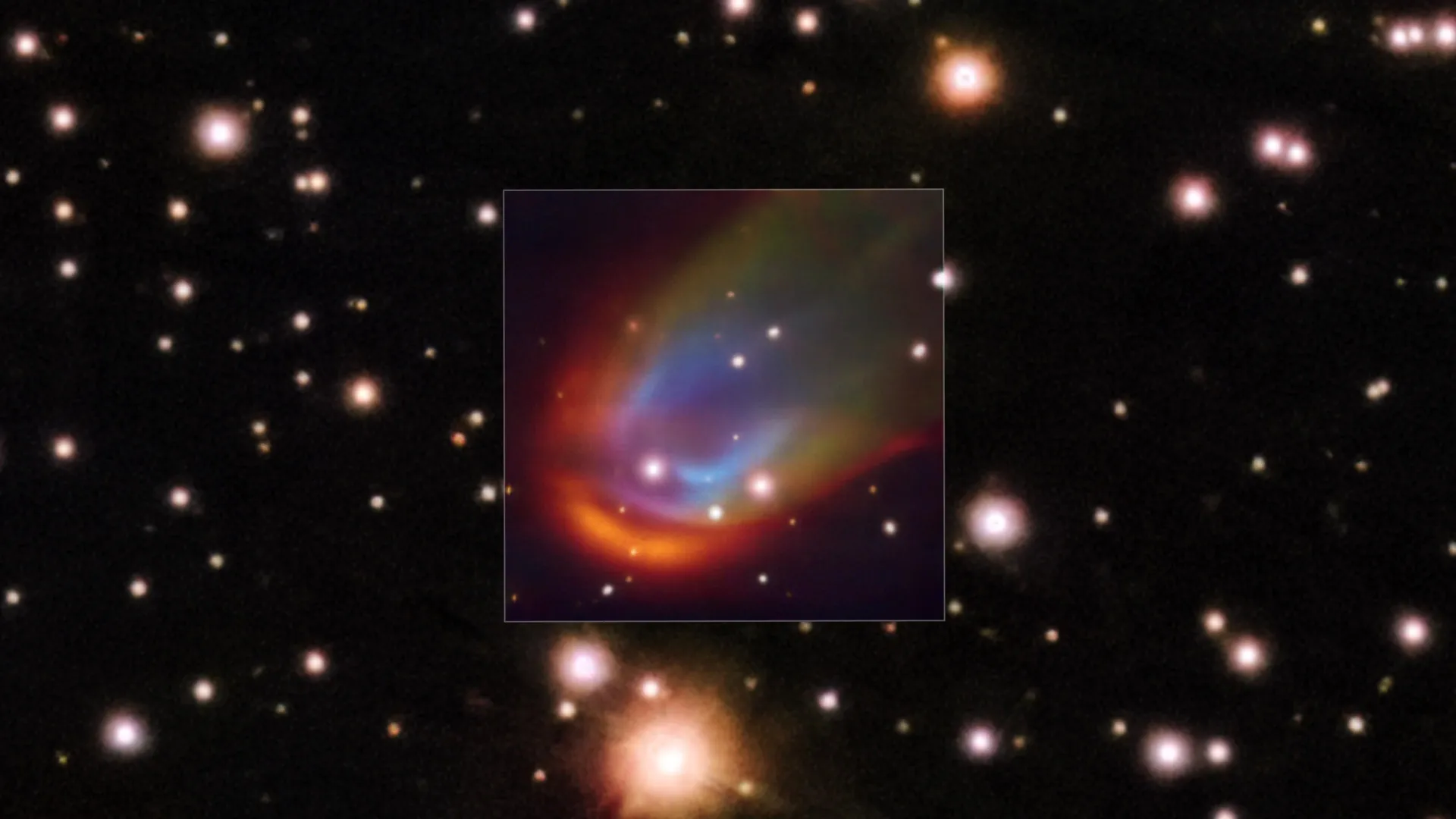
Researchers studying the binary star system RXJ0528+2838, located approximately 730 light-years from Earth, have identified an unusual shock wave structure that contradicts existing theoretical models. Using the European Southern Observatory’s Very Large Telescope and its MUSE instrument, an international team detected a powerful outflow and bow shock—a curved arc of material similar to waves forming ahead of a moving ship—around the white dwarf and its Sun-like companion star.
The discovery presents a significant puzzle for astronomers because standard mechanisms cannot fully account for the observed phenomenon. White dwarfs in binary systems typically develop accretion discs when material is pulled from companion stars, and these discs generate the outflows that create bow shocks. RXJ0528+2838, however, shows no evidence of such a disc, eliminating the conventional explanation for the observed structure. The bow shock’s size and composition indicate it has been active for at least 1,000 years, suggesting a sustained and powerful process at work.
The white dwarf possesses a notably strong magnetic field, which appears to guide material from the companion star directly onto the dead star rather than allowing it to form a disc. Despite this magnetic influence, scientists face an energetic problem: the current magnetic field strength could only sustain such an outflow for several hundred years, yet observations indicate the bow shock has existed for at least a millennium. This discrepancy points to an unidentified energy source driving the system, which researchers describe as a “mystery engine.”
The findings, published in Nature Astronomy, underscore gaps in current understanding of how matter and energy exchange occurs in extreme binary systems. Future observations using the Extremely Large Telescope are expected to provide additional insights by allowing detailed study of similar systems, potentially revealing the mysterious mechanisms responsible for generating these powerful outflows without accretion discs.
Article Attribution | Read More at Article Source
Article summary produced by Claude AI