

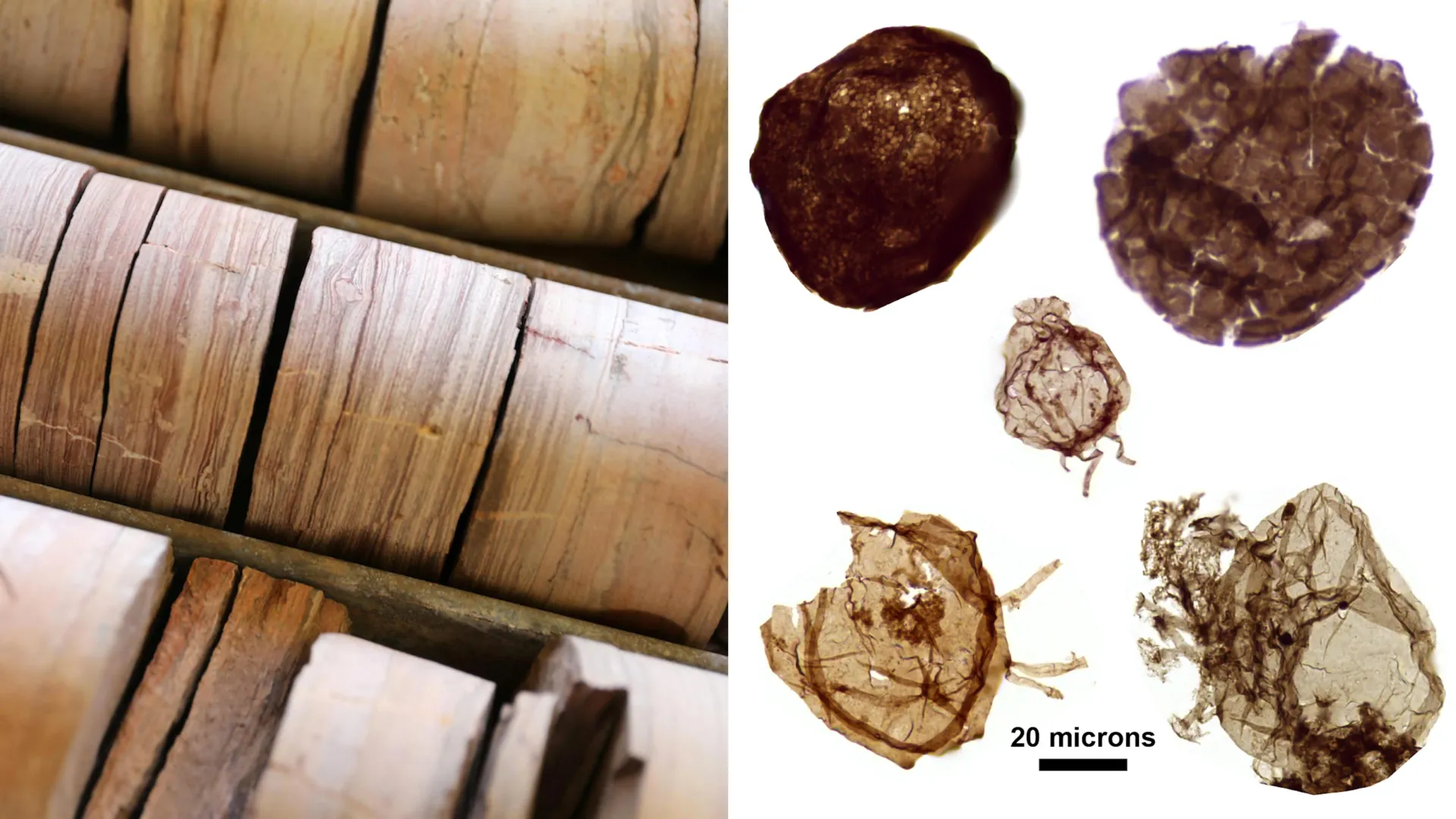
Researchers examining rock cores stored in Darwin, Australia have discovered fossils of some of the oldest known eukaryotes, organisms that represent a fundamental shift in the evolution of life on Earth. The specimens, preserved in mudstone from an ancient seafloor, date back approximately 1.7 to 1.4 billion years and represent a critical period in the development of complex life forms.
The distinction between prokaryotes and eukaryotes marks a pivotal moment in biological history. Prokaryotes, which include bacteria and archaea, possess simple cellular structures and typically exist as single cells. Eukaryotes, by contrast, feature complex cells with nuclei and specialized organelles, and this group encompasses all animals, plants, fungi, and algae. Scientists widely accept that eukaryotes arose through a symbiotic merger between an archaeon and a bacterium.
A long-standing question in evolutionary biology concerns the environmental conditions that enabled early eukaryotes to emerge and flourish. While many bacteria can survive in oxygen-free environments, nearly all modern eukaryotes depend on aerobic respiration to generate sufficient energy for complex life. Recent discoveries of eukaryotes capable of thriving without oxygen, combined with geological evidence suggesting oxygen scarcity in ancient oceans, had prompted researchers to reconsider the role oxygen played in early eukaryote evolution.
To investigate these questions, the research team analyzed over 12,000 microfossils extracted from the drill cores by dissolving mudstone samples and examining the organic residue. They also studied the chemical composition and depositional characteristics of the mudstone to reconstruct ancient environmental conditions. Their findings indicate that eukaryotic fossils appeared exclusively in samples from oxygenated marine settings, ranging from coastal mudflats to open ocean, while oxygen-free environments contained only prokaryotic forms.
These results support the hypothesis that oxygen availability was instrumental in driving the emergence and evolution of early eukaryotes. The research contributes to understanding one of biology’s major outstanding questions regarding the origins and context of complex life on Earth.
Article Attribution | Read More at Article Source
Article summary produced by Claude AI