

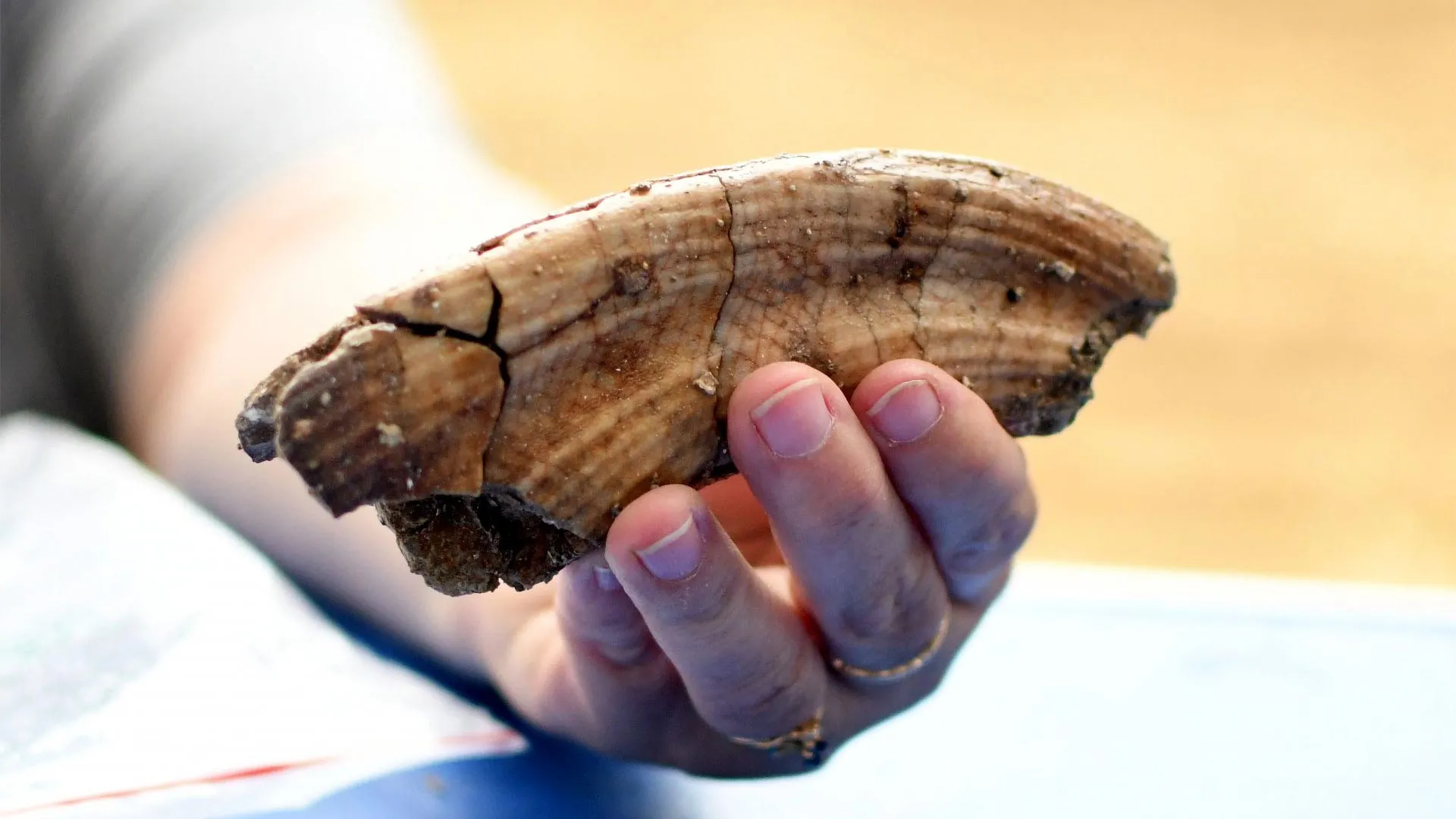
Researchers have determined that the ‘Ubeidiya archaeological site in the Jordan Valley is at least 1.9 million years old, significantly revising earlier estimates and placing the location among the oldest known sites of early human activity outside Africa. The study was conducted by Prof. Ari Matmon of the Hebrew University of Jerusalem, Prof. Omry Barzilai of the University of Haifa, and Prof. Miriam Belmaker of the University of Tulsa, who employed three advanced dating methodologies to establish a more reliable chronology for the site.
The research team applied cosmogenic isotope burial dating, magnetic field analysis of sediments, and uranium-lead dating of fossilized freshwater snail shells to determine the age of deposits containing ancient stone tools. The site’s magnetic signature matched the Matuyama Chron period, which began over two million years ago, and all three techniques converged on an age of approximately 1.9 million years. This finding places ‘Ubeidiya at a similar age to Dmanisi in Georgia, another significant location for understanding early human dispersal patterns.
The ‘Ubeidiya Formation has long attracted scientific interest due to its evidence of the Acheulean stone tool tradition, characterized by large bilateral tools including hand axes, alongside fossils of species originally associated with African and Asian ecosystems. Previous dating estimates had generally placed the site between 1.2 million and 1.6 million years old, but these relied on comparative analysis rather than direct measurement. The revised dating suggests that early human populations carrying different toolmaking traditions, including both the simpler Oldowan style and the more sophisticated Acheulean approach, had already spread into the Levant region during the early stages of human expansion beyond Africa.
The research team discovered complications in initial measurements suggesting some rocks were approximately three million years old. Further analysis revealed that sediments in the Dead Sea rift had undergone a complex history of repeated deposition, burial, and redeposition. Some material had been buried long before being transported and redeposited near the ancient lake at ‘Ubeidiya, explaining the conflicting measurements. By accounting for this sediment recycling, the researchers reconciled the data and strengthened confidence in the site’s revised age. The findings indicate that ancient human migration out of Africa may have involved multiple populations with distinct toolmaking technologies expanding simultaneously during this early period.
Article Attribution | Read More at Article Source
Article summary produced by Claude AI