

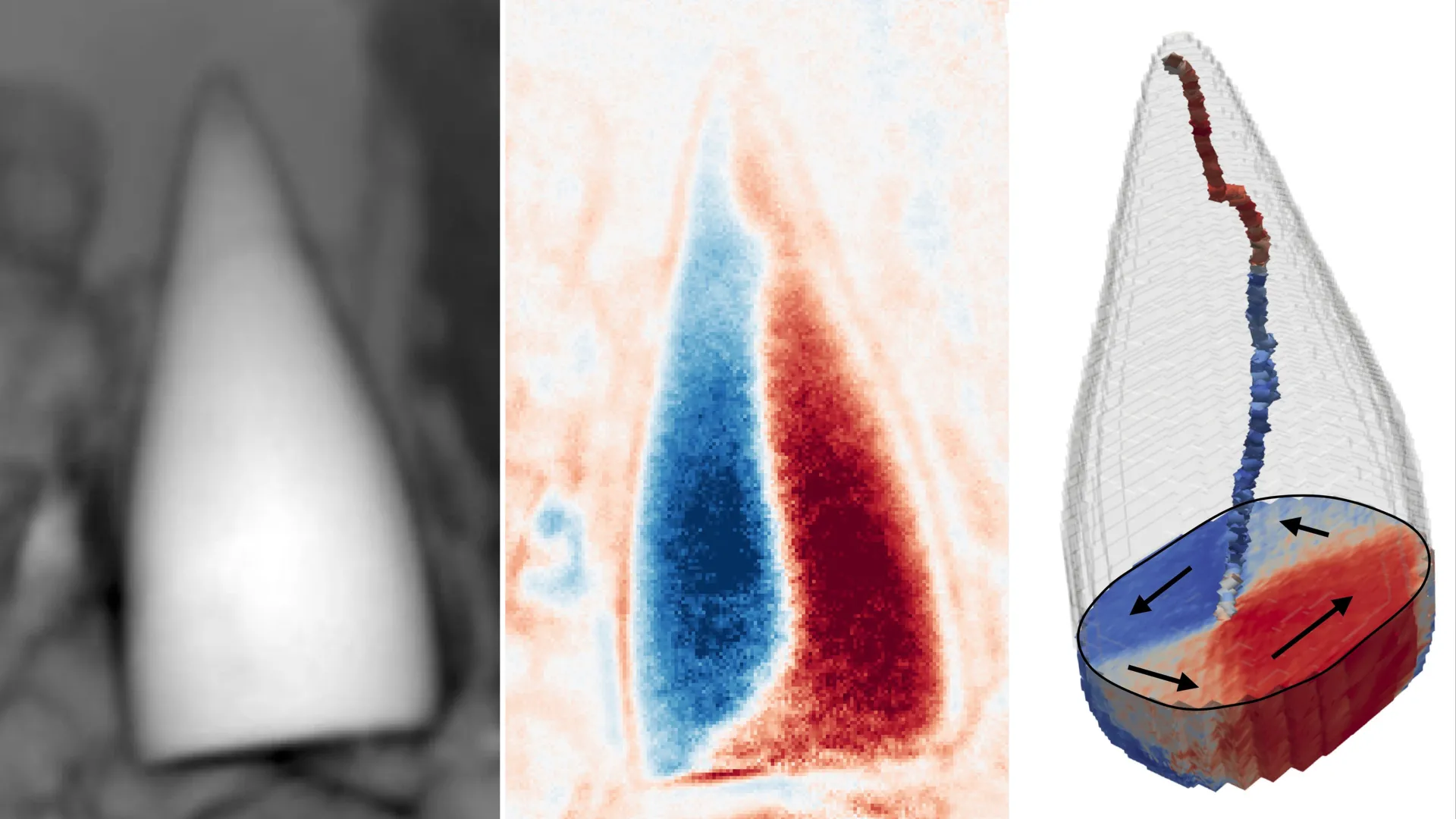
Scientists from the University of Cambridge and Helmholtz Zentrum Berlin have identified microscopic magnetic structures preserved in ancient seafloor sediments that appear to function as sophisticated navigation systems. The magnetofossils, dating back 97 million years, are no larger than bacterial cells and come in various shapes including spearheads, spindles, bullets, and needles. While their biological origin has been established, researchers have now determined that these structures likely enabled an ancient organism to detect both the direction and strength of Earth’s magnetic field.
Using advanced 3D imaging techniques, scientists revealed that the magnetofossils contain complex internal magnetic patterns resembling tornado-shaped vortexes. This configuration allows for the detection of latitude through sensing the tilt of Earth’s magnetic field while simultaneously measuring its strength, which varies with longitude. The vortex geometry also provides exceptional stability, allowing the system to resist environmental interference and maintain reliable navigational information. According to researchers, such a particle design would be ideal for an organism requiring navigation across vast oceanic distances.
The findings represent the first direct evidence that animals were capable of navigating using Earth’s magnetic field approximately 97 million years ago. Magnetoreception, the ability to sense magnetic fields, remains one of nature’s least understood senses. Modern birds, fish, and insects demonstrate this capability, yet the biological mechanisms underlying it are not fully comprehended. Some bacteria use chains of magnetic particles to orient themselves, though the ancient magnetofossils are significantly larger, suggesting more sophisticated functionality.
The discovery raises questions about the mysterious organism responsible for creating these structures. Researchers suggest that eels represent one possible candidate, as they evolved around 100 million years ago and are known to undertake extraordinary migratory journeys. Modern eels travel thousands of kilometers from freshwater rivers to reproduce in the Sargasso Sea and possess the ability to detect Earth’s magnetic field, though the exact sensory mechanisms remain unclear. The research, published in Communications Earth & Environment, provides new insights into how magnetoreception may have evolved while highlighting the need for further investigation into the identity of the fossil-producing organism.
Article Attribution | Read More at Article Source
Article summary produced by Claude AI