

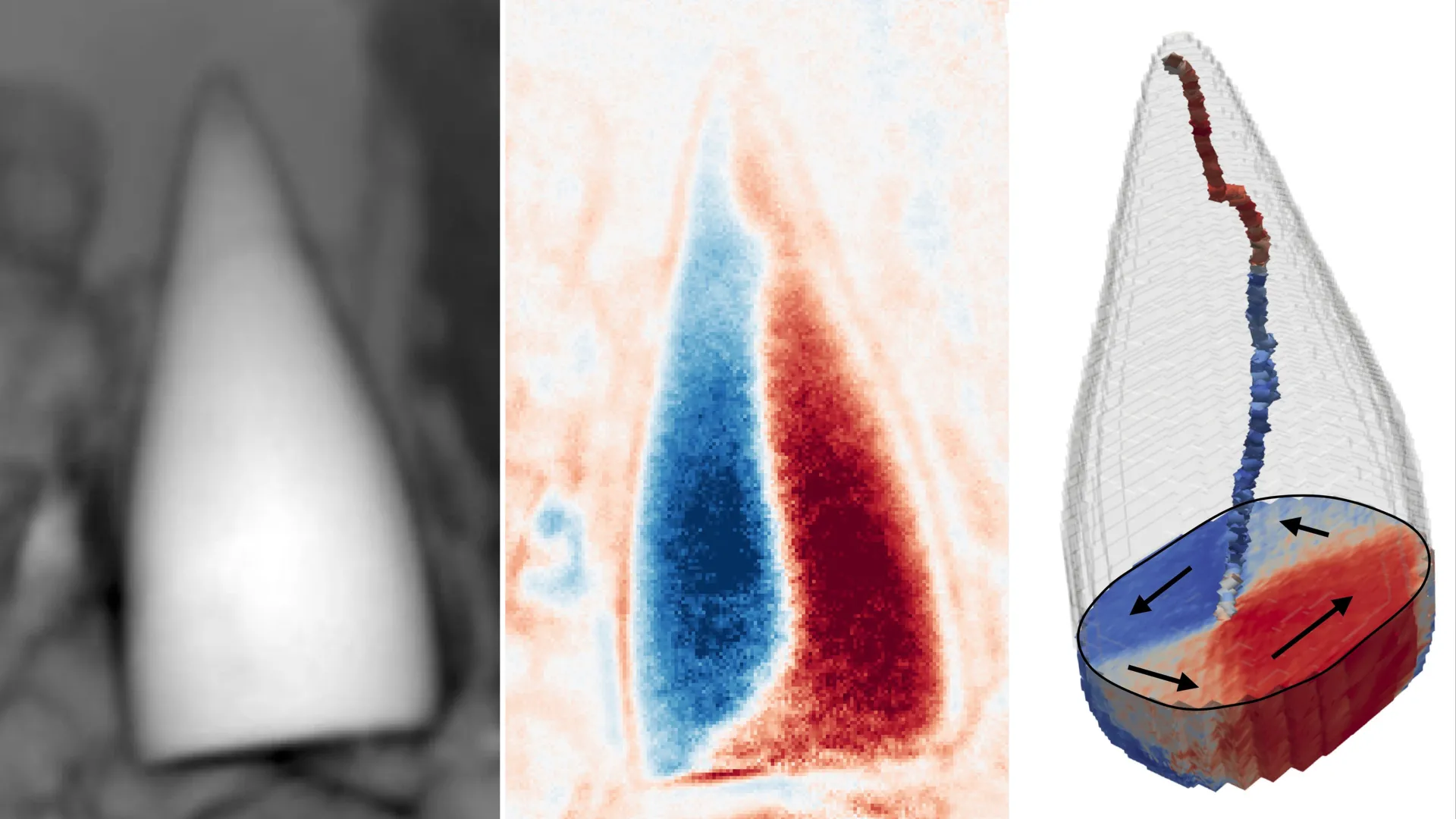
Scientists from the University of Cambridge and Helmholtz Zentrum Berlin have discovered what may represent the earliest known evidence of a biological system for detecting Earth’s magnetic field, preserved as microscopic structures dating back 97 million years. The findings were uncovered through analysis of magnetofossils—tiny magnetic particles recovered from ancient seafloor sediments in the North Atlantic Ocean—whose origin species remains unidentified. These structures, which measure only 10 to 20 times larger than the magnetic particles used by modern bacteria, come in various shapes including spearheads, spindles, bullets, and needles.
Using advanced 3D imaging techniques previously unavailable to researchers, scientists revealed that the interior of these fossils contains a complex magnetic pattern resembling a tornado-shaped vortex. This distinctive internal structure appears optimized for detecting both the direction and strength of Earth’s magnetic field simultaneously. According to the research team, this combination of properties would allow an organism to extract detailed navigational information, essentially functioning as a biological GPS system. The vortex geometry also provides exceptional stability, potentially helping any creature relying on it to maintain reliable directional information across long-distance migrations.
Magnetoreception—the ability to navigate using Earth’s magnetic field—remains poorly understood in modern science, despite being observed in birds, fish, insects, and other species. Some bacteria use simpler magnetic systems involving chains of particles that align with the magnetic field. The newly analyzed fossils demonstrate that far more sophisticated magnetic detection mechanisms existed in ancient times, suggesting this sensory ability evolved earlier than previously documented. The research was published in Communications Earth & Environment.
Identifying the organism responsible for producing these magnetofossils presents the next challenge for researchers. Scientists have speculated that eels, which evolved approximately 100 million years ago, represent one possibility given their documented ability to detect magnetic fields and undertake extraordinary long-distance migrations. Modern eels travel thousands of kilometers from freshwater rivers to reproduce in ocean basins, though the precise biological mechanisms enabling their navigation remain unclear to scientists.
Article Attribution | Read More at Article Source
Article summary produced by Claude AI