

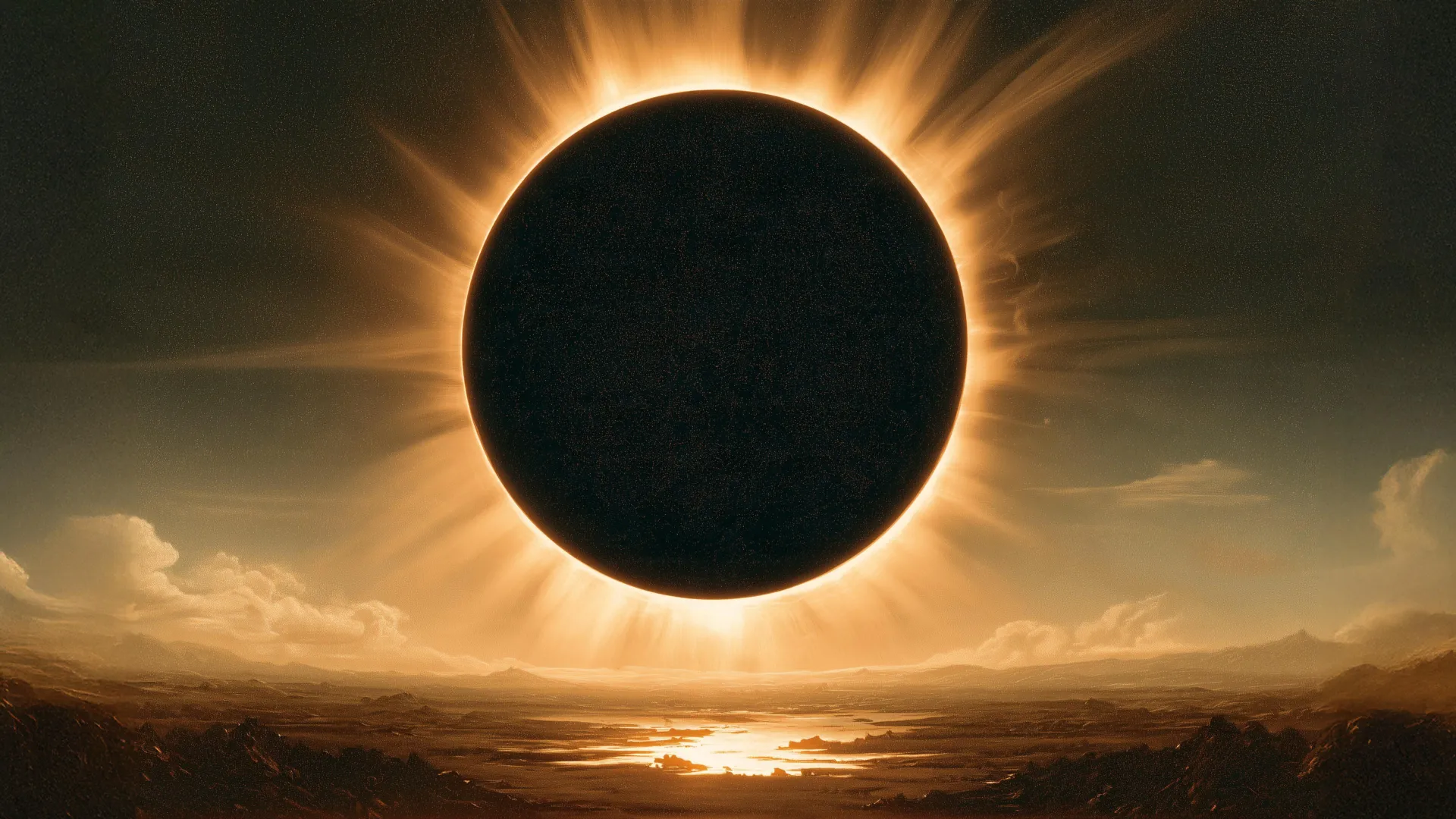
An international research team has reexamined one of the oldest precisely documented records of a total solar eclipse to extract new information about Earth’s rotational history and solar activity. The eclipse occurred on July 17, 709 BCE and was witnessed by observers in Qufu, the ancient capital of China’s Lu Duchy. The original account appeared in the “Spring and Autumn Annals,” a historical chronicle compiled 200 to 300 years after the event, stating that “the Sun was totally eclipsed.” A later description in the “Hanshu” (Book of Han), written approximately seven centuries after the eclipse, may contain one of the earliest surviving written references to the Sun’s corona, describing the eclipsed Sun as “completely yellow above and below.”
Initial calculations using existing estimates of Earth’s ancient rotation suggested that a total eclipse should not have been visible from the previously assumed location of the Lu court. Researchers resolved this discrepancy by identifying an error in historical geographic coordinates. Through examination of archaeological reports and historical geographic evidence, they determined that earlier calculations had misplaced ancient Qufu by approximately eight kilometers. Correcting this relatively minor geographic error allowed the team to accurately reconstruct the eclipse and extract valuable information about Earth’s rotation during this period.
The findings were published in Astrophysical Journal Letters and provide improved constraints on Earth’s rotation during the eighth through sixth centuries BCE. Using the corrected coordinates, researchers calculated that delta T (ΔT), a measurement describing variations in Earth’s rotation relative to a uniform time scale, fell between 20,264 and 21,204 seconds during the eclipse. These measurements help scientists better understand how the length of Earth’s day has changed over thousands of years and improve calculations for dating other ancient astronomical events.
The possible corona description from the historical record offers an additional research avenue by providing potential independent evidence of solar activity transitions. Scientists have previously reconstructed ancient solar cycles by studying radiocarbon preserved in tree rings and ice cores. The potential reference to the solar corona from 709 BCE may offer an independent validation point for these solar activity models and help researchers understand transitions in the Sun’s behavior across historical timescales. The ancient Chinese practice of carefully documenting celestial events, motivated by beliefs connecting astronomical phenomena to political circumstances, resulted in some of the world’s most valuable historical sources for studying ancient eclipses.
Article Attribution | Read More at Article Source
Article summary produced by Claude AI