

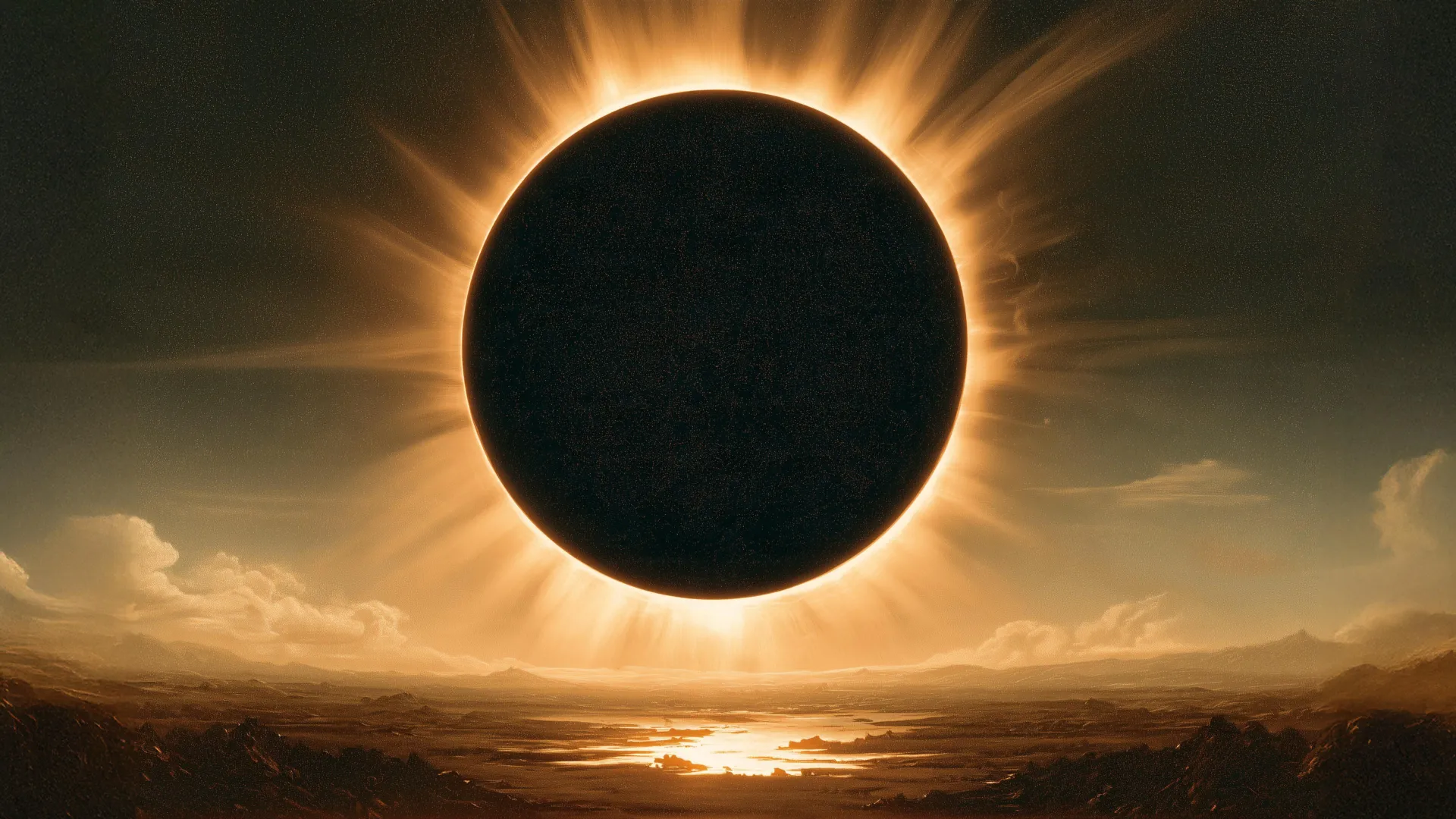
Researchers have conducted a detailed analysis of a total solar eclipse that occurred on July 17, 709 BCE, as documented in ancient Chinese historical records. The event was initially recorded in the “Spring and Autumn Annals,” a chronicle compiled roughly two to three centuries after the eclipse, with the simple notation that “the Sun was totally eclipsed.” A subsequent account appears in the “Hanshu,” a text written approximately seven centuries following the event, which contains a description potentially referring to the Sun’s corona—the luminous outer atmosphere visible during total solar eclipses.
The research team encountered an initial discrepancy when comparing historical records with modern astronomical calculations. Using existing estimates of Earth’s ancient rotation, calculations suggested that a total eclipse should not have been visible from Qufu, the assumed location of the Lu court. Through examination of archaeological evidence and historical geographic sources, the scientists determined that previous coordinate calculations had placed ancient Qufu approximately eight kilometers from its actual position. Correcting this relatively minor geographic error enabled the team to accurately reconstruct the eclipse and extract valuable data about Earth’s historical rotation characteristics.
The corrected analysis provided improved measurements of how Earth’s rotation has changed over millennia. Earth’s rotational speed has gradually declined over long timescales due to tidal friction generated by the Moon’s gravitational influence. Using the revised location data, researchers calculated delta T values for the period spanning the eighth through sixth centuries BCE, contributing more precise constraints on Earth’s rotation during ancient times. These findings refine the ability to date and reconstruct other historical astronomical events.
Beyond Earth’s rotational history, the possible corona description from the ancient account offers potential insights into solar activity patterns. Previous scientific reconstructions of ancient solar cycles have relied on studying radiocarbon preserved in tree rings and ice cores. The historical reference to the eclipsed Sun as “completely yellow above and below” may provide independent validation of those solar activity models and indicate that the Sun was transitioning from an extended period of unusually low activity toward a more active phase.
The preservation of such detailed astronomical observations reflects the significant role astronomy held in ancient Chinese governance and culture. Court astronomers monitored celestial phenomena because unusual sky events were interpreted as omens related to imperial conduct, creating incentive for careful documentation. This practice resulted in comprehensive records that have become invaluable sources for modern scientific study of ancient astronomical events.
Article Attribution | Read More at Article Source
Article summary produced by Claude AI