

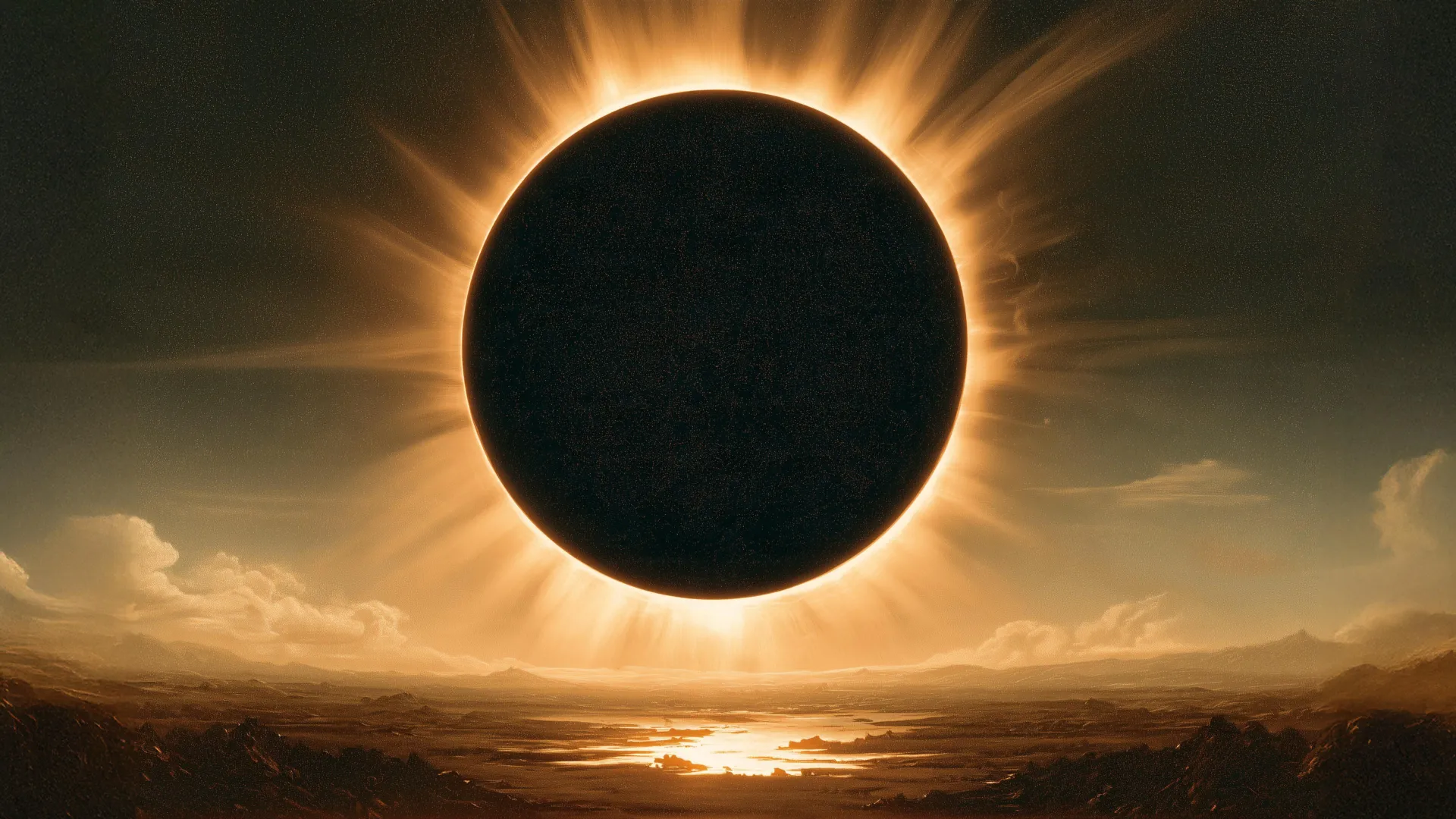
Researchers from multiple institutions have conducted a detailed analysis of a total solar eclipse that occurred in 709 BCE, as documented in ancient Chinese historical records. The eclipse was observed by the court of the Lu Duchy and preserved in the “Spring and Autumn Annals,” making it one of the earliest precisely dated eclipse observations. A secondary account in the “Book of Han” contains a description that may refer to the solar corona, potentially representing one of the oldest known written descriptions of this phenomenon.
The research team encountered an initial discrepancy when comparing historical records with modern astronomical calculations. Using existing estimates of Earth’s ancient rotation rate, their models predicted that a total eclipse should not have been visible from the previously assumed location of Qufu, the ancient capital. Through examination of archaeological reports and historical geographic evidence, the team identified an error in the city’s coordinates, determining that earlier calculations had placed Qufu approximately eight kilometers from its actual position. Correcting this relatively minor geographic adjustment allowed for an accurate reconstruction of the eclipse.
Using the corrected location, researchers calculated constraints on delta T, a measurement describing variations in Earth’s rotation. Their findings indicate that Earth was rotating faster 2,700 years ago than today, a process that occurs gradually over millennia as ocean tidal friction slows the planet’s spin. The improved data provides more precise understanding of how Earth’s rotation has changed over thousands of years and helps refine calculations for dating and locating other ancient astronomical events.
The eclipse record also offers potential insights into solar activity patterns. The possible corona description from the ancient source may provide independent corroboration for solar activity reconstructions based on radiocarbon measurements from tree rings and ice cores. The research, published in Astrophysical Journal Letters, reflects the significance of ancient Chinese astronomical observations, which were carefully documented by court astronomers who monitored celestial events as part of political and administrative practices.
Article Attribution | Read More at Article Source
Article summary produced by Claude AI