

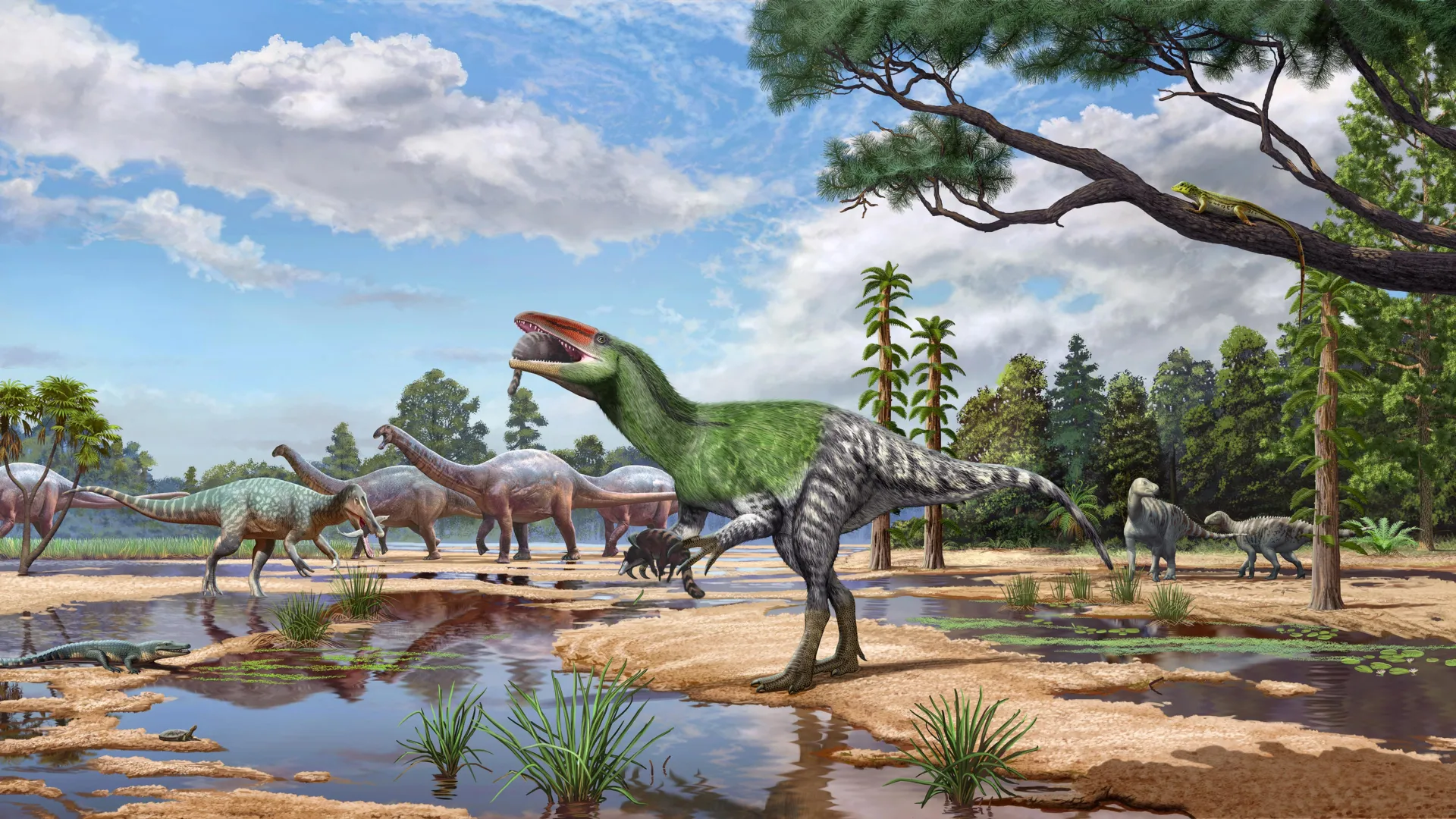
A fossil skull fragment housed in the Natural History Museum since 1924 has been identified as belonging to a previously unknown dinosaur species, according to research published in Royal Society Open Science. The specimen, discovered on the Isle of Wight, represents Invictibellatrix amberina, marking the first documented megaraptoran dinosaur found in Europe. Scientists from University College London led the investigation that revealed the fossil’s significance after nearly a century of obscurity.
Invictibellatrix was a carnivorous predator approximately three to four meters in length, standing slightly taller than an average human. Among the smallest known megaraptorans, it possessed the characteristic hunting equipment of its group: relatively narrow skulls, powerful arms, and curved claws estimated at 10 to 20 centimeters in length. The dinosaur likely hunted small dinosaurs, lizards, and mammals, filling an ecological niche similar to modern hyenas. The species name translates to “unconquered female warrior,” referencing the larger predators that evolved from this lineage.
The discovery holds significant implications for understanding megaraptoran evolution and migration patterns. Scientists have long theorized that these carnivorous dinosaurs originated in Asia and subsequently spread to Europe and the southern supercontinent of Gondwana, yet European fossil evidence had been lacking until now. The identification of Invictibellatrix provides crucial support for this proposed dispersal route, demonstrating that Europe served as an important transitional zone in the dinosaurs’ global expansion.
Researchers employed CT scanning technology to examine the fossil in detail, creating three-dimensional reconstructions of the skull fragment and its internal cavity. Distinctive anatomical features, including an oval opening at the spinal cord connection and a characteristic hourglass-shaped crest, distinguished this specimen from known dinosaur species. Computational analysis comparing skeletal characteristics with other predatory dinosaurs confirmed its classification within the megaraptoran group.
Mathematical modeling of megaraptoran distribution and evolution revealed that these predators occupied widespread geographic ranges during the Early Cretaceous. However, their presence in the northern supercontinent of Laurasia, including Europe, appears to have declined significantly during the Late Cretaceous. In contrast, megaraptorans continued thriving and diversifying across Gondwana, eventually evolving into formidable apex predators with claws exceeding 35 centimeters in length.
Article Attribution | Read More at Article Source
Article summary produced by Claude AI