

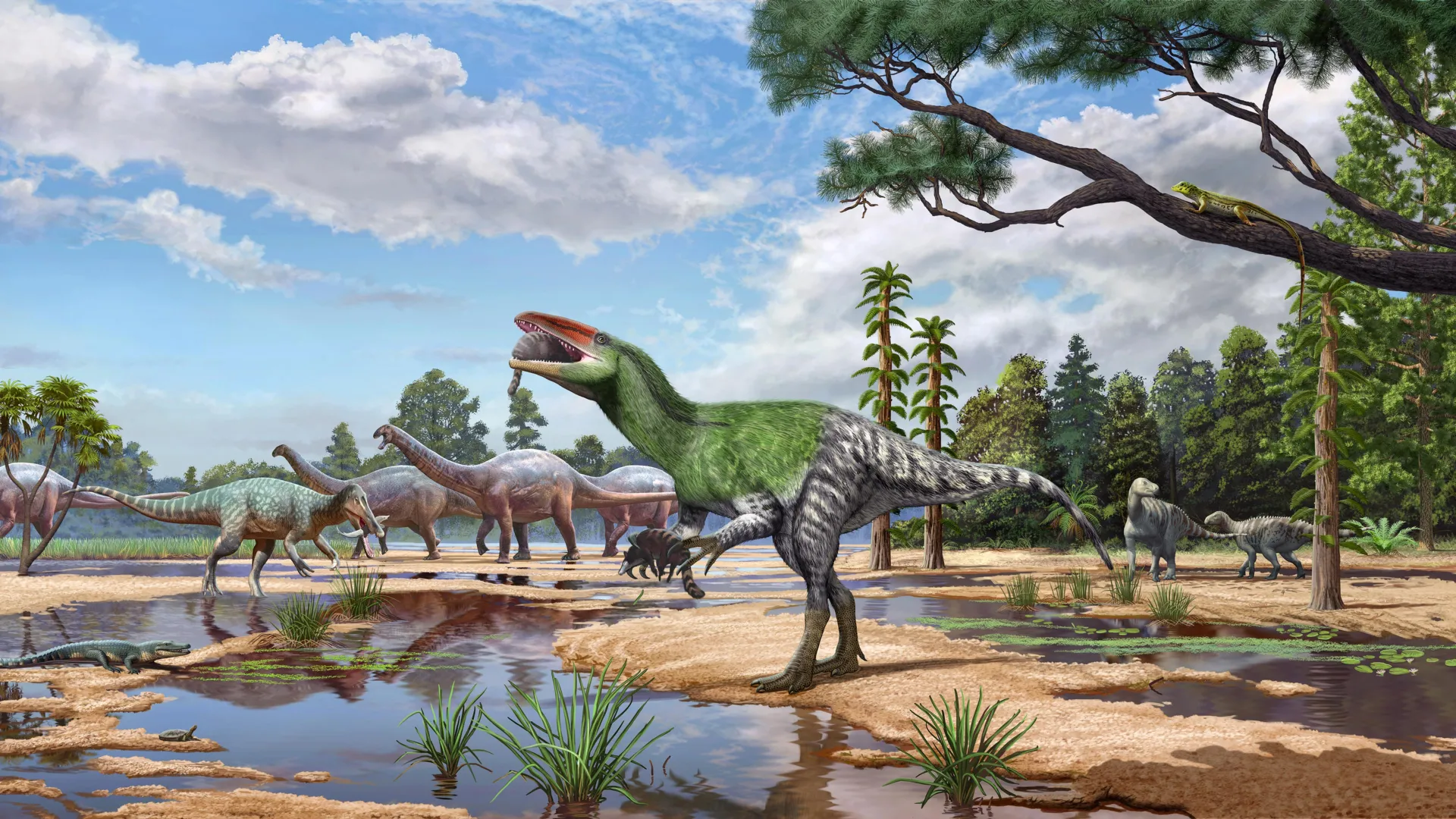
An international team of scientists from University College London has identified a previously unknown dinosaur species from a fossil specimen that remained unrecognized in museum collections for nearly a century. The fossil, a skull fragment originally discovered on the Isle of Wight and acquired by the Natural History Museum in 1924, has been classified as Invictibellatrix amberina. The findings appear in the journal Royal Society Open Science and represent the first confirmed European member of a group of carnivorous dinosaurs known as megaraptorans.
Invictibellatrix roamed what is now Britain approximately 120 million years ago during the Early Cretaceous period. Based on comparative analysis with related species, researchers estimate the dinosaur measured three to four meters in length and stood just over a meter and a half tall. Despite its modest size compared to some later predators, the animal possessed distinctive hunting equipment including relatively narrow skull structure, powerful arms, and curved claws measuring between 10 and 20 centimeters in length. The predator likely hunted small dinosaurs, lizards, and mammals, occupying an ecological role similar to modern hyenas.
The discovery addresses a significant gap in scientific understanding of megaraptoran evolution. Scientists have long theorized that these predators originated in Asia before spreading to Europe and eventually reaching Gondwana, the ancient southern supercontinent encompassing present-day Africa, South America, and Antarctica. However, no confirmed European megaraptoran fossils had been identified until now. The finding of Invictibellatrix provides evidence supporting the proposed migration pathway and suggests Europe played a crucial role in the global dispersal of these predators.
Researchers employed advanced CT scanning technology to analyze the fossil in detail, generating three-dimensional reconstructions of the skull fragment and its internal cavity. Unusual anatomical features, including an oval opening where the spinal cord connected to the brain and a distinctive hourglass-shaped crest, distinguished the specimen from known species. Computer algorithms comparing skeletal characteristics with other meat-eating dinosaurs, including tyrannosaurs, spinosaurs, and raptors, consistently placed the fossil within the megaraptoran group.
Mathematical modeling incorporating fossil records, evolutionary relationships, ancient geography, and climate conditions suggests megaraptorans were widely distributed during the Early Cretaceous. However, their presence in the northern supercontinent of Laurasia, including Europe, appears to have ended as the Cretaceous progressed. In contrast, megaraptorans in Gondwana continued evolving, eventually becoming dominant predators with some species developing claws up to 35 centimeters long and reaching lengths of nine to ten meters.
Article Attribution | Read More at Article Source
Article summary produced by Claude AI