

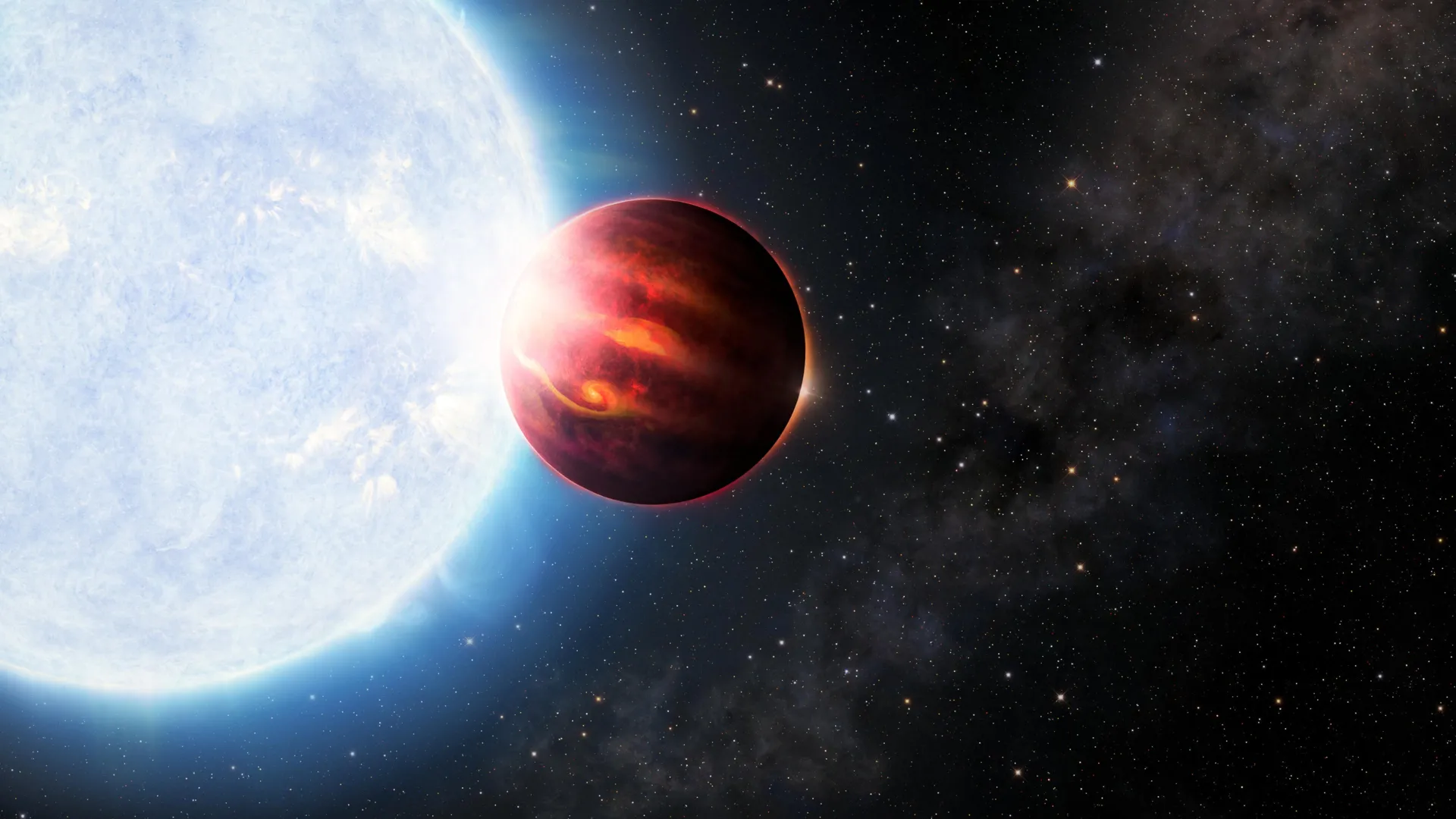
An international research team has confirmed a long-standing scientific principle about planetary formation by analyzing the atmosphere of WASP-189b, an ultra-hot Jupiter located approximately 320 light-years away in the Libra constellation. The investigation, led by graduate student Jorge Antonio Sanchez at Arizona State University, utilized the Gemini South telescope in Chile to conduct the first simultaneous measurement of gaseous magnesium and silicon in an exoplanet’s atmosphere.
The observations revealed that the proportion of magnesium to silicon on WASP-189b matches the ratio found in its parent star. This finding provides the first direct observational confirmation of an assumption that scientists have long held regarding the chemical relationship between stars and their planets. Astronomers have theorized that giant planets form within protoplanetary disks—massive structures of gas and dust surrounding young stars—and that these disks originate from the same material as the stars themselves, suggesting similar chemical proportions.
While this principle has been foundational to planetary science research and has been supported by evidence from our own Solar System, it had not been directly verified by measuring the same relationship in a planet orbiting another star until this discovery. The confirmation strengthens the scientific foundation for using stellar chemistry to understand the composition and formation of distant planets.
Beyond planetary formation, these findings have implications for astrobiology and the search for potentially habitable worlds. The relative amounts of rock-forming elements available to planets, determined by studying their host stars’ composition, influence planetary internal structure, geological processes, and chemical environments—all factors that could affect the development of conditions suitable for life. As researchers advance toward studying smaller, rocky exoplanets in greater detail, establishing a reliable connection between stellar chemistry and planetary composition becomes increasingly important for understanding habitability prospects across the galaxy.
Article Attribution | Read More at Article Source
Article summary produced by Claude AI