

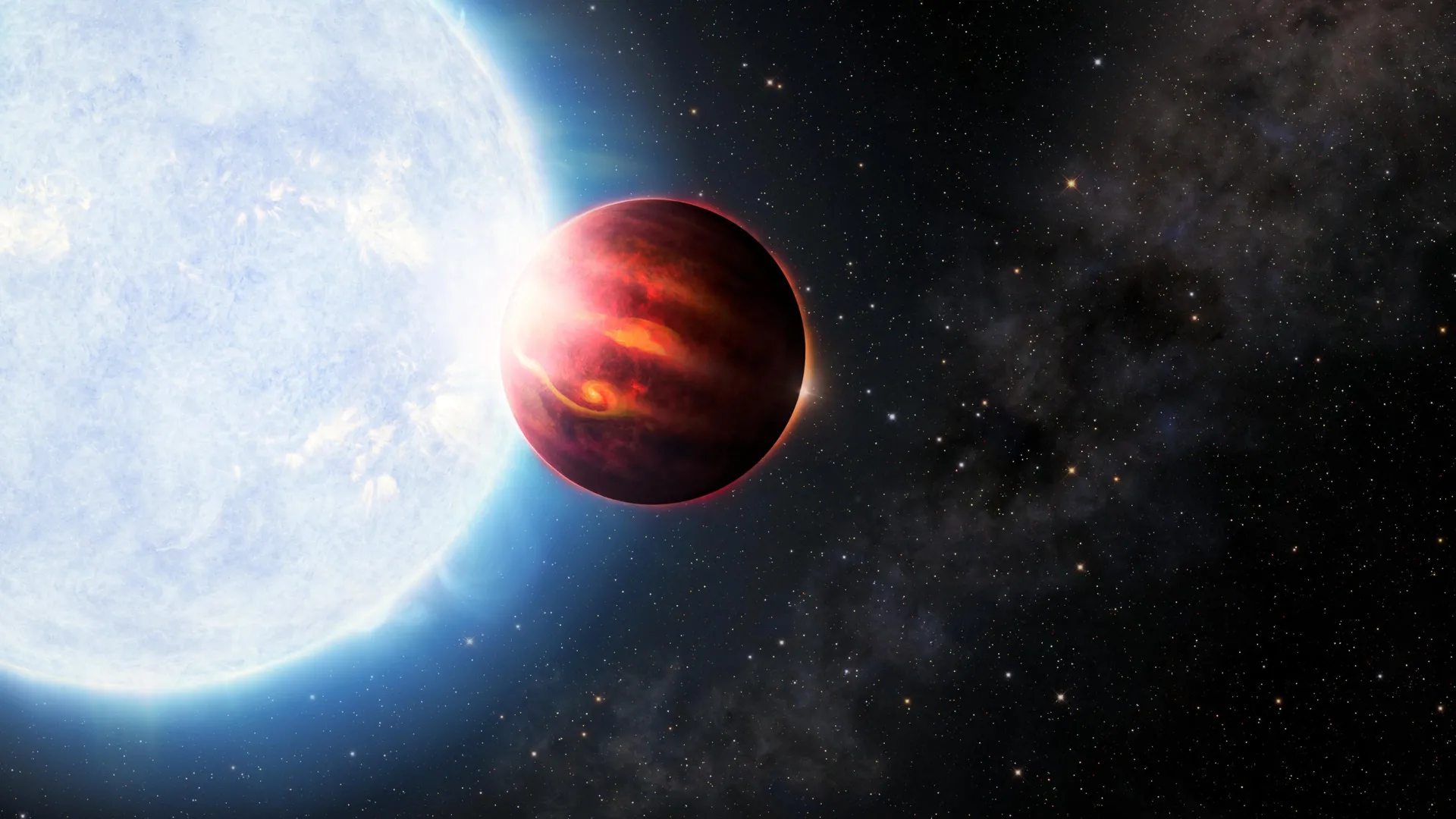
An international research team has provided direct observational evidence supporting a fundamental assumption about planetary formation by studying the atmosphere of WASP-189b, an ultra-hot Jupiter located approximately 320 light-years away in the Libra constellation. Using the Immersion GRating INfrared Spectrograph installed on the Gemini South telescope in Chile, researchers led by Jorge Antonio Sanchez of Arizona State University conducted the first simultaneous measurement of gaseous magnesium and silicon in an exoplanet’s atmosphere.
WASP-189b belongs to an extreme category of planets characterized by temperatures so intense that typically solid materials vaporize into gaseous form. The measurements revealed that the proportion of magnesium to silicon in WASP-189b’s atmosphere closely matches the ratio present in its host star. This finding validates a widely held scientific assumption that the chemical composition of giant planets reflects the elemental makeup of the protoplanetary disk from which they formed, which originates from the same material cloud as the central star.
Previously, this relationship between stellar and planetary chemistry had been supported primarily through observations within Earth’s solar system, but direct measurements from exoplanetary systems were lacking. The discovery provides crucial observational evidence strengthening the scientific foundation for using stellar composition to predict the materials from which distant planets form and evolve.
The implications extend beyond understanding planetary assembly processes. In astrobiology, establishing reliable connections between stellar chemistry and planetary composition becomes increasingly valuable for estimating the availability of rock-forming materials and assessing potential habitability conditions. Elements within planets influence internal structure, geological activity, and chemical environments that affect conditions suitable for life development, similar to how Earth’s elemental composition supports processes such as plate tectonics and magnetic field generation.
Researchers anticipate that future observations using ground-based, high-resolution spectrographs will detect additional elements in exoplanet atmospheres, providing more comprehensive chemical profiles that could reveal further insights into planetary formation, evolution, and the conditions that might support habitability in distant systems.
Article Attribution | Read More at Article Source
Article summary produced by Claude AI