

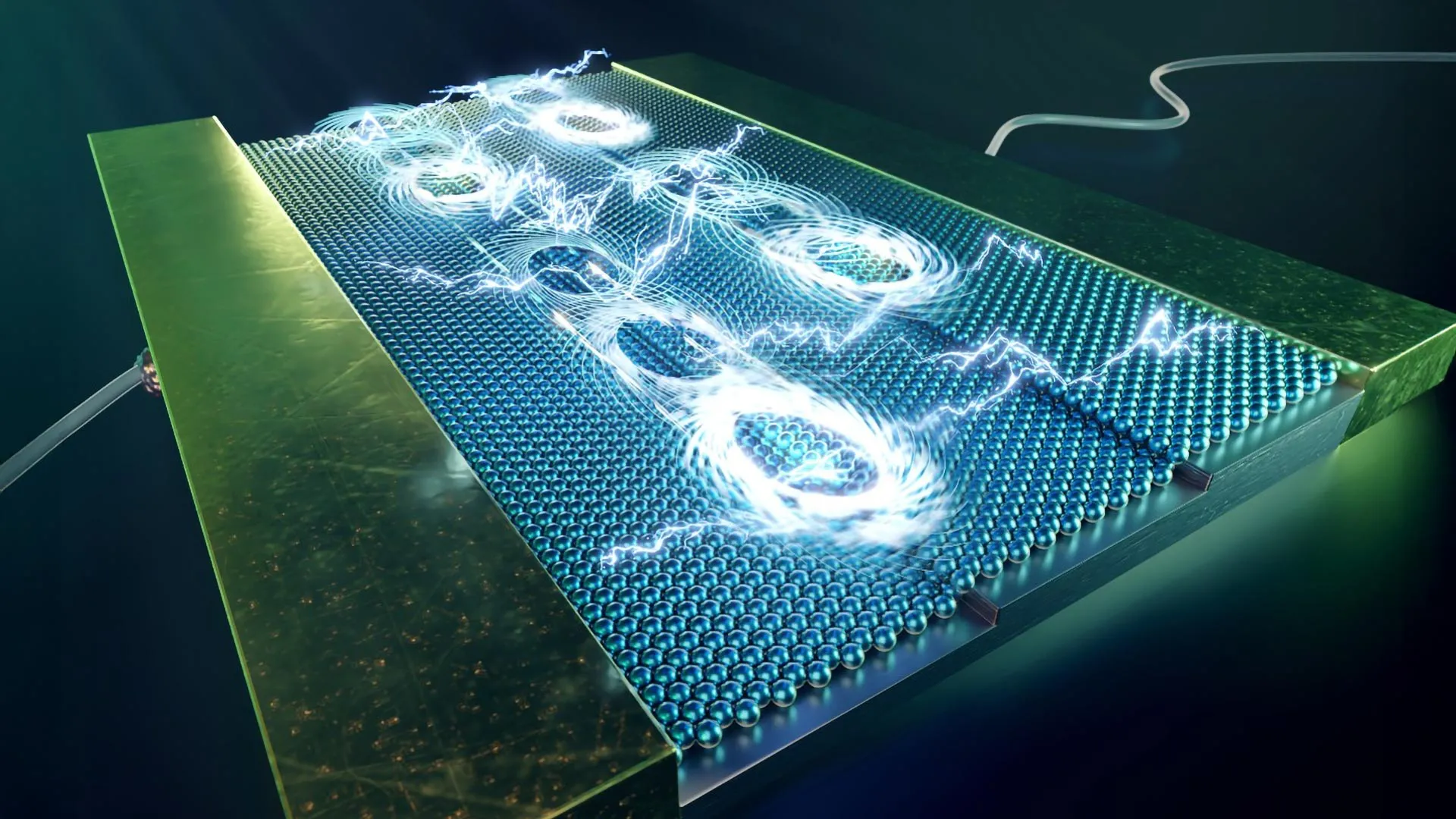
Scientists at Japan’s National Institute for Materials Science have identified a novel mechanism for controlling quantum vortices in ultrathin superconductors. The research team, led by Takashi Uchihashi at the Research Center for Materials Nanoarchitectonics, found that microscopic surface features measuring just one atom in height can direct the movement of these quantum structures with remarkable efficiency.
Superconductors are materials that conduct electricity without resistance when cooled below a critical temperature. Within these materials, quantum vortices form where magnetic fields penetrate, creating regions surrounded by circulating electrical currents. The movement of vortices typically generates electrical resistance and degrades superconductor performance, making vortex control a significant challenge in developing advanced applications. Controlling vortex motion has proven particularly difficult in extremely thin, two-dimensional superconductors.
The research involved studying an ultrathin superconductor with regularly spaced atomic steps on its surface. Using scanning tunneling microscopy to observe the material at atomic resolution, researchers confirmed that vortices aligned along these steps. Measurements using four-terminal resistance techniques revealed that vortices traveled more than 1,000 times more readily along the atomic steps than perpendicular to them when exposed to intermediate magnetic fields. The steps functioned as microscopic pathways or rails for quantum motion.
The team identified a particularly significant range of magnetic field strength, from approximately 0.10 to 0.20 tesla, within which vortices could flow freely along the steps without being trapped by material imperfections. This phenomenon, termed one-dimensional pinning-free vortex flow, allowed vortices to maintain defined trajectories. At the lowest temperatures, researchers observed that vortex motion operated through quantum tunneling, enabling the vortices to pass through energy barriers that would normally obstruct their movement.
The results, published in Physical Review B, demonstrate that temperature and magnetic field adjustments can tune the vortex-guiding effect. Researchers indicate that this atomic-scale approach could eventually enable more precise control of vortex and heat flow in superconducting devices, potentially advancing energy-efficient electronics and information processing technologies.
Article Attribution | Read More at Article Source
Article summary produced by Claude AI