

Researchers analyzing data from multiple space-based observatories have identified evidence of a neutron star merger occurring billions of years ago. The event, detected on July 4, 2025, by satellites including the Einstein Probe, SVOM, and Insight-HXMT, produced a gamma-ray burst lasting approximately half a second followed by an extended X-ray emission visible for nearly ten minutes. This represents the longest-lasting prompt X-ray flash ever recorded from a suspected neutron star merger.
The international team, led by Professor Eleonora Troja’s research group, conducted rapid follow-up observations using ground-based telescopes including the European Southern Observatory’s Very Large Telescope in Chile. By analyzing the light spectrum using the VLT’s X-Shooter instrument, researchers determined the explosion occurred more than six billion years away, based on a measured redshift value of 0.6610. Crucially, deep observations revealed no accompanying supernova, which would be expected if the X-ray flash had originated from a collapsing massive star.
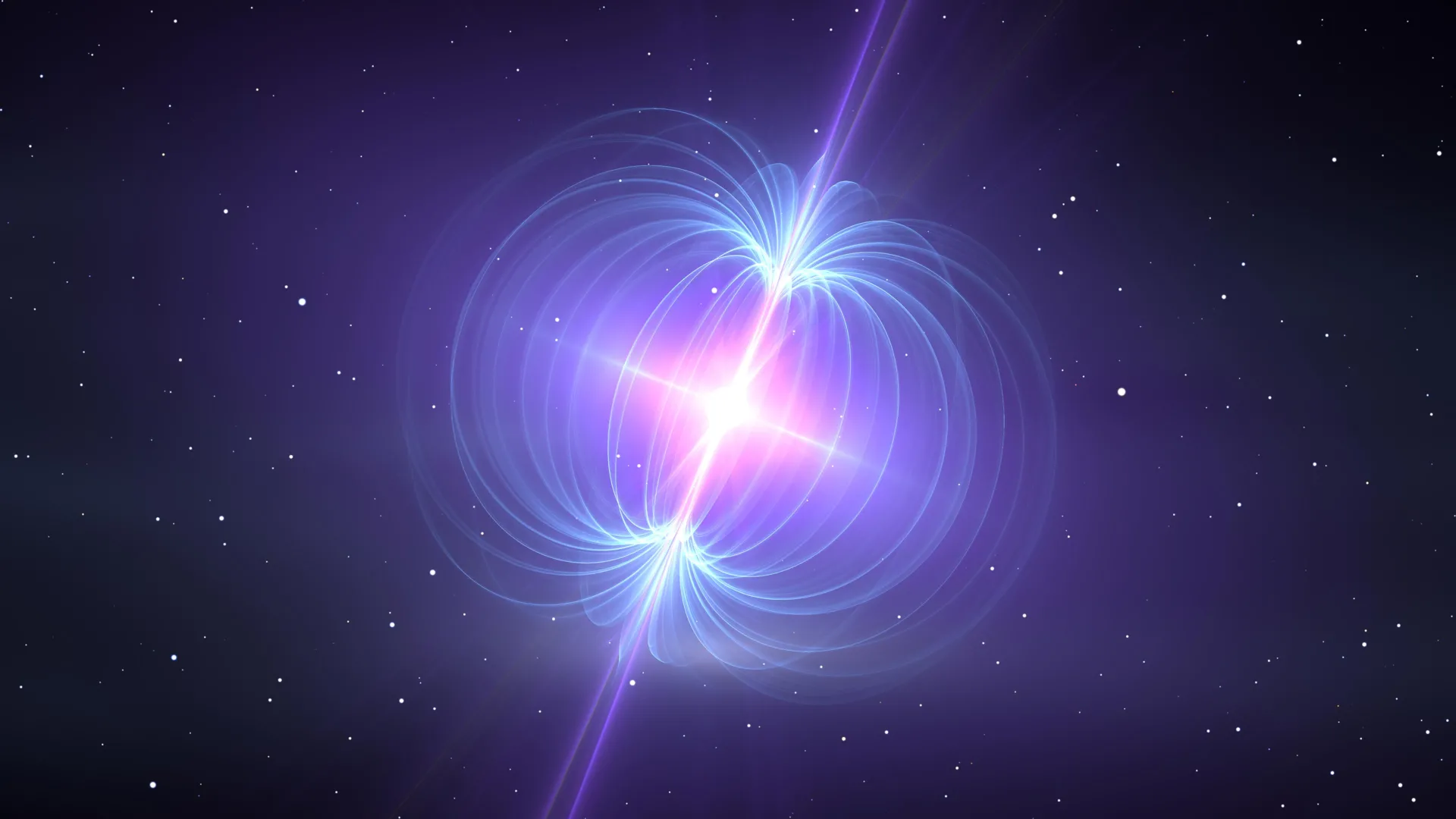
The findings, published in Science Bulletin, support the hypothesis that extended X-ray flashes from neutron star mergers may result from the formation of a magnetar—an extremely dense neutron star with an extraordinarily powerful magnetic field. As the magnetar releases its magnetic energy, it can extend and intensify the brightness of the explosion beyond the brief gamma-ray signal traditionally associated with such events. This mechanism could explain several previously mysterious fast X-ray transients detected by space observatories since the Einstein Probe’s launch.
The research suggests that identifying additional similar events could help astronomers determine how frequently neutron star mergers produce magnetars. Future observations combining X-ray detections with gravitational wave measurements from the same sources may provide comprehensive understanding of these extreme cosmic phenomena and their role in the universe.
Article Attribution | Read More at Article Source
Article summary produced by Claude AI