

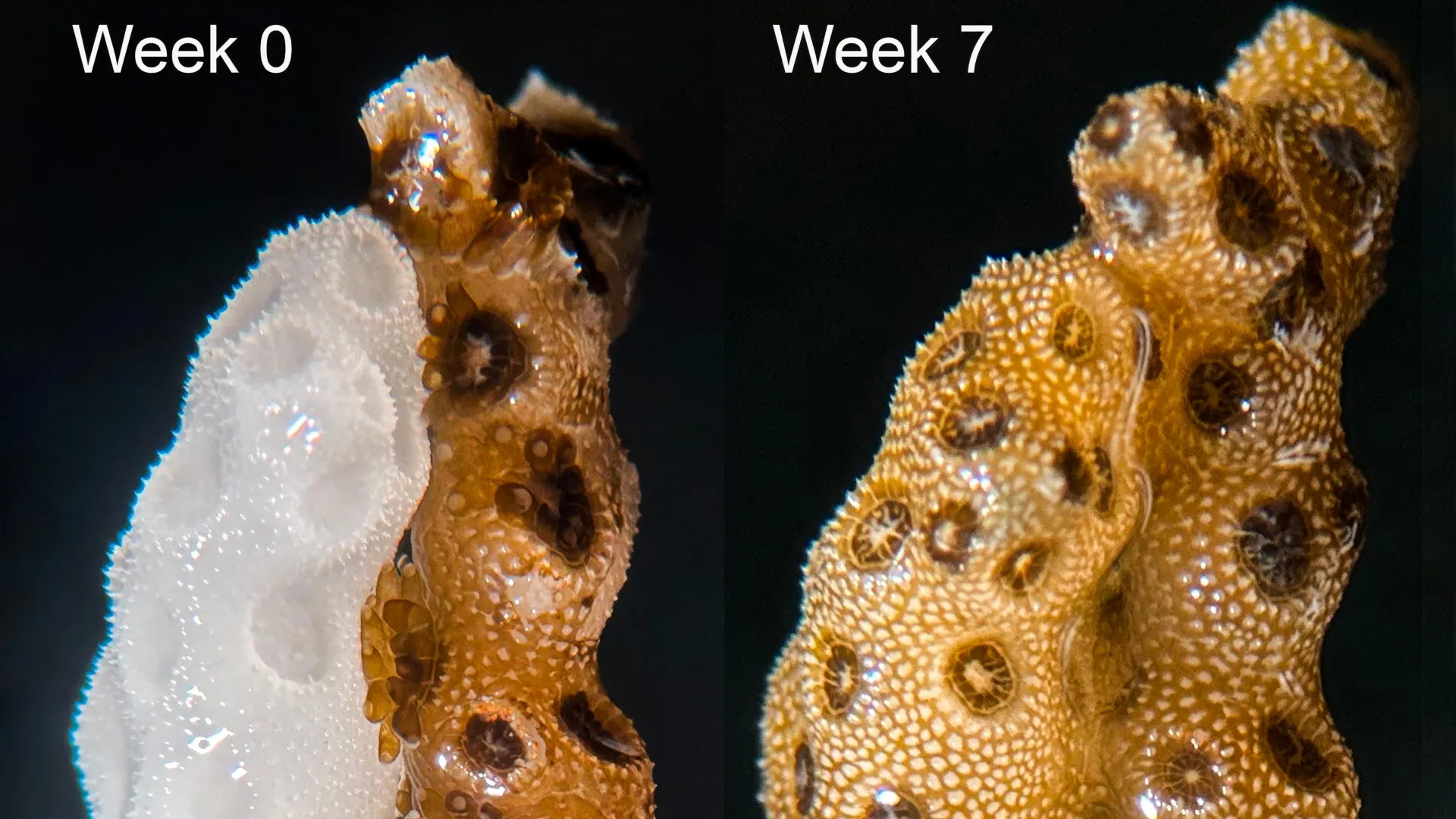
A study published on October 14 in Science Advances demonstrates that corals experiencing severe bleaching can achieve complete recovery through brief physical contact with healthy, genetically identical specimens. Laboratory experiments showed that bleached corals regained full health within seven weeks of this interaction, marking the fastest documented recovery from bleaching to date. The findings emerge as coral reefs face escalating threats from climate-driven marine heat waves and other environmental pressures.
The research originated from an unexpected observation in 2025 when two coral fragments from the same colony—one healthy and one bleached—accidentally came into contact in an aquarium and began exchanging beneficial algae. Researchers subsequently designed controlled experiments using paired coral fragments, with one group kept in physical contact and another separated by millimeter-scale gaps. All bleached fragments that touched their healthy counterparts recovered completely within seven weeks, while separated fragments died, revealing the critical importance of direct contact.
Microscopic analysis revealed that genetically identical corals recognize each other and establish tissue connections through tiny channels, similar to successful organ transplants between identical twins in humans. These connections enabled the transfer of beneficial algae from healthy to bleached coral within three days. Researchers found that just five to seven days of contact provided sufficient algae for complete recovery, as the transferred organisms then reproduced rapidly within their new host at rates approximately ten times faster than observed in wild corals.
The accelerated recovery mechanism works because transferred algae replicate quickly rather than requiring continuous supply from the healthy coral. During the second week of contact, beneficial algae populations doubled approximately every four days. Scientists emphasize that while these findings suggest promising restoration possibilities for helping bleached corals survive critical post-heatwave periods, the experimental approach cannot yet be scaled for large-scale reef restoration. The research adds to existing coral conservation strategies including selective breeding for heat tolerance and coral nursery programs.
Article Attribution | Read More at Article Source
Article summary produced by Claude AI