

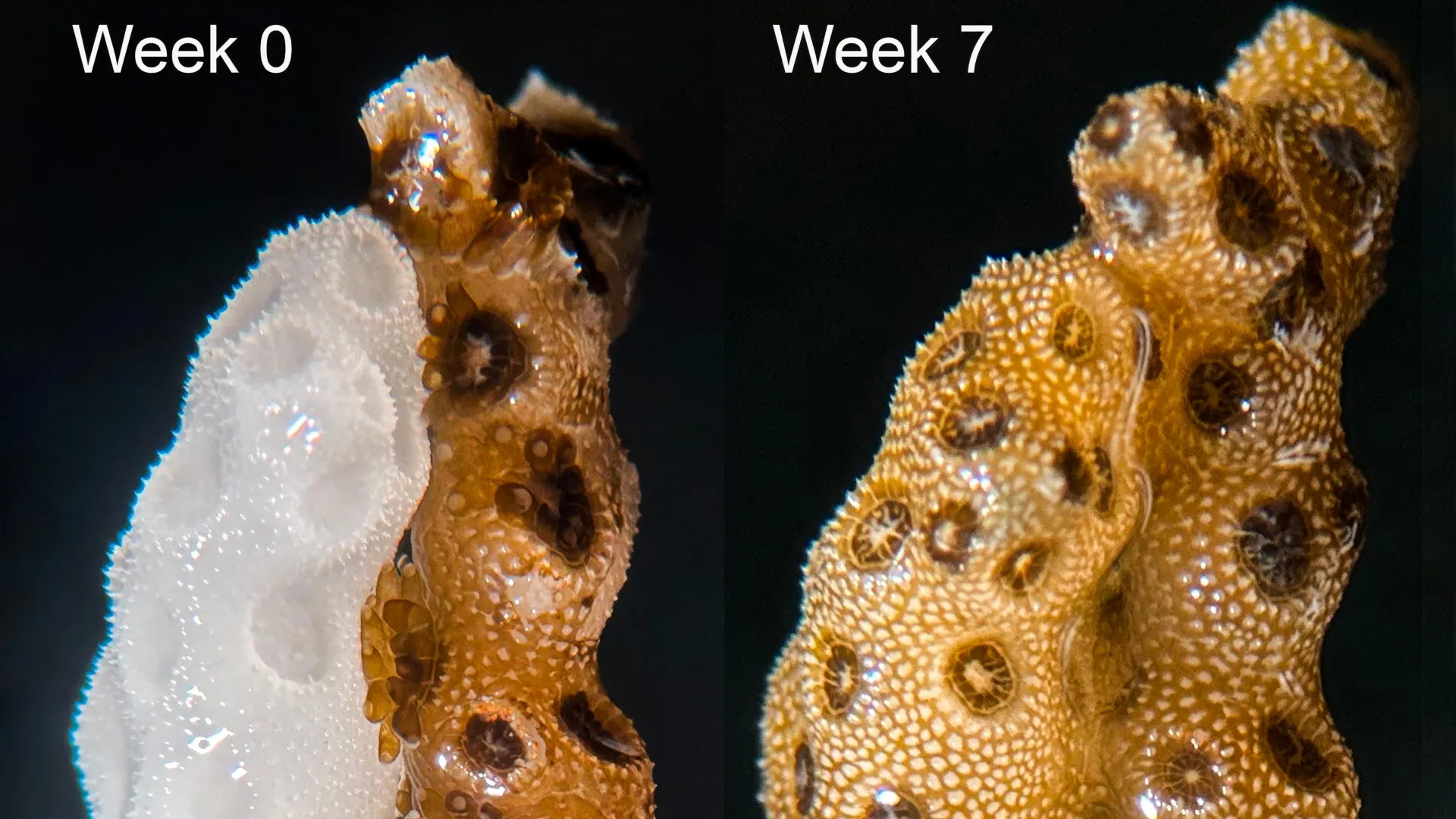
Scientists have documented the fastest known recovery from coral bleaching, with severely bleached corals regaining full health in seven weeks after contact with genetically identical healthy specimens. The findings, published on October 14 in Science Advances, emerged from laboratory experiments at Stanford University and could inform future reef restoration strategies as climate change drives increasingly severe marine heat waves.
The discovery began with an unexpected observation in 2025, when researchers noticed a bleached coral fragment regaining its color after falling against a healthy fragment from the same colony in an aquarium. Lead researcher Danny Collins then conducted controlled experiments using coral pairs, with half the fragments positioned to touch and half separated by millimeter-wide gaps. The results showed stark contrasts: every bleached fragment that maintained physical contact with healthy tissue recovered completely within seven weeks, while separated fragments died.
The mechanism behind the recovery involves tissue fusion between genetically identical corals. When coral fragments touch, tiny channels within their tissues align and connect, allowing materials to transfer between them. Researchers observed beneficial algae moving into bleached fragments within three days of contact. Notably, corals separated after just five to seven days of contact still achieved full recovery, indicating that the algae reproduced rapidly once inside the bleached coral rather than relying on continued supply from the healthy counterpart. During the second week, beneficial algae in formerly bleached fragments doubled approximately every four days—roughly ten times faster than rates observed in wild corals.
The potential applications for reef conservation are significant, as coral bleaching occurs when rising ocean temperatures cause corals to expel symbiotic algae essential for their survival and energy production. Current restoration efforts include selective breeding for heat tolerance and coral nurseries. While researchers emphasize that scaling this approach to large reef systems remains undetermined, the findings suggest that helping bleached corals survive recovery periods following heat waves could be achievable through targeted intervention.
Experts note that bleached corals are often dismissed as irrecoverable because natural healing typically requires months or years. This research presents an alternative pathway to preserving coral populations during the vulnerable period following marine heat waves, though substantial additional work is needed before field applications become feasible.
Article Attribution | Read More at Article Source
Article summary produced by Claude AI