

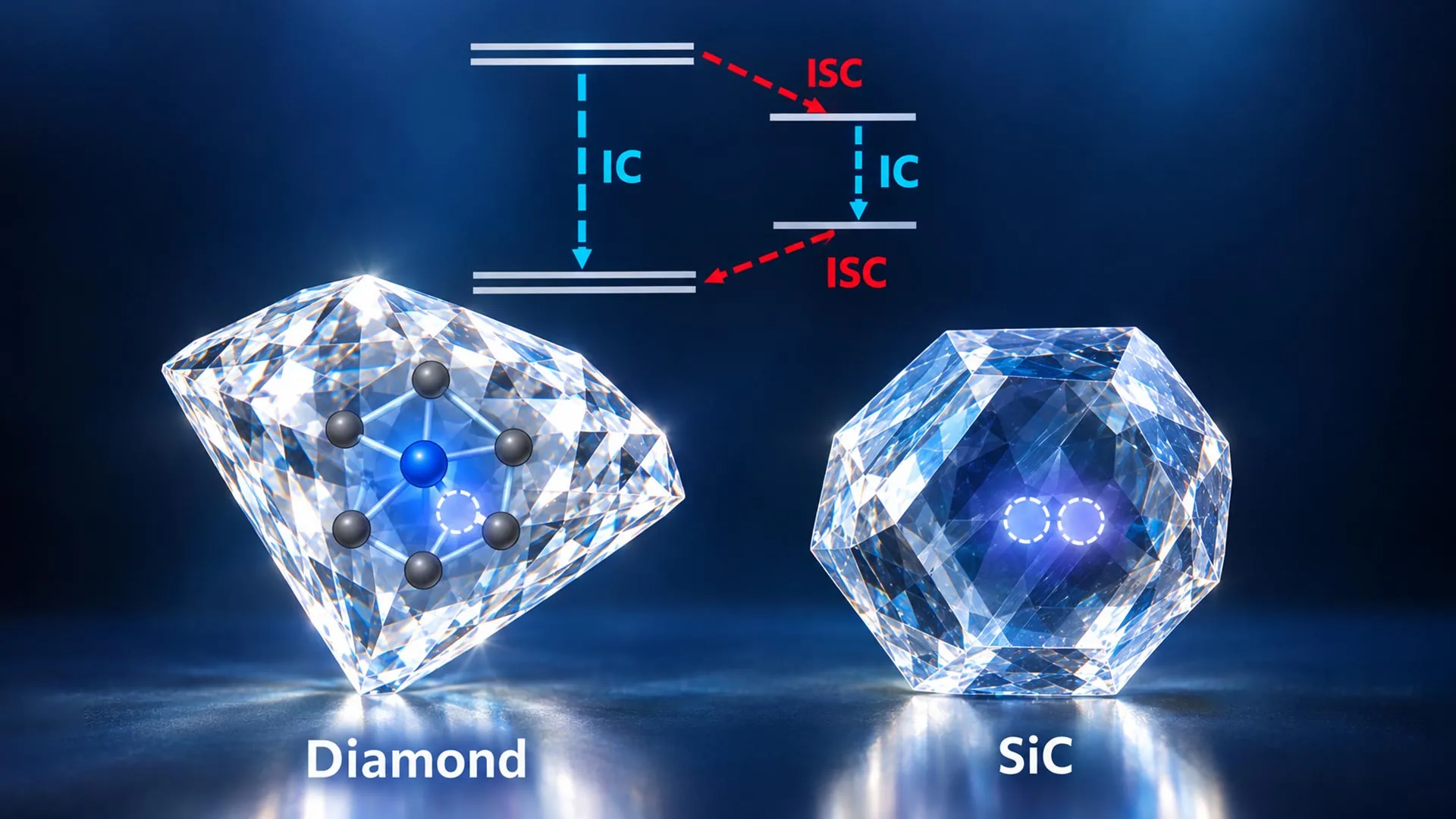
Scientists at the University of Chicago Pritzker School of Molecular Engineering have created a new computational approach for modeling how spin defects—tiny imperfections in materials like diamond and silicon carbide—interact with light. These defects are considered promising candidates for building quantum technologies, including quantum sensors and qubits, but predicting how their energy changes over time has presented significant challenges for researchers.
The team’s breakthrough involves simulating the complete optical cycle of spin defects, with particular focus on a process called internal conversion. This occurs when excited electrons return to lower energy states by transferring energy into vibrations of surrounding atoms. While quantum mechanics equations can describe other energy-loss pathways, accurately modeling internal conversion has been computationally difficult due to complex interactions between electrons and atoms in realistic solid materials.
The researchers combined several mathematical and computational techniques developed over many years, using descriptions called many-body wavefunctions to represent excited states. Their method calculates how electronic states interact with vibrational configurations of hundreds of surrounding atoms simultaneously, rather than analyzing each configuration separately. The framework was incorporated into WEST, an open-source simulation program optimized for graphics processing units.
Testing revealed surprising findings. While calculations for nitrogen-vacancy centers in diamond matched expected results, examination of divacancy defects in silicon carbide showed that internal conversion plays a far more significant role in energy loss than previous models suggested. This discovery helps resolve long-standing disagreements between theoretical predictions and experimental observations for silicon carbide defects.
The findings, published in Physical Review Letters, could enable more accurate predictions of spin defect behavior for quantum applications and may also benefit research into renewable energy conversion and storage. Researchers are now exploring ways to reduce computational demands through machine learning integration and plan to extend the approach to study spin defects in silicon and other materials relevant to quantum and energy technologies.
Article Attribution | Read More at Article Source
Article summary produced by Claude AI