

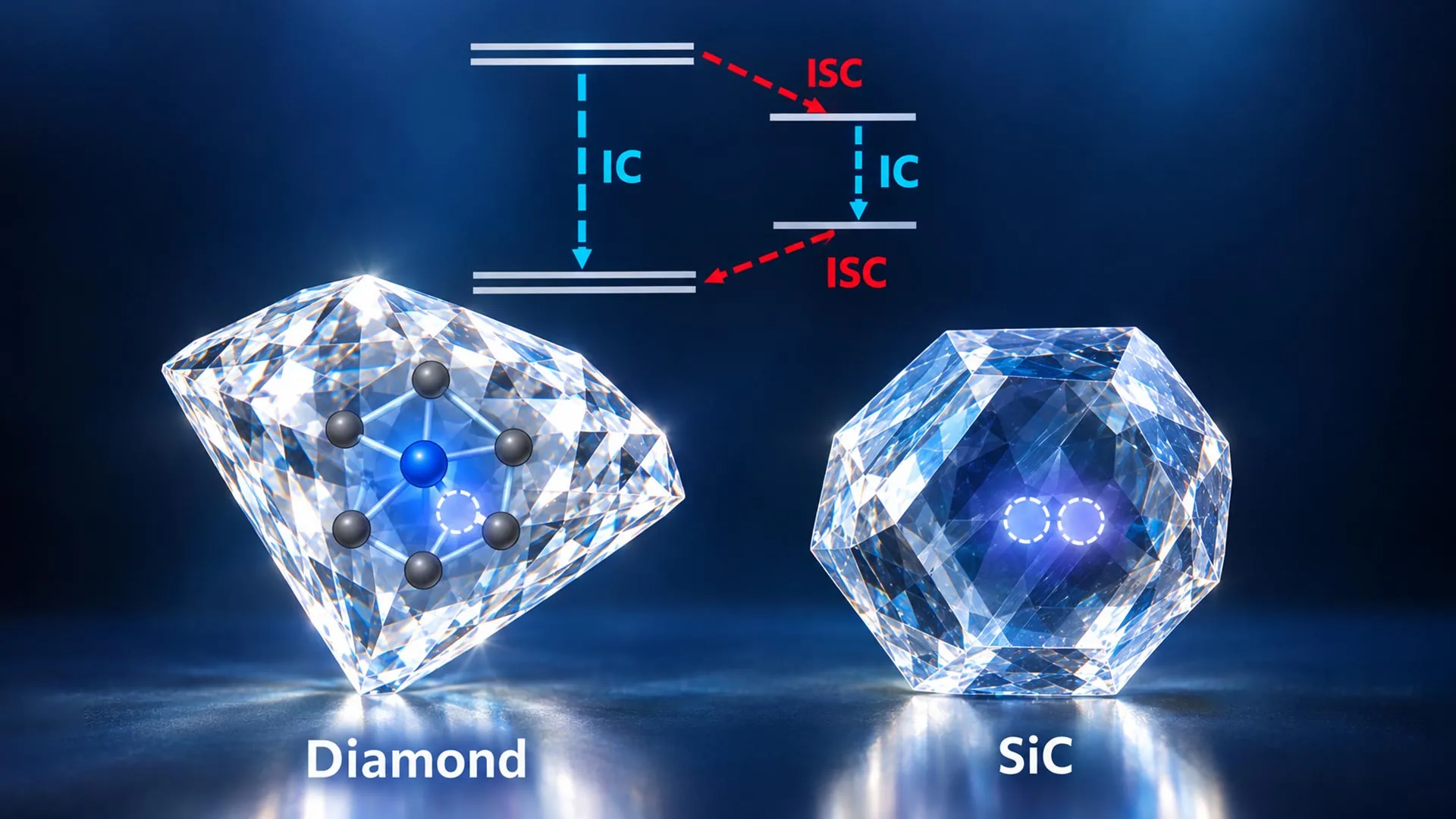
Scientists at the University of Chicago Pritzker School of Molecular Engineering have created a new computational approach to model how crystal defects behave when exposed to light. The method, published in Physical Review Letters, addresses a long-standing challenge in understanding energy transitions within spin defects—microscopic imperfections in materials like diamond and silicon carbide that show promise for quantum applications.
When light strikes these defects, electrons become excited and can release energy through various pathways. While scientists could previously model most of these processes, one mechanism called internal conversion—where energy transfers into vibrations of surrounding atoms—remained computationally difficult to predict accurately. The team, led by Giulia Galli, overcame this obstacle by combining multiple mathematical and computational techniques developed over several years of research.
The researchers used mathematical representations called many-body wavefunctions to characterize how excited states interact with atomic vibrations. This approach allowed them to calculate electron-vibration interactions across hundreds of surrounding atoms simultaneously, rather than analyzing each configuration individually. The new framework was incorporated into WEST, an open-source simulation program designed to run efficiently on graphics processing units.
When tested on a nitrogen-vacancy center in diamond, the calculations matched experimental measurements closely and confirmed existing theories. However, analysis of a divacancy defect in silicon carbide revealed unexpected results. Internal conversion proved far more influential in the defect’s energy loss than previous models suggested, finally explaining a long-standing discrepancy between theoretical predictions and experimental observations.
The researchers are now making their method available to other institutions and exploring ways to reduce computational demands through artificial intelligence integration. They plan to extend the approach to study silicon defects and materials relevant to renewable energy applications, where internal conversion affects energy transfer and storage efficiency.
Article Attribution | Read More at Article Source
Article summary produced by Claude AI