

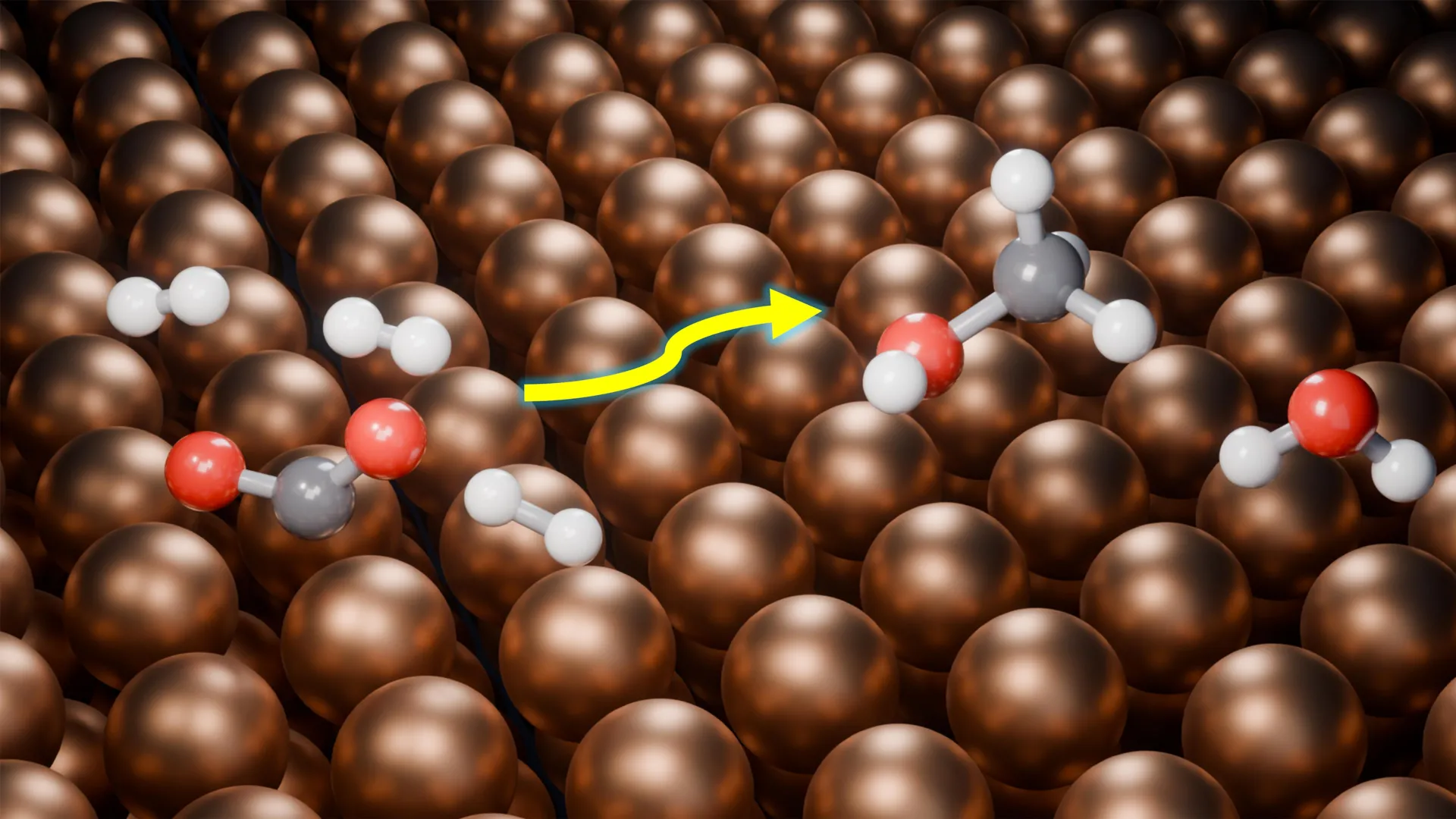
Scientists at the Indian Institute of Science have identified thousands of previously unknown chemical reactions occurring during carbon dioxide conversion using a combination of machine learning and quantum mechanics simulations. The research, published in Nature Communications, focused on reactions taking place on copper catalysts used to transform CO2 into useful products like methanol.
Traditional modeling approaches rely on a limited set of reactions believed to be most significant because simulating all possible chemical steps would require prohibitive computing resources. The research team began by building a database of 152 reactions through quantum mechanics simulations, then trained machine learning models to estimate energy barriers for additional reactions. Using automated computational tools to examine 105 chemical species on the catalyst surface, they expanded their reaction network to 9,389 individual steps.
The expanded model produced substantially different results compared to simpler approaches. When using only the initial 152 reactions, the model incorrectly predicted formic acid as the primary product and significantly underestimated CO2 conversion rates. Incorporating the larger reaction network increased predicted CO2 conversion by approximately 40 times and correctly identified methanol and carbon monoxide as major products, aligning predictions with experimental observations.
The study also revealed an unexpected chemical pathway in which hydrogen can be transferred directly as a molecular unit rather than splitting into individual atoms first. This finding challenges conventional understanding of hydrogen behavior in catalytic reactions and suggests that catalysts interacting more strongly with molecular hydrogen could potentially improve methanol production pathways.
The researchers indicate their computational framework combining quantum mechanics, machine learning, and reaction rate modeling could be applied to other industrial processes beyond CO2 hydrogenation, including nitrogen reduction and water splitting.
Article Attribution | Read More at Article Source
Article summary produced by Claude AI