

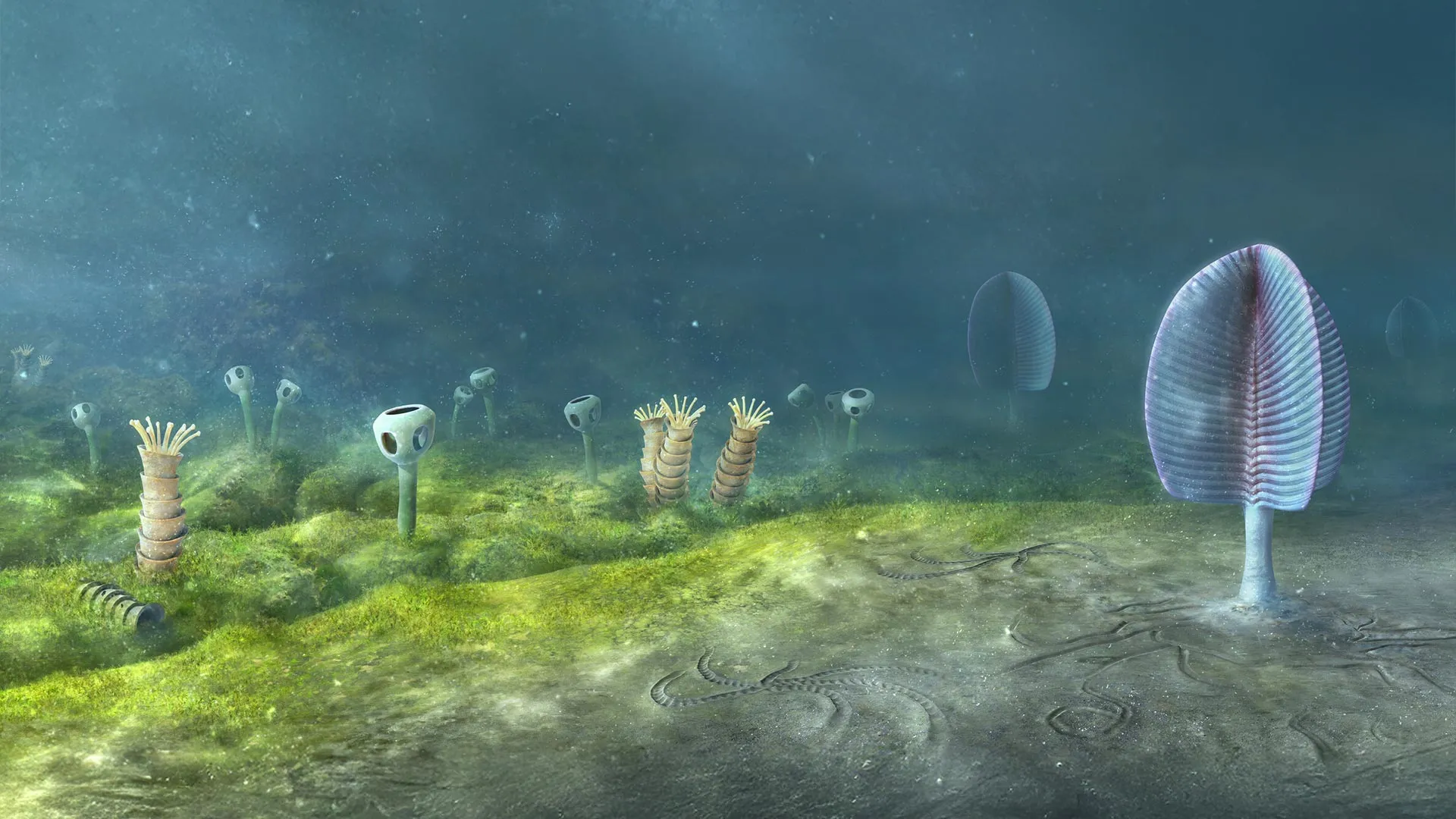
Research conducted by an international team led by the University of Oxford challenges long-held assumptions about when animals first evolved on Earth. The findings, published Oct. 2 in Science Advances, propose that animals may have originated significantly earlier than their appearance in the fossil record suggests, potentially during the Neoproterozoic Era hundreds of millions of years before the Cambrian Period.
The study reexamines a critical assumption scientists have relied upon regarding ancient fossil deposits. The Weng’an Biota in China, a 590 million year old fossil assemblage, contains exceptionally preserved microscopic organisms but no definitive animal remains. Researchers previously interpreted this absence as evidence that animals had not yet evolved at that time. However, the new research disputes this reasoning by analyzing the Kheseen Biota in Mongolia, a younger deposit that is more than 40 million years more recent. Despite being equally well-preserved and containing exquisitely detailed microfossils, the Kheseen Biota similarly lacks identifiable animal fossils—even though animals are documented from other locations worldwide during that same period. This contradiction suggests that the absence of animal fossils from either deposit does not necessarily indicate animals had not yet evolved.
Using older geological constraints from deposits spanning 850 to 730 million years ago, the research team employed molecular clock analysis to estimate when animals may have originated. This technique compares genetic differences among living species with fossil records and evolutionary rates. When calculations incorporated these older fossil deposits rather than relying on Weng’an, the estimated emergence of animals shifted backward by approximately 200 million years, placing potential animal origins between 800 and 700 million years ago.
Additional evidence supports this expanded timeline. Chemical fossils preserved in ancient rocks contain biomarkers consistent with sponges existing at least 650 million years ago, predating the earliest definitive macroscopic animal fossils by tens of millions of years. Early animals would likely have been small and soft-bodied organisms without hard structures, making fossilization far less probable than for later species.
The implications extend to understanding Earth’s climate history. If animals originated between 800 and 700 million years ago, they may have existed before or during the Cryogenian Period, which began around 720 million years ago and featured extreme ice ages known as Snowball Earth episodes. The research reopens questions about whether these severe environmental conditions influenced animal origin and early evolution.
Article Attribution | Read More at Article Source
Article summary produced by Claude AI