

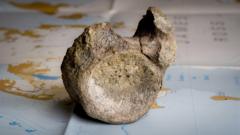
A paleontological discovery has been confirmed after decades of obscurity. The fossil, a tail vertebra from a Titanosaur dinosaur, was originally collected on James Ross Island in 1985 and documented in field notes by geologist Dr Mike Thomson. The specimen was subsequently placed in the British Antarctic Survey’s geology collection in Cambridge, where it remained unstudied for four decades.
The fossil was recently identified by Dr Mark Evans, collections manager at BAS, who recognized its distinctive characteristics and consulted Prof Paul Barrett from the Natural History Museum for confirmation. The vertebra displays the characteristic ball-and-socket joint structure unique to Titanosaurs, with a hollow feature on one end and a rounded protrusion on the other. Based on the specimen’s dimensions, scientists estimate the dinosaur measured approximately 23 feet in length.
Titanosaurs comprised over 100 identified species worldwide and were four-legged herbivores characterized by elongated necks and counterbalancing tails. The largest members of this group exceeded 115 feet in length and weighed approximately 60 tonnes. The Antarctic specimen may represent either a juvenile or an unusually small adult among its species.
The dinosaur inhabited Antarctica approximately 82 million years ago during the Late Cretaceous Period, when the continent supported lush forest ecosystems. This dramatically contrasts with the frozen, inhospitable environment present today. The discovery underscores how the remote continent once hosted diverse fauna and provides insight into Late Cretaceous ecosystems at the planet’s southern reaches. A formal paper on the findings has been published in the journal Acta Palaeontologica Polonica.
Article Attribution | Read More at Article Source
Article summary produced by Claude AI