

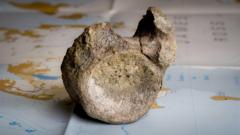
Researchers have identified what appears to be the first dinosaur fossil discovered in Antarctica, a vertebra that spent four decades unexamined in a storage collection. The specimen was originally collected on James Ross Island in 1985 by a geological team that documented the find in field notes but did not recognize its significance. It remained in the geology collection at the British Antarctic Survey in Cambridge until recently being rediscovered and properly studied.
The fossil has been confirmed as a tail bone from a Titanosaur, a group of massive herbivorous dinosaurs characterized by their long necks and extended tails. Paleontologists from the Natural History Museum examined the specimen and identified its distinctive hollow and rounded features as diagnostic of this dinosaur group. Based on the size of the vertebra, researchers estimate the Antarctic Titanosaur measured approximately 23 feet in length, suggesting it may have been either a juvenile or an unusually small member of its species.
The dinosaur lived 82 million years ago during the Late Cretaceous Period, when Antarctica had a dramatically different climate and environment. The continent was then covered in forests that would have provided abundant vegetation for the plant-eating animal. The discovery contributes to a limited but growing body of evidence about prehistoric life on the polar continent, where challenging conditions have made paleontological research difficult and where the fossil record remains sparse.
The finding demonstrates the potential for significant discoveries within existing museum collections and highlights Antarctica’s history as a habitable ecosystem. Scientists indicate the discovery helps clarify how diverse organisms adapted to and populated ancient Antarctic ecosystems millions of years ago. The research has been published in the journal Acta Palaeontologica Polonica.
Article Attribution | Read More at Article Source
Article summary produced by Claude AI