

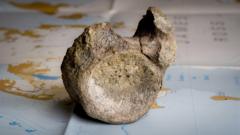
A fossil recovered from Antarctica in 1985 has been confirmed as the first dinosaur bone ever discovered on the continent, according to paleontologists who recently examined the specimen. The tail vertebra, which spent four decades stored in a drawer at the British Antarctic Survey’s geology collection in Cambridge, was initially collected on James Ross Island but went unidentified by the original research team, who suspected it might belong to a marine reptile.
Dr. Mark Evans, a collections manager at the British Antarctic Survey, made the discovery while reviewing thousands of specimens from Antarctic expeditions. He recognized distinctive features of the bone and consulted Prof Paul Barrett from the Natural History Museum to confirm its identification. The fossil displays characteristic features unique to Titanosaurs, including a hollow depression on one end and a rounded protrusion on the other that would have formed part of a ball-and-socket joint system along the creature’s spine.
Based on the size of the tail bone, researchers estimate the dinosaur measured approximately 23 feet in length, suggesting it may have been either a juvenile or a smaller member of its species. The Titanosaur group comprises over 100 identified species worldwide, characterized as four-legged herbivores with elongated necks and tails. The Antarctic specimen would have lived 82 million years ago during the Late Cretaceous Period, when the continent supported lush forests and diverse wildlife rather than its current ice-covered state.
The discovery provides valuable insights into prehistoric Antarctic ecosystems and demonstrates the habitable conditions that once existed in this remote region. While other dinosaur fossils have been found in Antarctica since 1985, such discoveries remain rare due to challenging research conditions and extensive ice coverage. The findings have been published in the journal Acta Palaeontologica Polonica.
Article Attribution | Read More at Article Source
Article summary produced by Claude AI