

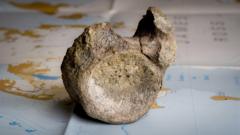
A fossil specimen initially overlooked by paleontologists has been identified as the first dinosaur bone ever recovered from Antarctica. The tail vertebra was collected in 1985 from James Ross Island by a geological team, who documented the finding in field notes but were uncertain of its true nature at the time. The specimen was subsequently placed in storage at the British Antarctic Survey in Cambridge, where it remained for four decades alongside thousands of other specimens.
The fossil’s significance emerged when a collections manager recently identified it among materials in the BAS archive. Upon examination, specialists from the Natural History Museum confirmed the specimen belongs to a Titanosaur, a group of massive sauropod dinosaurs characterized by their four-legged structure, elongated necks, and extended tails. The vertebra displays distinctive anatomical features including a hollow depression at one end and a rounded protrusion at the other, forming part of the ball-and-socket joint system that ran along the creature’s spine.
Based on the size of the recovered bone, researchers estimate the Antarctic dinosaur measured approximately 23 feet in length. Scientists note that this dimension is notably smaller than many known Titanosaur species, suggesting it may have been either a juvenile or a smaller adult variant of the group. The creature inhabited Antarctica approximately 82 million years ago during the Late Cretaceous Period, when the continent supported dense forests rather than its current ice-covered landscape.
The discovery contributes valuable information to the paleontological understanding of Antarctica’s ancient ecosystems. While additional dinosaur fossils have been identified in Antarctica since this specimen was collected, the continent remains underrepresented in the global fossil record due to challenging exploration conditions and extensive ice coverage. Findings have been detailed in a scientific publication, advancing knowledge of how prehistoric fauna occupied the southern polar regions millions of years ago.
Article Attribution | Read More at Article Source
Article summary produced by Claude AI