

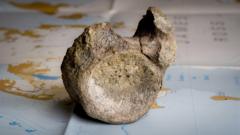
A fossil specimen stored in a British Antarctic Survey collection for four decades has been confirmed as Antarctica’s first known dinosaur bone. The tail vertebra was originally collected on James Ross Island in 1985 by a geological team that documented the find in field notes but did not initially recognize its significance.
Dr. Mark Evans, the collections manager at the British Antarctic Survey in Cambridge, identified the specimen while reviewing accumulated materials from Antarctic expeditions. He noted the fossil’s distinctive characteristics and consulted Prof Paul Barrett from the Natural History Museum to confirm the discovery. Barrett identified the vertebra as belonging to a Titanosaur, a group of massive herbivorous dinosaurs that inhabited the planet during prehistoric times.
Titanosaurs were four-legged, long-necked plant eaters with elongated tails used for balance. The species could grow to lengths exceeding 115 feet and weigh approximately 60 tonnes, though this particular specimen was estimated at roughly 23 feet in length based on bone size. Scientists believe it may have been either a juvenile or a smaller adult member of the species.
The dinosaur lived approximately 82 million years ago during the Late Cretaceous Period, when Antarctica maintained a climate dramatically different from today. The continent was covered in forests that provided sustenance for plant-eating creatures. The discovery was documented in a scientific paper published in the journal Acta Palaeontologica Polonica.
The finding contributes to limited understanding of Antarctic prehistoric ecosystems, as fossil discoveries on the continent remain sparse. The remote location and extensive ice coverage present significant challenges for paleontological research in the region. The specimen demonstrates that areas now considered inhospitable once supported diverse animal populations during the Cretaceous era.
Article Attribution | Read More at Article Source
Article summary produced by Claude AI