

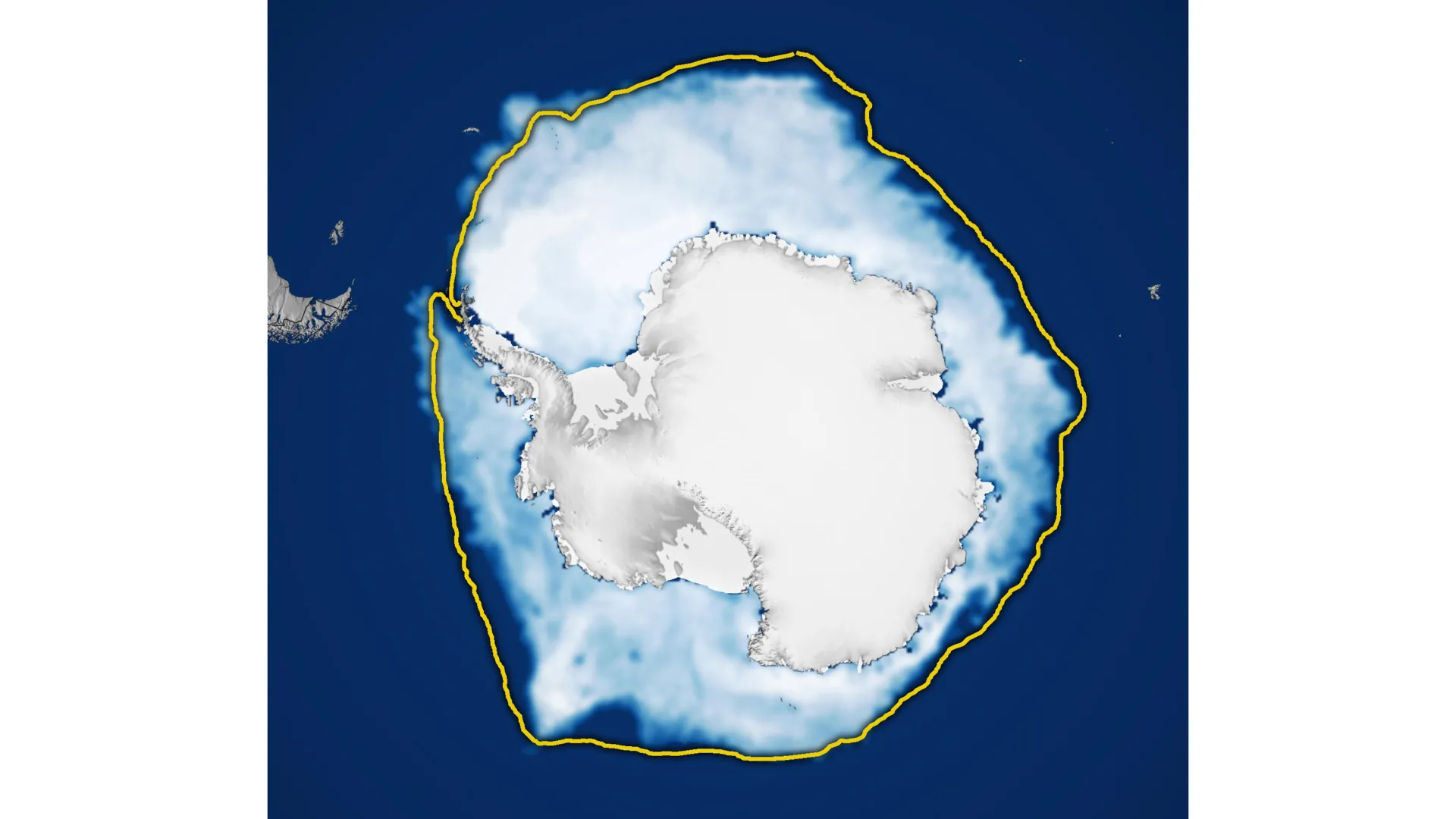
Antarctic sea ice achieved its annual winter peak in September 2026, extending across approximately 17.59 million square kilometers. This maximum represented the third-lowest extent recorded since satellite measurements began in the late 1970s, according to data from NASA and the National Snow and Ice Data Center.
The region’s sea ice dynamics differ significantly from Arctic conditions due to geography. Antarctica’s surrounding ocean allows winter ice to expand over vast distances during the Southern Hemisphere’s winter season, typically peaking in September before declining to its minimum in February. However, this expansive geography also pushes ice into warmer latitudes where summer melting becomes more probable.
Antarctic sea ice exhibited a notable long-term pattern shift. From 1979 through 2014, the region’s sea ice extent gradually increased by roughly one percent annually, contrasting sharply with accelerating Arctic ice loss. Between 2012 and 2014, Antarctic winter sea ice set consecutive record highs. This upward trajectory reversed beginning in 2016, with the region experiencing substantial ice coverage declines since then. The most severe conditions occurred in 2023, when Antarctica recorded both its lowest summer minimum and winter maximum in the satellite record.
Scientists employ passive microwave sensors aboard satellites to track Antarctic sea ice, a methodology that allows observations to penetrate cloud cover. The monitoring effort began in late 1978 and has continued through multiple satellite programs, including contributions from the Defense Meteorological Satellite Program and NASA’s Aqua spacecraft. As of 2025, data from Japan’s GCOM-W satellite has been incorporated to maintain continuity of this decades-long observational record. Researchers continue analyzing whether recent declines represent a sustained transformation in Antarctic sea ice conditions or constitute natural variability within the system.
Article Attribution | Read More at Article Source
Article summary produced by Claude AI