

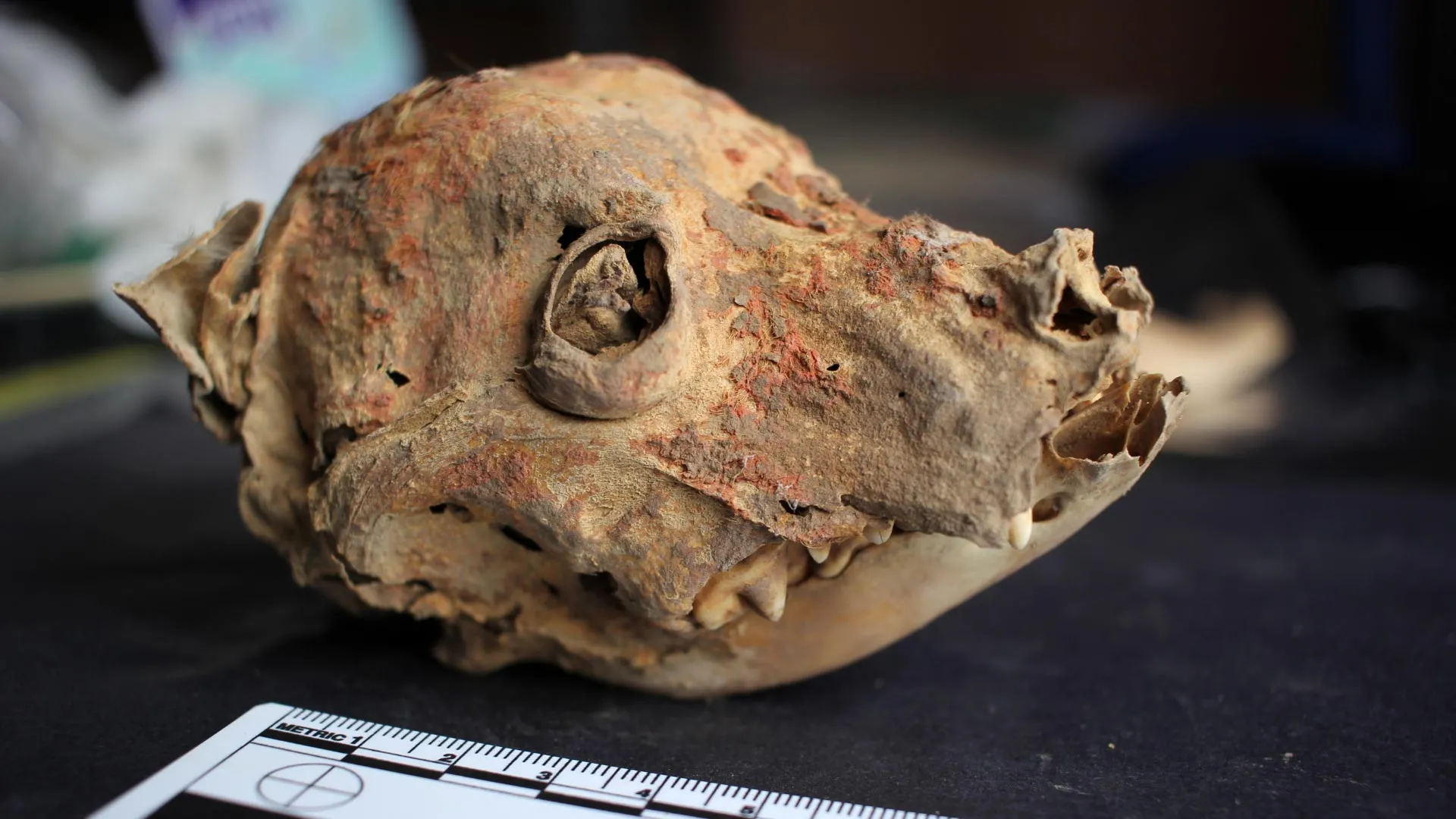
Researchers working at Castillo de Huarmey, an archaeological complex in Peru located approximately 190 miles north of Lima, have documented the discovery of hairless dog remains dating to more than 1,200 years ago. The findings represent the first physical evidence of Peruvian hairless dogs at a Wari Empire site and have been detailed in a study published in the Journal of Anthropological Archaeology. The site, which spans 110 acres, functioned as an administrative and burial center for the Wari Empire between 600 and 1050 CE, predating the rise of the Inca Empire by roughly four centuries.
The excavations, conducted between 2010 and 2025, revealed three distinct sets of dog remains in the northern section of the main ceremonial area. One discovery consisted of a naturally mummified skull retaining visible hairless skin and attached ears, which had been treated with cinnabar, a bright red pigment used in ancient Peruvian funerary practices. A second skull was found alongside the nearly complete mummified skeleton of a male dog buried in a shallow pit. The remarkable preservation of these remains resulted from the site’s location in an extremely arid region of Peru’s Pacific coast, where desert conditions have protected organic materials over centuries.
Identification of the dogs as Peruvian hairless dogs came through careful analysis of their skeletal characteristics. Researchers noticed that all three animals lacked their first premolars, with some teeth never having erupted during their lifetimes. This dental feature proved significant because the same genetic trait responsible for hairlessness in dogs also causes a reduced number of teeth. Additional analysis using isotopic examination of bones and teeth provided information about the animals’ diet and environmental conditions. According to researchers, the findings demonstrate that humans and dogs coexisted at the Wari site, though understanding the precise nature of their relationship presents challenges for archaeological interpretation.
Article Attribution | Read More at Article Source
Article summary produced by Claude AI