

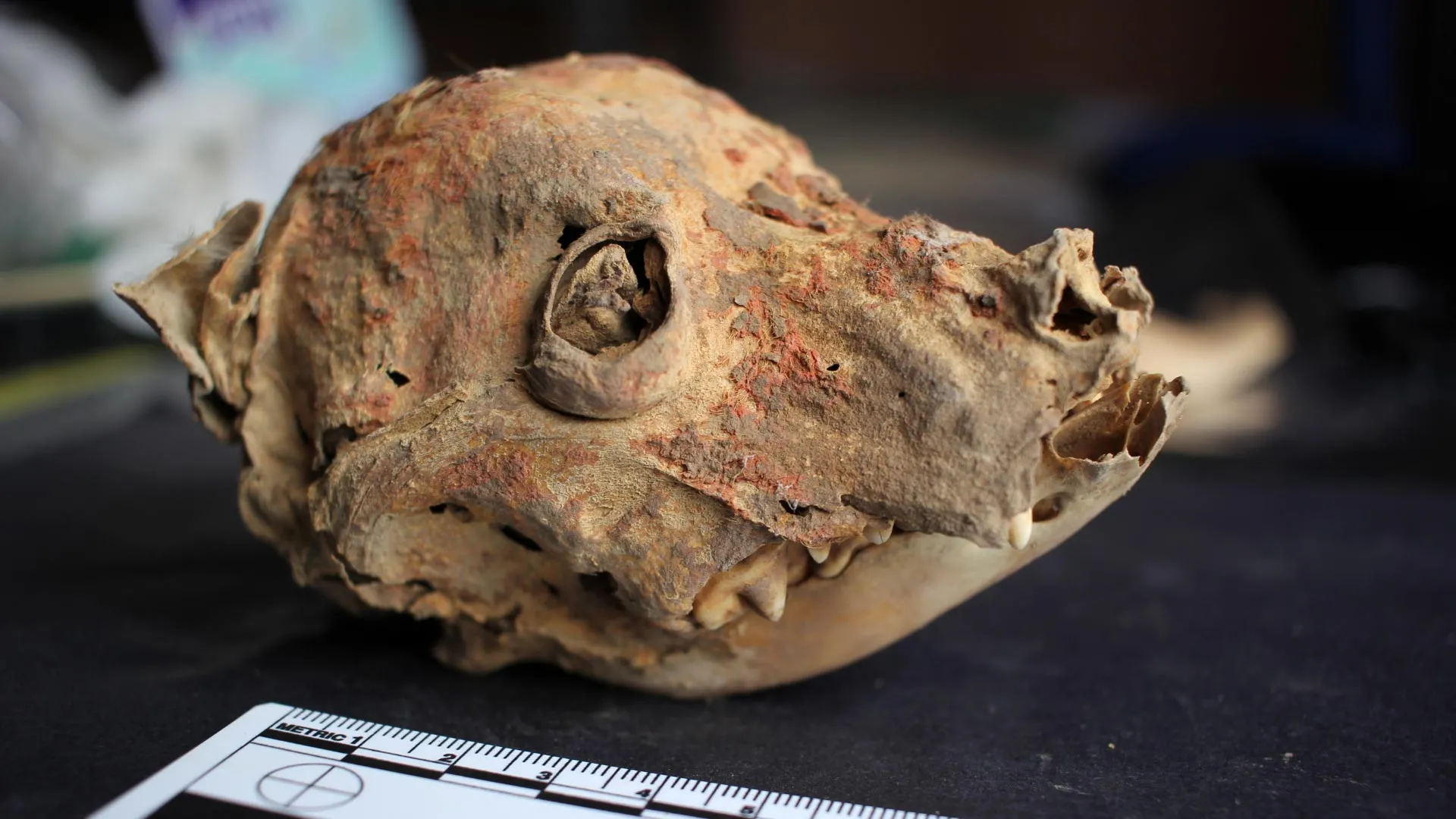
Researchers working at Castillo de Huarmey, an archaeological complex located approximately 190 miles north of Lima, have identified physical evidence of Peruvian hairless dogs that lived between 600 and 1050 CE. The site, which spans 110 acres, served as an administrative and burial center for the Wari Empire roughly 400 years before the Inca rise to power. The findings, reported in the Journal of Anthropological Archaeology, represent the first confirmed discovery of this distinctive Indigenous breed at a known Wari location on Peru’s northern coast.
Three sets of canine remains were recovered from the northern section of the main ceremonial area. One specimen consisted of a naturally mummified skull that retained visible hairless skin and attached ears, colored with cinnabar, a bright red pigment used in ancient Peruvian funerary practices. A second, larger skull was also identified, along with an almost complete naturally mummified skeleton of a male dog discovered in a shallow pit, missing only the lower portions of its front limbs. The exceptional preservation resulted from the region’s extremely arid desert conditions, which have protected organic materials including bone, skin, and decorated pottery over centuries.
Researchers employed zooarchaeological methods and isotopic analysis to authenticate the remains and gather information about the animals’ diets and origins. A key identifying feature proved crucial: all three dogs lacked their first premolars, a condition genetically linked to hairlessness in the breed. According to Weronika Tomczyk, a research associate at Dartmouth’s Department of Anthropology and first author of the study, the missing teeth were not due to injury or disease but rather reflected the same genetic trait responsible for the animals’ hairlessness.
The discovery provides perspective on relationships between humans and animals at the Wari site, though researchers acknowledge that reconstructing past emotional bonds remains challenging through archaeological methods. The findings suggest that people maintained complicated, sometimes contradictory relationships with dogs, viewing them variously as companions or pests depending on individual circumstances, a pattern that parallels modern attitudes toward animals.
Article Attribution | Read More at Article Source
Article summary produced by Claude AI