

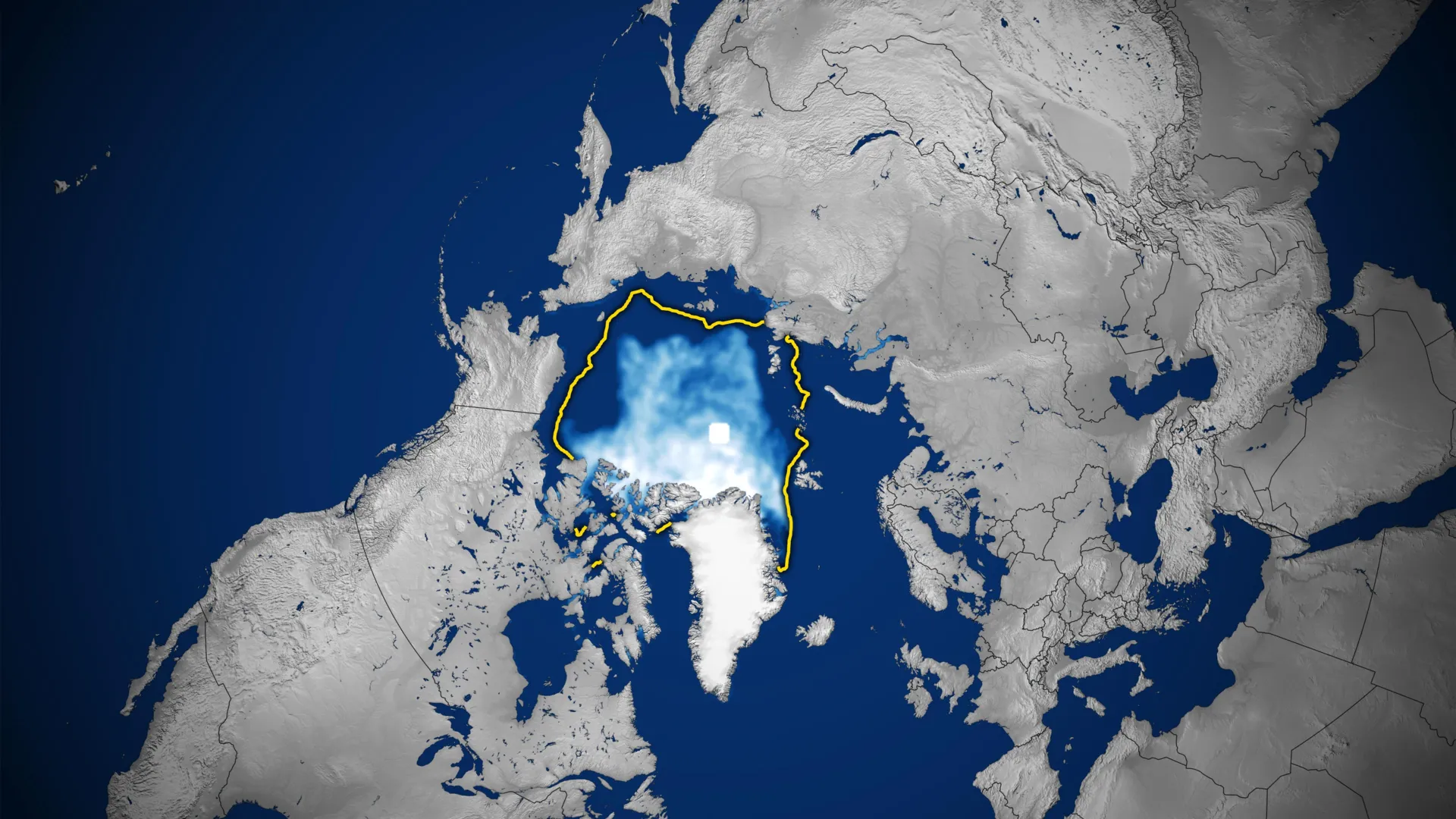
Nearly fifty years of satellite observations document a significant transformation occurring across the Arctic, where sea ice coverage is declining during both seasonal peaks and reaching historically low levels. The Arctic Ocean undergoes an annual cycle of expansion and contraction as frozen seawater builds up during winter months and retreats in summer, a pattern that has persisted for millennia but is now showing substantial disruption.
In September 2026, Arctic sea ice reached its annual minimum extent on September 12, covering approximately 4.6 million square kilometers. This measurement tied with three previous years for the tenth-lowest minimum since satellite monitoring commenced in late 1978, according to data from NASA and the National Snow and Ice Data Center. The satellite record reveals that every summer from 2007 through 2026 has ranked among the twenty lowest September sea ice extents on record, with the smallest extent ever observed occurring in September 2012.
While the rate of summer ice loss has slowed in recent years, the long-term decline remains pronounced. Scientists attribute the recent stabilization partly to increased cloud cover over the Arctic, which has reduced sunlight reaching the ice and limited additional melting. Despite this temporary slowdown, September ice coverage remains substantially below its historical average. The pattern of decline has extended to winter months as well, with the March 2026 maximum tying the March 2025 maximum for the lowest winter peak in the satellite record.
Beyond total ice area, the composition of Arctic sea ice has shifted significantly. Multiyear ice that survives multiple seasons and accumulates thickness has declined substantially, replaced increasingly by thinner first-year ice that forms during winter but proves more vulnerable to melting. Scientists indicate that natural climate variability combined with rising global temperatures has driven the persistent decline since 1978, with projections suggesting the Arctic Ocean could become largely ice-free during summer at least once before the middle of the twenty-first century. Satellite technology using passive microwave sensors enables continuous monitoring by detecting microwave energy differences between frozen seawater and open ocean, allowing measurements to penetrate cloud cover that would obscure visible-light imaging.
Article Attribution | Read More at Article Source
Article summary produced by Claude AI