

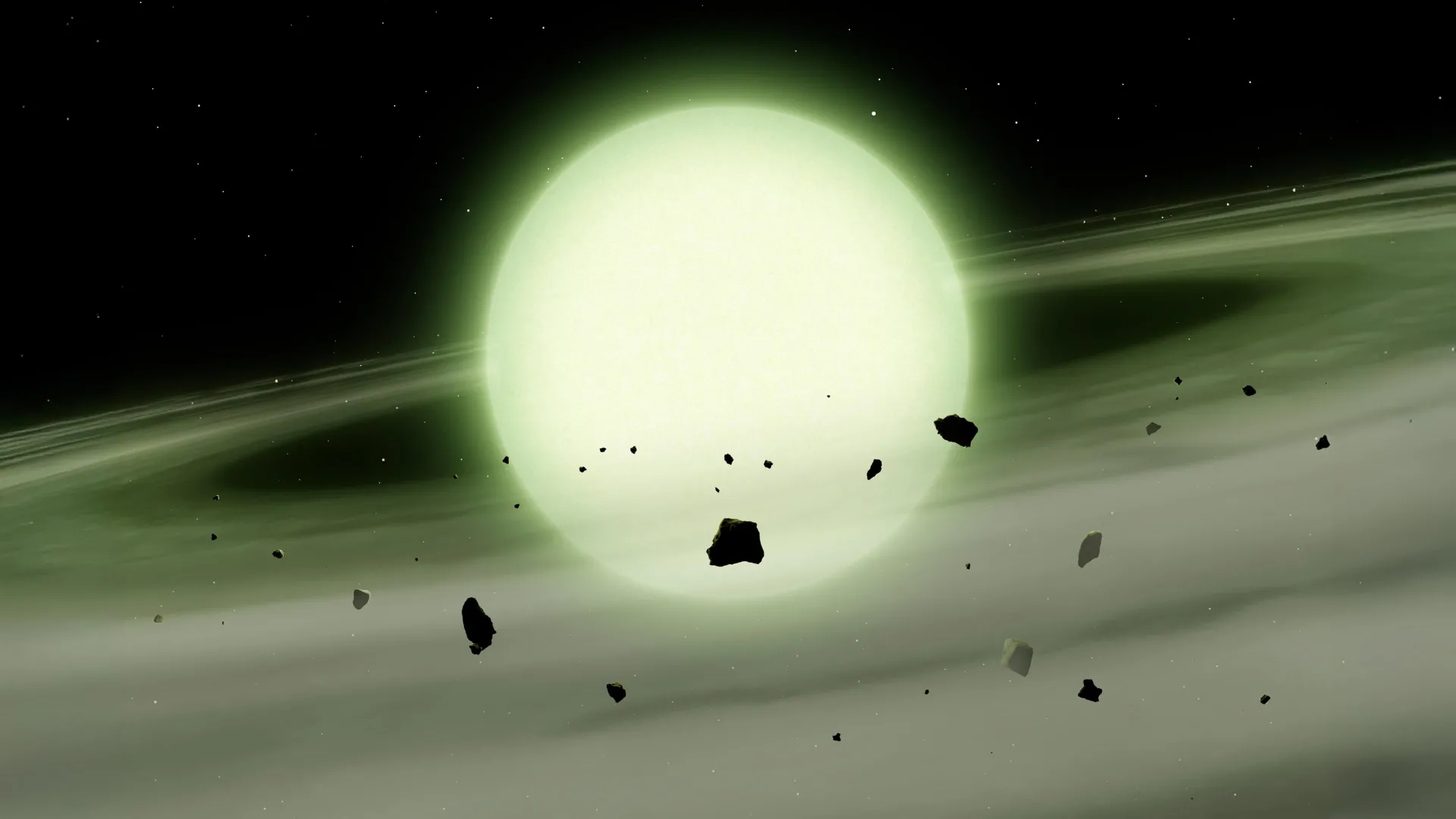
Researchers at the University of Warwick have documented a surprising diversity of colors among white dwarf stars, challenging long-held assumptions about stellar coloration. White dwarfs, which are the dense remnants left behind after stars similar to our Sun exhaust their nuclear fuel, were previously thought to adhere to the standard relationship between temperature and color seen in most stars. The discovery reveals that these stellar corpses can instead display a wide range of hues including green, pink, purple, yellow, and cyan, depending on their atmospheric composition and physical conditions.
The explanation for these unexpected colors lies in the extreme density of white dwarf atmospheres. In the coolest of these objects, matter can reach densities comparable to water—millions of times denser than the visible surface of our Sun. Under such extraordinary pressure and density, elements such as carbon, calcium, sodium, and lithium interact with surrounding helium plasma in ways that cause them to absorb much broader ranges of light wavelengths than would occur under normal stellar conditions. These interactions fundamentally alter the colors of light that escape from the star’s surface, producing hues that deviate significantly from what temperature alone would predict.
The research team identified the first known genuinely green star, designated WD J1330+6435, which has an effective temperature of approximately 4,000 degrees Celsius. This white dwarf has accumulated debris from its former planetary system, introducing calcium, lithium, and sodium into its atmosphere. Sodium absorption in the star’s upper layers removes orange wavelengths from the escaping light, leaving behind a distinctive chartreuse green appearance. The team also documented WD J1011+2845, located 48 light-years from Earth, which appears to be among the reddest stars ever observed due to carbon in its atmosphere shifting light toward longer wavelengths.
To assess how common these unusual colors might be, the researchers examined a sample of 151 white dwarfs located within approximately 65 light-years of Earth. Among this sample, five stars displayed unexpected colors, suggesting that roughly one in every 30 white dwarfs throughout the universe could possess similarly striking coloration. The findings, published in RAS Techniques and Instruments, indicate that while such colors remain relatively uncommon on a percentage basis, the sheer number of white dwarfs in existence means that vast quantities of strangely colored stellar remnants likely populate the cosmos.
Article Attribution | Read More at Article Source
Article summary produced by Claude AI