

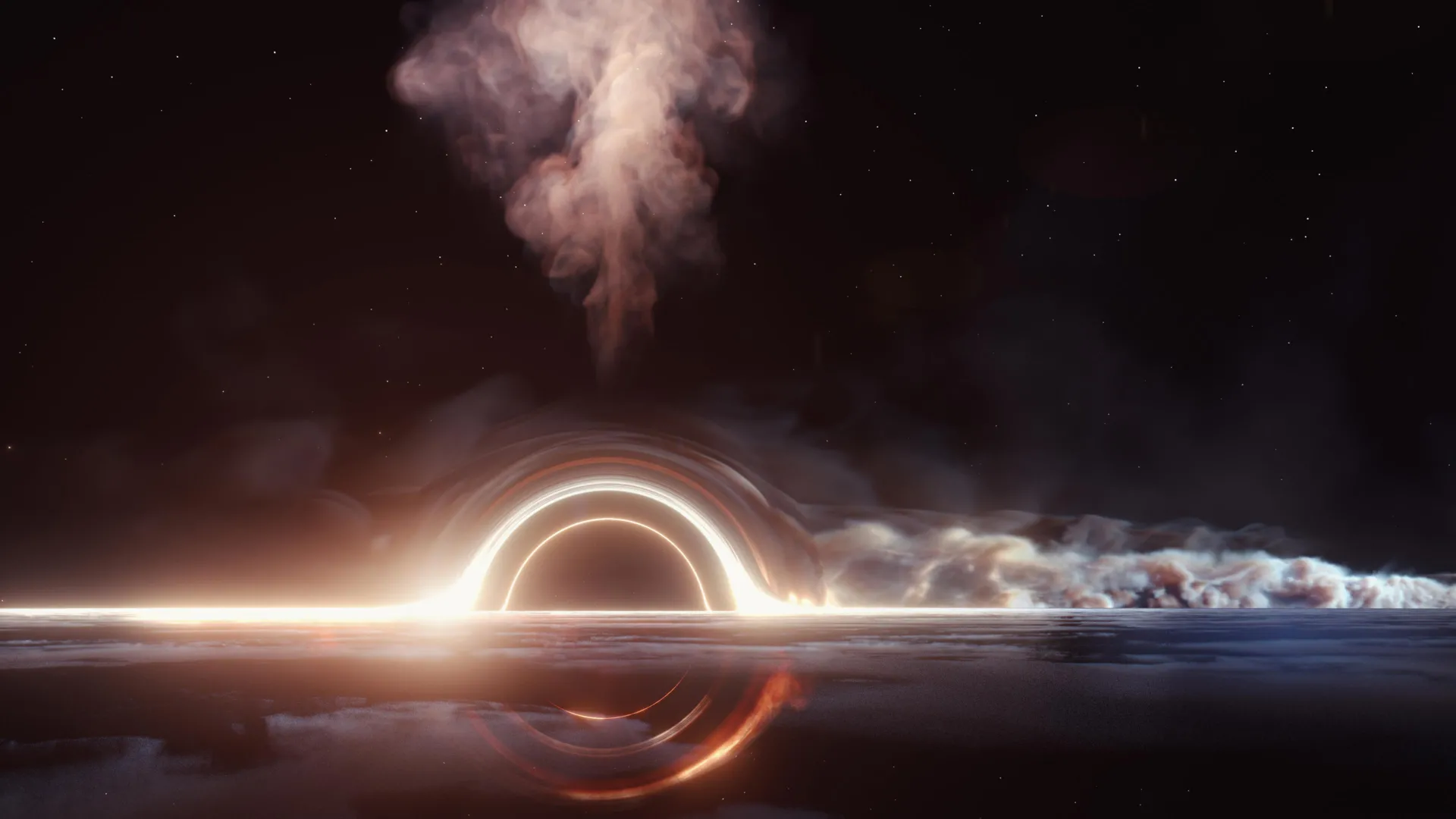
Researchers led by Dr. Adelle Goodwin at Curtin University’s International Centre of Radio Astronomy Research have identified a universal pattern governing when black holes produce jets of material into space. The findings, published in Nature Astronomy, demonstrate that black holes across an enormous range of masses—from objects roughly 10 times the Sun’s weight to those millions of times more massive—follow the same fundamental rule when generating these cosmic outflows.
The breakthrough emerged from studying tidal disruption events, rare occurrences in which supermassive black holes tear apart stars that pass too close to them. These events provided scientists with a unique opportunity to observe black hole feeding behavior over relatively short timescales of just a few years, unlike the typical thousands-of-year cycles that make direct observation difficult. The research team, working with Dr. Andrew Mummery of the Institute for Advanced Study in Princeton, analyzed observations from telescopes across multiple continents and space-based instruments to track how black holes respond as they consume matter from destroyed stars.
The key discovery centers on a consistent threshold in black hole behavior. The observations revealed that delayed jets—those appearing months or even years after a star is destroyed—activate when a black hole’s feeding rate drops to approximately 2 percent of its Eddington limit, a theoretical benchmark measuring the intensity of a black hole’s consumption relative to a physical equilibrium point. Notably, this same 2 percent threshold has previously been identified in much smaller black holes within the Milky Way, suggesting the underlying physics operates identically regardless of mass.
The research addresses a longstanding mystery regarding the variability in jet production from black holes. While some produce powerful radio outflows almost immediately after disrupting a star, others remain relatively quiet for extended periods before suddenly generating detectable emissions. The universal 2 percent rule provides an explanation for this apparent inconsistency, indicating that jets appear when specific conditions in the feeding process align, independent of the black hole’s mass. The findings underscore that fundamental physics governing black hole behavior remains consistent across the universe’s most extreme objects.
Article Attribution | Read More at Article Source
Article summary produced by Claude AI