

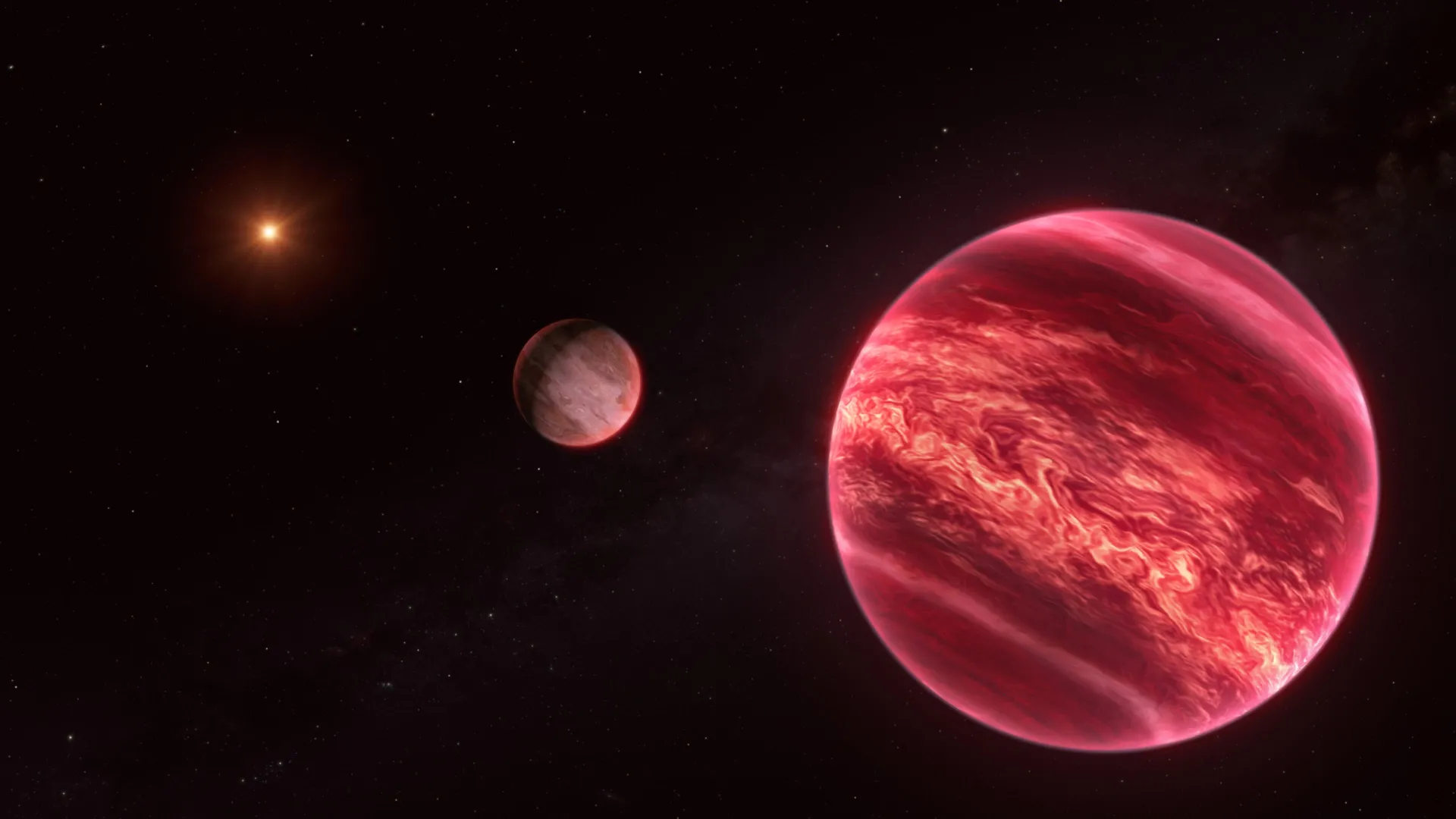
Researchers using the European Southern Observatory’s Very Large Telescope have identified potential evidence of an exosatellite—a natural satellite located outside our Solar System—in the CD-35 2722 star system. The discovery was led by Kevin Hoy, an ESO student in Chile, and published in Nature. The object in question orbits a brown dwarf, a celestial body that falls between planets and stars in terms of mass and composition. This arrangement creates an unusual cosmic structure where a massive satellite circles a brown dwarf, which itself orbits a star.
The potential moon presents significant challenges to conventional astronomical terminology. The suspected exosatellite possesses at least as much mass as Jupiter, making it far larger than any natural satellite in our Solar System, yet it does not orbit a star directly. Alice Zurlo, director of the Millennium Nucleus of Young Exoplanets and their Moons, notes that the CD-35 2722 system blurs traditional distinctions between stars, planets, and moons, complicating standard definitions. Scientists have not yet established a universally accepted definition of an exomoon, which becomes particularly relevant when the candidate satellite is massive enough to qualify as a planet under certain classification systems.
The detection used the radial velocity method, which measures subtle changes in an object’s motion caused by gravitational interactions with companion bodies. By observing wobbles in the brown dwarf’s movement, researchers gathered evidence suggesting a massive body orbits it. This approach was previously instrumental in discovering the first exoplanet around a Sun-like star. The research represents a significant advancement, as astronomers have identified thousands of exoplanets but have found no confirmed exomoons to date, though other candidates have been proposed earlier this year and in previous observations.
Confirming such discoveries would extend beyond cataloging new object types. Understanding exosatellites could illuminate how planetary systems form, why certain systems develop structures unlike our own, and whether massive satellites are common or rare phenomena. The forthcoming Extremely Large Telescope, equipped with a 39-meter mirror, is anticipated to enhance detection capabilities and facilitate identification of smaller exomoons currently undetectable with existing technology.
Article Attribution | Read More at Article Source
Article summary produced by Claude AI