

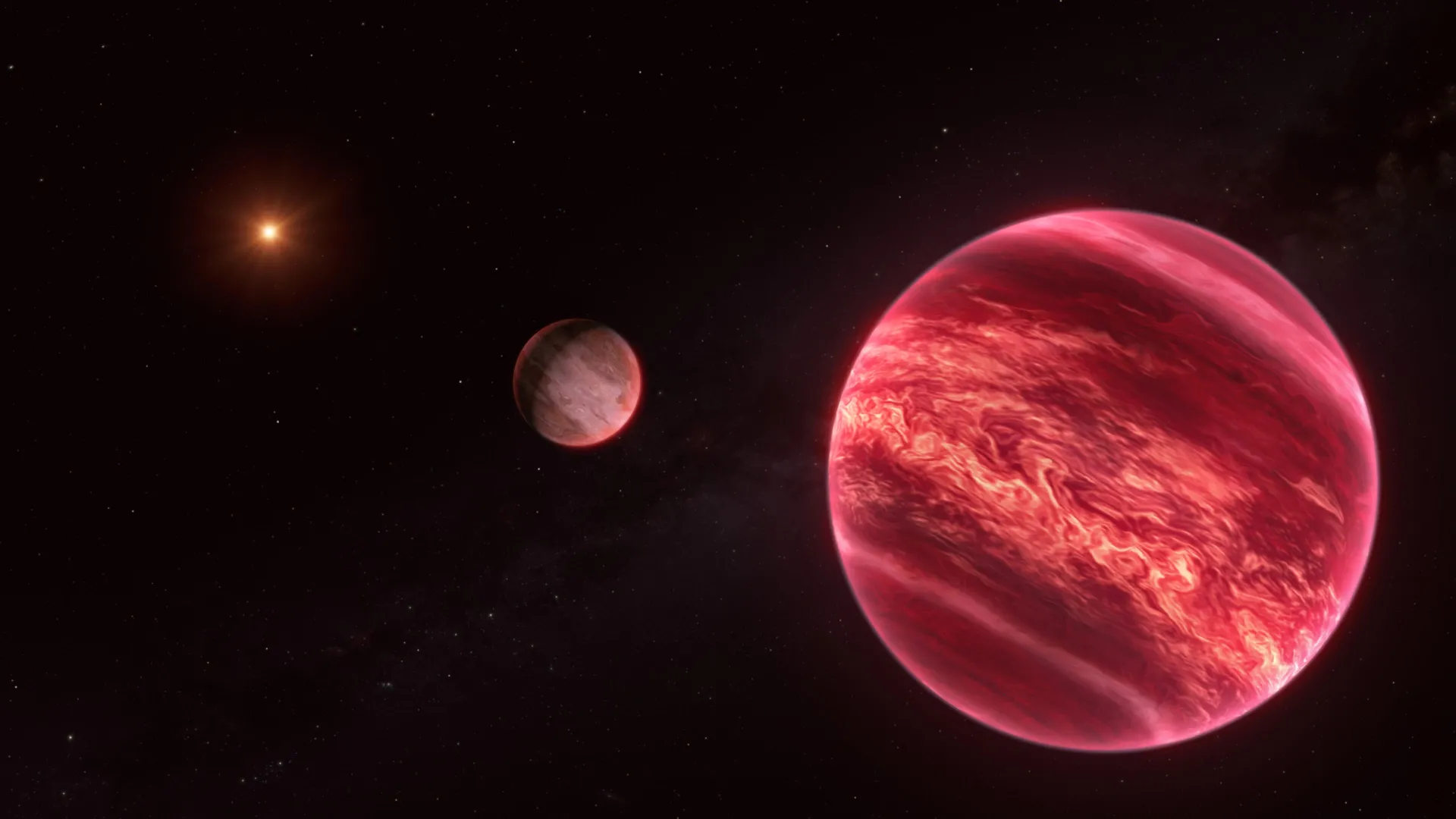
Researchers using the European Southern Observatory’s Very Large Telescope have identified potential evidence of an exosatellite in the CD-35 2722 star system, which could represent the first confirmed detection of a natural satellite beyond our Solar System. The object orbits a brown dwarf, a celestial body that is more massive than a planet but lacks sufficient mass to sustain the hydrogen fusion that characterizes stars. This arrangement is fundamentally different from structures observed in our Solar System, where moons orbit planets that themselves orbit stars.
The newly identified object possesses a mass comparable to Jupiter, while the brown dwarf it orbits exceeds 30 times Jupiter’s mass. This makes the potential exosatellite far more massive than any known moon in our Solar System, creating a classification challenge for astronomers. Researchers led by Kevin Hoy of the European Southern Observatory used the CRIRES+ instrument and applied the radial velocity method to detect subtle changes in the brown dwarf’s motion caused by the massive companion orbiting it. The technique, which measures gravitational effects between celestial bodies, has previously been instrumental in discovering exoplanets.
The discovery highlights ongoing debates within the astronomical community regarding definitions for objects found in distant star systems. An exomoon typically refers to a natural satellite orbiting a planet or celestial body outside our Solar System, though no universally accepted definition has been established. In this case, the object is massive enough to qualify as a planet under certain classification schemes, yet it does not orbit a star directly, complicating its categorization.
While astronomers have identified thousands of exoplanets, confirmed detections of exomoons remain elusive. Earlier in 2026, another research team reported possible signs of a satellite in the HD 206893 star system, though that detection was not definitive. The CD-35 2722 findings, supported by measurements of gravitational effects, represent a significant step toward confirming the existence of moons beyond our Solar System. Future observations using the European Southern Observatory’s Extremely Large Telescope, equipped with a 39-meter mirror, are expected to enhance the ability to detect smaller exomoons and determine whether massive satellites are common or exceptional in distant planetary systems.
Article Attribution | Read More at Article Source
Article summary produced by Claude AI