

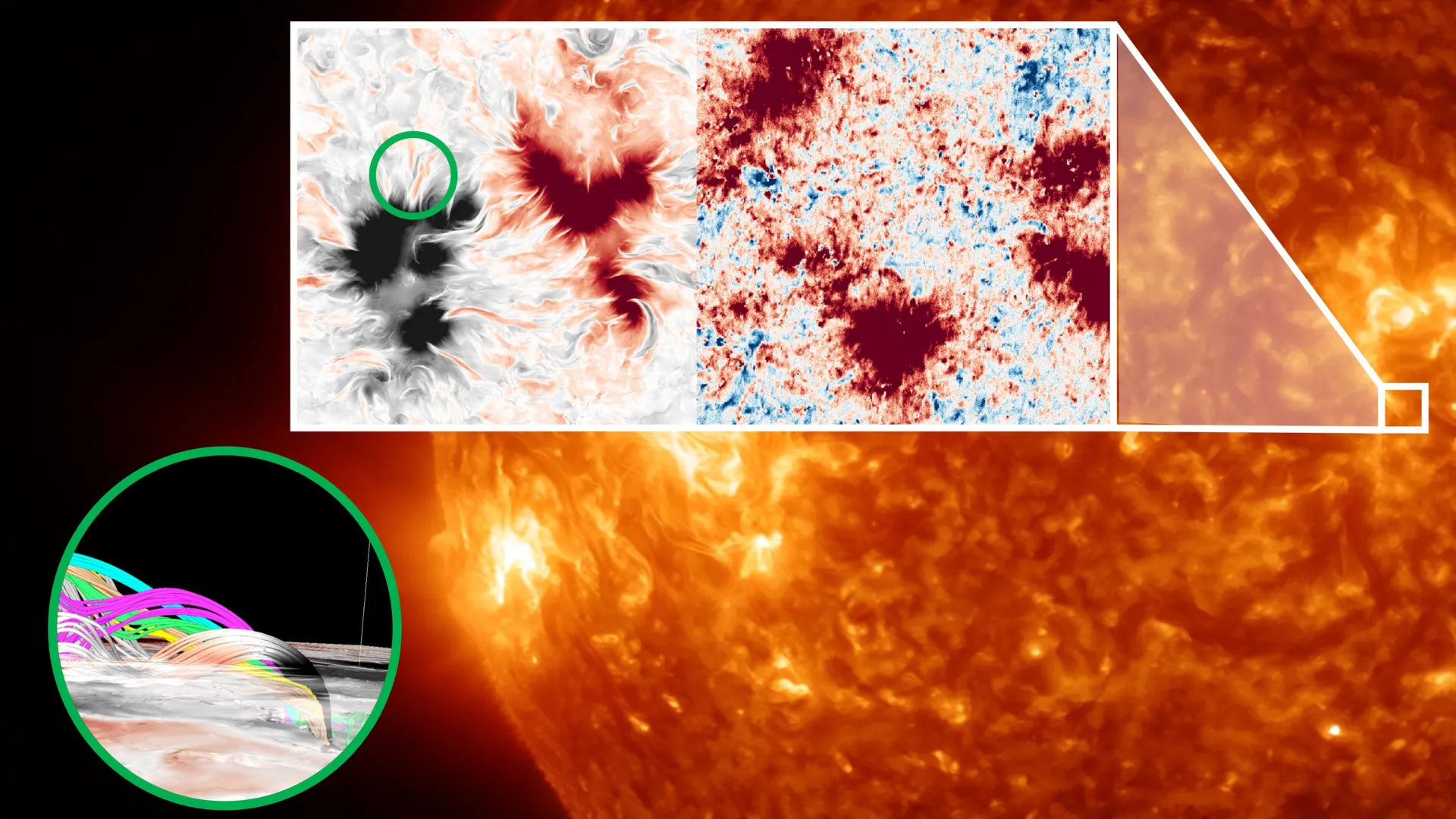
An international research team led by the National Astronomical Observatory of Japan has identified a complex network of magnetic structures in the solar atmosphere using the Sunrise-III solar observatory. The observatory, which operated from the stratosphere during a 2024 mission, detected numerous thin, thread-like magnetic features woven into a larger network above regions of the Sun that appear relatively inactive. These findings reveal that even quiet areas of the Sun contain elaborate magnetic configurations rather than simple, uniform structures.
The Sunrise-III telescope operated at approximately 35 kilometers altitude aboard a high-altitude balloon, allowing it to conduct observations with minimal atmospheric interference. The instrument, carrying three scientific tools including the SCIP near-infrared spectroPolarimeter developed under NAOJ leadership, measured magnetic fields across multiple layers of the solar atmosphere. Computer simulations created by researchers successfully reproduced the patterns observed by the telescope, suggesting that surface movements twist magnetic field lines to create the intricate structures detected in higher atmospheric layers.
The research examined both quiet regions of the Sun and areas near its visible edge, measuring magnetic field distributions within spicules—narrow jets of solar material extending upward from the surface. Scientists describe much of the Sun’s surface as quiet due to the absence of prominent features such as sunspots, though these regions remain magnetically active with generally weaker fields than more active areas. Ground-based telescopes struggle to measure these subtle structures due to atmospheric turbulence, making the stratospheric vantage point of Sunrise-III particularly valuable.
The observations provide new insights into how energy generated near the solar surface transfers into higher atmospheric layers. Understanding the complex magnetic structures in quiet regions could advance scientific knowledge of how magnetic activity contributes to heating the Sun’s atmosphere, including in areas that appear calm from distant observation. The findings represent a significant step toward explaining fundamental heating mechanisms in the solar atmosphere.
Article Attribution | Read More at Article Source
Article summary produced by Claude AI