

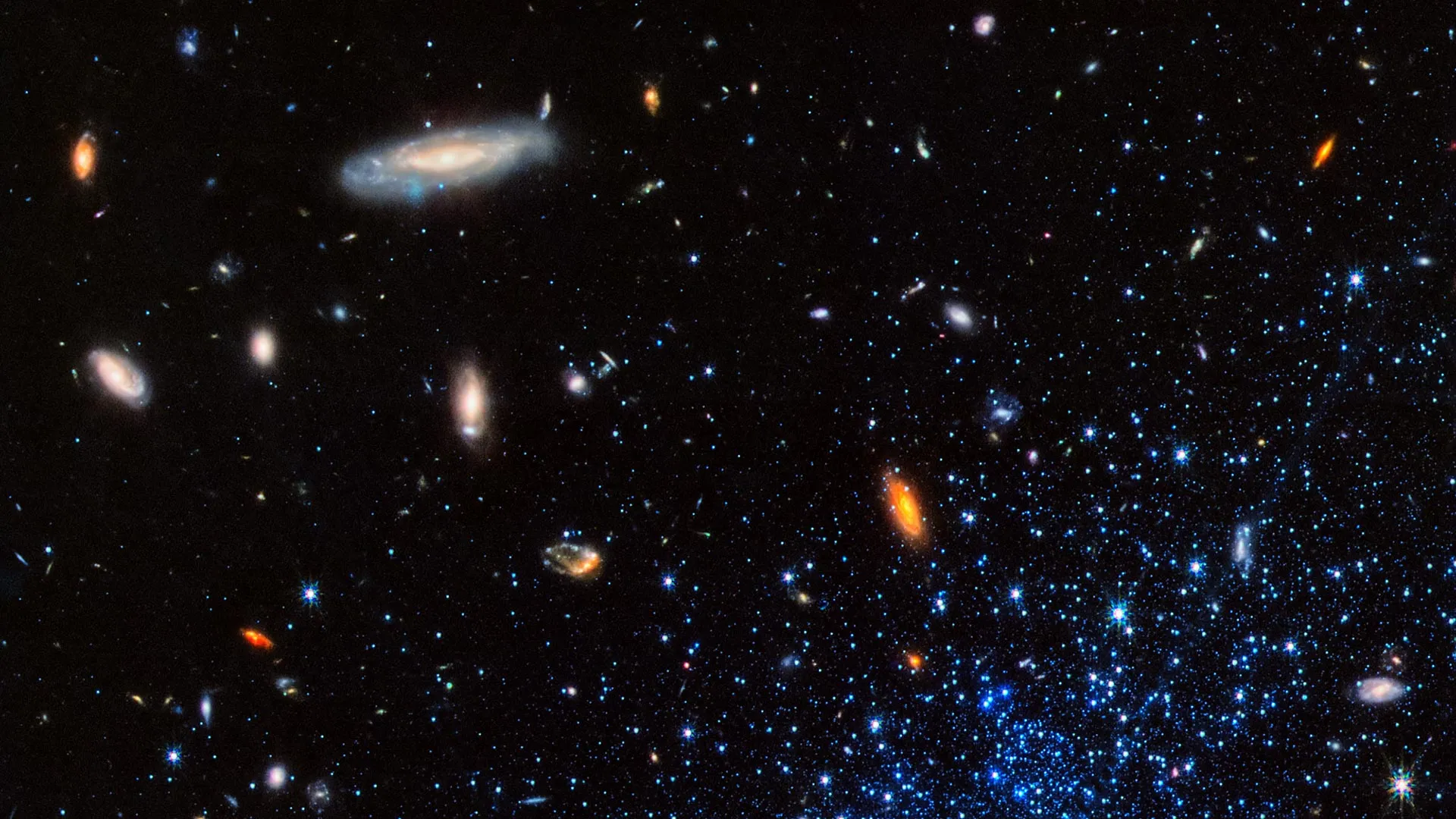
An international team of astronomers has successfully measured the primordial helium abundance with record-breaking accuracy, achieving a measurement uncertainty of just 0.5%. The research, conducted by scientists from institutions including the University of Minnesota Twin Cities and Ohio State University, represents a significant advancement in precision cosmology and has been detailed across five papers published in The Astrophysical Journal.
The measurements were based on 130 hours of observations conducted with the Large Binocular Telescope, focusing on distant galaxies to determine the amount of helium created during the Universe’s first five minutes following the Big Bang. This level of precision is approximately three times more accurate than previous estimates and provides cosmologists with improved tools for investigating the early Universe and validating fundamental physics theories.
Rather than employing conventional methods that extrapolate results from large numbers of galaxies, the research team selected 15 exceptionally pristine, small, and distant galaxies that have undergone minimal chemical evolution. These galaxies serve as cosmic archives preserving information about the Universe’s original elemental composition. The researchers utilized sophisticated spectrographs developed at Ohio State University, allowing them to simultaneously examine more than 10 helium spectral lines and 15 hydrogen lines, which enabled identification and correction of subtle measurement errors that earlier studies could not adequately account for.
Beyond refining estimates of the Universe’s composition during its earliest moments, the measurement offers a more precise test of the Standard Model of physics. The findings allow researchers to calculate the number of neutrino families present in the early Universe, as the amount of helium produced depends on the physical conditions and particle types existing at that time. This advancement provides cosmologists with enhanced capability to verify whether established physical theories accurately describe cosmic conditions during the first few minutes after the Big Bang.
Article Attribution | Read More at Article Source
Article summary produced by Claude AI