

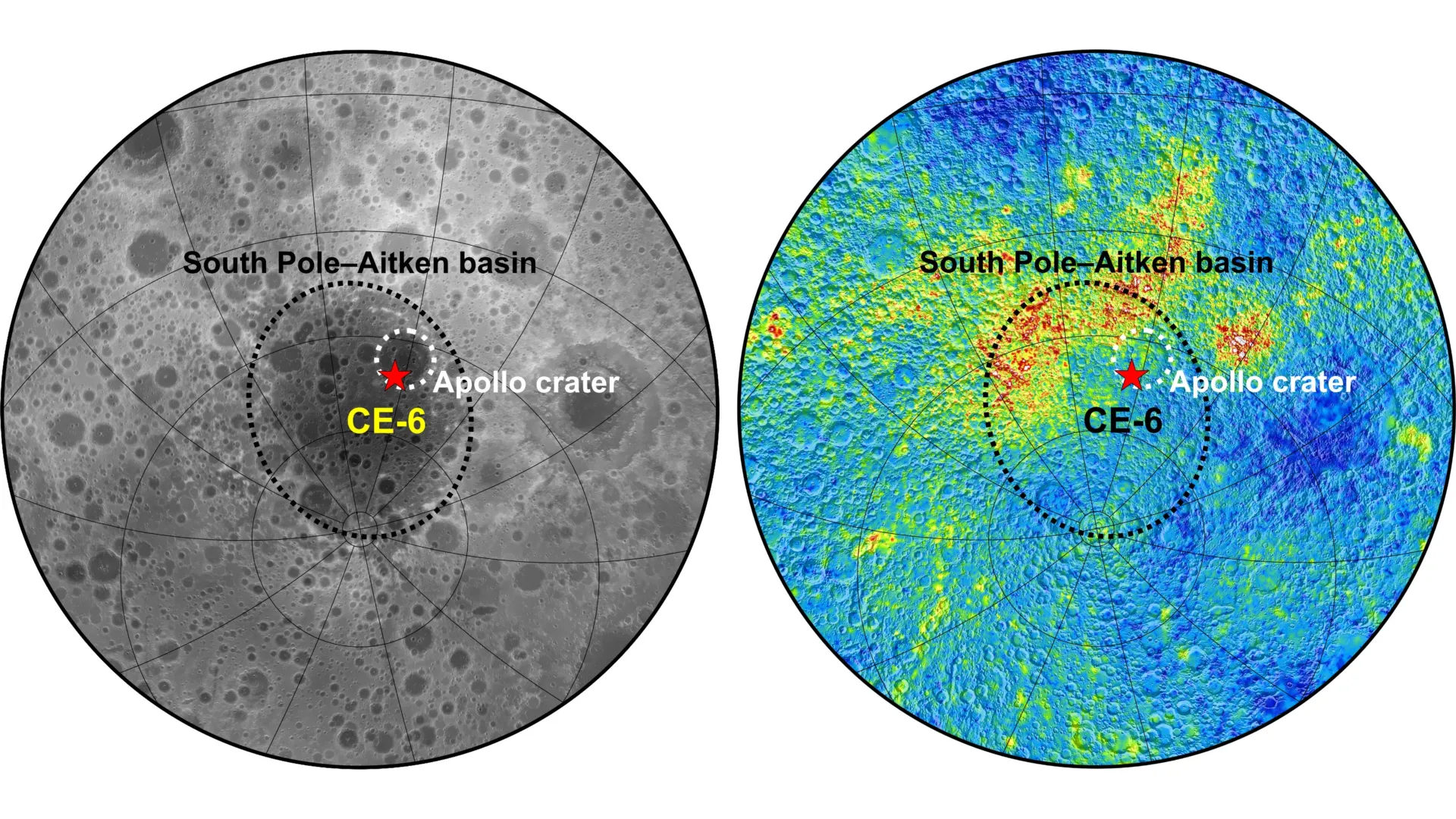
Scientists led by Prof. Haifeng Du of the High Magnetic Field Laboratory at the Hefei Institutes of Physical Science examined soil samples collected by China’s Chang’e-6 mission. The research, published in the Proceedings of the National Academy of Sciences on September 16, identified face-centered cubic γ-Fe in natural lunar samples for the first time.
Using advanced analytical techniques including focused ion beam preparation and transmission electron microscopy, the team discovered numerous nanoscale iron particles embedded in impact glass from the lunar soil. Notably, γ-Fe was the dominant form of iron present in the two impact-glass samples studied. The iron phase is typically stable only at high temperatures on Earth and normally transforms into a different structure called α-Fe as material cools. The researchers determined that unusual conditions created by lunar impacts may allow γ-Fe to persist at the Moon’s surface, potentially stabilized by factors such as carbon impurities, rapid cooling of molten impact material, and protection from the surrounding glass.
Investigations using electron holography revealed that larger γ-Fe nanoparticles could maintain a stable single-vortex magnetic state and retain consistent magnetic responses when exposed to external magnetic fields. This stability indicates the particles may function as recorders of magnetic information in lunar material, potentially preserving evidence of conditions from the Moon’s past.
Since the Moon no longer generates a global magnetic field, studying magnetic minerals preserved in rocks and soil provides a means to reconstruct historical changes in the lunar magnetic environment. The discovery expands understanding of the varieties of magnetic minerals found in lunar samples. Because γ-Fe and α-Fe form under different conditions with distinct magnetic behaviors, each could potentially document information from different stages of impact events. Additional research will be required to establish the extent to which these minerals can illuminate details about the Moon’s ancient magnetic field and its evolution.
Article Attribution | Read More at Article Source
Article summary produced by Claude AI